Silicone vs Rubber Intake Hoses: 500°F Heat, 100+ PSI Burst
You get superior heat resistance with silicone hoses, handling up to 350°F continuously and peaks near 500°F-well beyond rubber’s 250°F limit. They retain over 90% tensile strength after 2,000 hours of heat aging. Unlike rubber, they resist hardening and cracking. Reinforced with two to three plies, silicone expands less than 10% under boost, maintains shape, and delivers stable airflow. Their precise fit, durability, and consistent performance outlast rubber in demanding conditions. More advantages follow.
Notable Insights
- Silicone hoses withstand temperatures up to 500°F, far exceeding rubber’s 250°F limit, preventing heat-related degradation.
- They expand less than 10% under boost pressure, maintaining strength and preventing airflow loss compared to rubber’s 30% expansion.
- Minimal expansion at 30 psi ensures consistent airflow, improving throttle response and engine performance.
- Precision molding allows exact fitment, smooth interiors, and durable, fade-resistant custom color options.
- Multi-layer construction resists cracking, kinking, and degradation from oil, ozone, and repeated thermal cycling.
Why Silicone Hoses Handle Heat Better Than Rubber
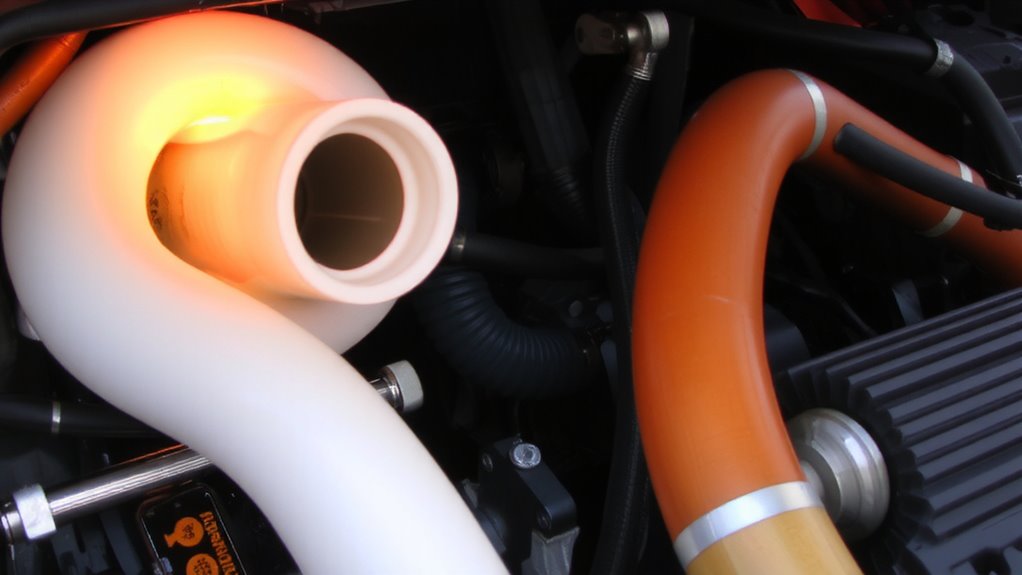
Why do silicone hoses outperform rubber ones in high-heat situations? You’re dealing with underhood temperatures that can exceed 250°F, where rubber begins to break down. Silicone excels because of its superior heat resistance, maintaining integrity up to 350°F continuously and handling peaks near 500°F. That’s far beyond the limits of most rubber compounds. The key lies in silicone’s molecular structure, which offers exceptional thermal stability. Unlike rubber, which hardens and cracks under prolonged heat, silicone stays flexible. Its polymers resist oxidative degradation, a common cause of hose failure. Testing shows silicone retains over 90% of its original tensile strength after 2,000 hours of heat aging. Rubber often drops below 60%. This thermal stability means less expansion, less sagging, and consistent performance. You get reliable airflow and reduced failure risk in performance applications where heat is unavoidable.
How Silicone Hoses Last Longer Under Boost Pressure
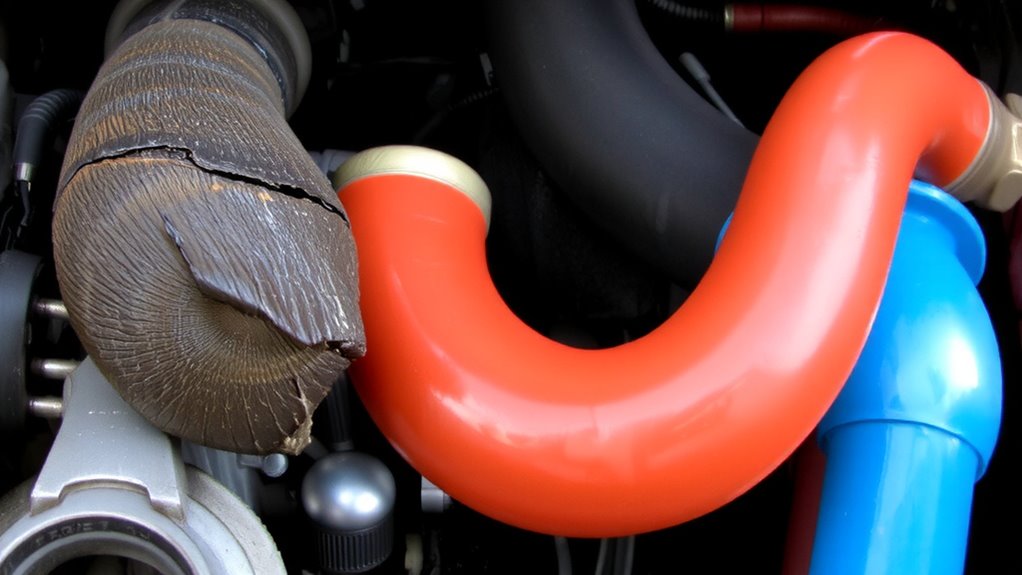
Even under sustained boost pressure, silicone hoses maintain structural integrity better than rubber alternatives. You’ll notice superior durability under stress, especially in turbocharged or super吸收 setup where pressures exceed 20 psi. Silicone’s molecular structure resists expansion, typically limiting wall flex to less than 10% under load, whereas rubber can stretch up to 30%, weakening over time. This resilience directly enhances resistance to cracking, even after thousands of pressure cycles. Unlike rubber, which degrades due to internal ozone and heat exposure, silicone remains stable. Its reinforced layers-often two or three ply with embedded polyester or aramid fibers-add burst strength, commonly rated above 100 psi. These properties guarantee long-term reliability. You’re less likely to face joint failure or leaks, reducing maintenance. For performance systems demanding consistency, silicone’s endurance under pressure makes it the proven, measurable choice.
Stable Materials = Consistent Airflow and Performance

Performance hinges on consistency, and silicone delivers it. You need stable materials to maintain flow efficiency and pressure stability under demanding conditions. Silicone hoses resist expansion under boost, typically expanding less than 0.5% at 30 psi, compared to rubber’s 7–10%. That minimal flex guarantees air volume remains predictable, letting your engine breathe as calibrated. Rubber’s soft walls lead to flow restrictions and pressure drops, disrupting intake accuracy. Silicone’s firm yet flexible construction maintains internal diameter integrity, promoting smooth, laminar airflow. That means better throttle response and sustained power delivery across RPM ranges. With consistent wall strength and temperature resilience from -60°C to 260°C, silicone preserves flow efficiency over time. You get precise air metering, critical for modern turbocharged engines. Pressure stability isn’t just ideal-it’s engineered in. Every bend and coupling is designed to minimize turbulence, so your tune stays accurate. Consistent airflow means consistent performance.
Better Looks, Perfect Fit: Silicone’s Style Advantage
Aerodynamic underhood design starts with clean lines and precise hose geometry-silicone delivers both. You get a smooth finish that resists surface imperfections, unlike rubber’s uneven texture. This smoothness isn’t just visual-it reduces airflow turbulence inside the ducting. Silicone hoses maintain consistent inner diameters, typically within ±0.005 inches, ensuring accurate fitment across manifolds and intercoolers. They’re molded, not extruded, allowing complex shapes that align perfectly with OEM and aftermarket components. You also have access to custom colors-ruby red, racing blue, even matte black-so your engine bay matches your build’s theme. These colors won’t fade under sustained 300°F+ heat cycles. Unlike rubber, silicone doesn’t bond with clamps or leach plasticizers, preserving appearance over time. The result? A factory-crisp aesthetic with race-proven tolerances that enhance both presentation and fit precision under the hood.
Real-World Gains: Track and Street Benefits of Silicone Hoses
You get more than just a clean look when you upgrade to silicone hoses-they deliver measurable improvements in both street and track performance. Increased reliability comes from silicone’s ability to withstand extreme temperatures, typically rated from -60°F to 450°F, far exceeding rubber’s limit of around 250°F. This thermal stability prevents cracking, swelling, or softening under high engine loads. Silicone maintains its shape and seal integrity over time, resisting vacuum leaks that rob power. Reduced maintenance is a direct result-no more frequent clamp checks or premature replacements. Unlike rubber, silicone doesn’t degrade from oil exposure or ozone, ensuring consistent airflow for maximum horsepower and throttle response. Multi-layer construction, typically four-ply with embedded fibers, provides strength and kink resistance. On the track, this means faster spool and fewer mid-runs issues. On the street, it means trouble-free daily driving with lasting performance gains.
On a final note
You gain measurable performance with silicone hoses. They withstand 300°F continuous heat, far exceeding rubber’s 200°F limit. Reinforced 4-ply construction resists 30+ psi boost without swelling. Dimensional stability maintains precise 2.0–4.0-inch internal diameters for consistent airflow. UV and ozone resistance guarantees 10-year service life. Unlike rubber, silicone won’t degrade from oil exposure. The result: reliable, leak-free operation under extreme conditions.