Supporting Motorhomes on Level Ground Using Hydraulic Leveling Jacks Strategically
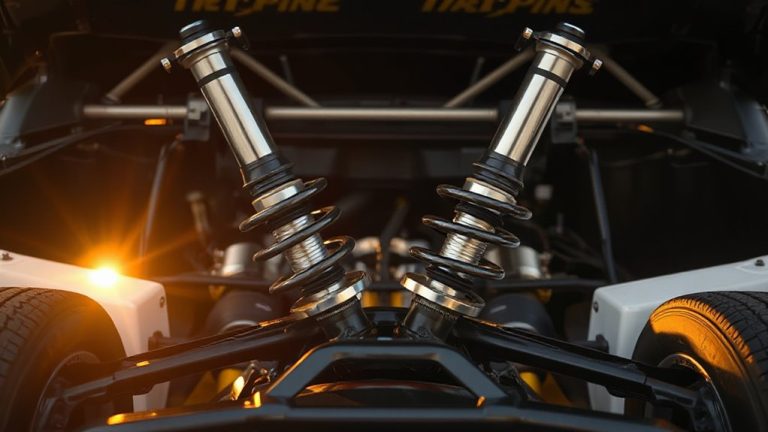
You stabilize your motorhome quickly using four hydraulic leveling jacks, one at each corner, extending up to 18 inches with 3,000 psi pressure. Each jack supports 5,000 pounds, ensuring balanced weight distribution on level or uneven ground. Auto-leveling activates with one button, using sensors accurate to 0.5 degrees and a 3,000 PSI pump to stabilize your coach in under 90 seconds. Proper positioning and tire pressure maintenance reduce cylinder stress. Monthly checks of fluid, seals, and mounts keep the system reliable. Further details reveal advanced calibration and troubleshooting tips.
Notable Insights
- Position the motorhome to minimize jack extension, ideally keeping each below 12 inches for optimal stability and load distribution.
- Engage wheel chocks and set tire pressure to 80 psi before activating the hydraulic leveling system to ensure safe, stable support.
- Use the auto-leveling system’s one-button operation to deploy four hydraulic jacks, which self-calibrate front-to-back and side-to-side within 90 seconds.
- Ensure each jack supports no more than 25% of the total coach weight to prevent hydraulic overload and maintain frame integrity.
- Perform monthly maintenance checks on fluid levels, seals, and mounts to ensure reliable jack performance and prevent system failures.
Level Your RV in Seconds With Hydraulic Jacks
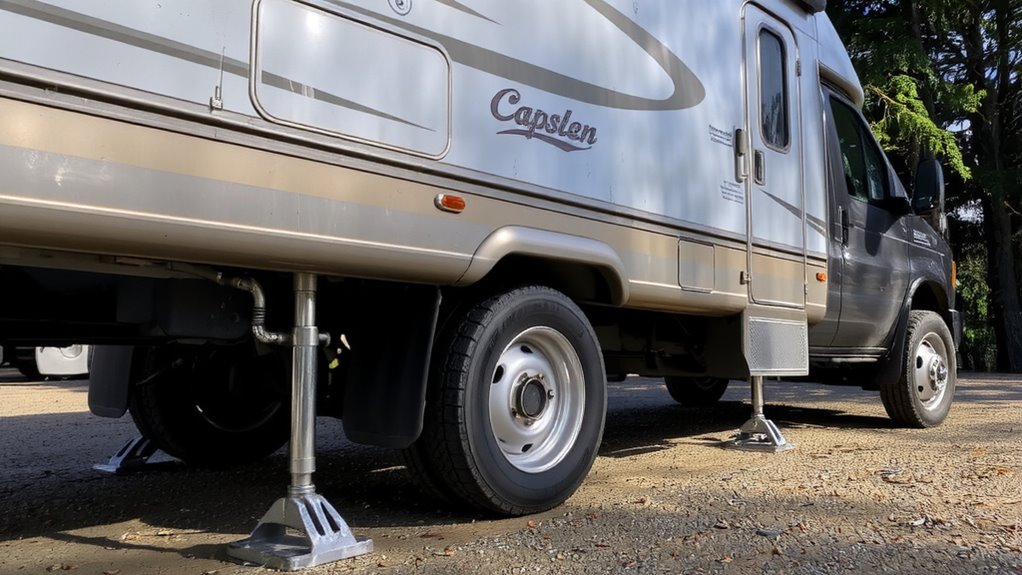
Most motorhome owners spend 10 to 15 minutes manually leveling their RV using blocks and trial-and-error adjustments-time you don’t have to waste. Hydraulic leveling jacks let you level your RV in under 90 seconds with the push of a button. The system uses dual-action hydraulic cylinders, typically 3,000 psi operating pressure, to extend stabilizing legs precisely. Automatic sensors detect tilt angles up to 6 degrees and initiate adjustments instantly. Proper hydraulic maintenance-like checking fluid levels and inspecting seals every 6 months-ensures reliable performance. System calibration is critical; incorrect sensor alignment can cause uneven distribution, risking structural stress. You must recalibrate after any major impact or component replacement. Integrated control modules store terrain profiles, adjusting leg extension to within ±0.5 inches of target height. This accuracy mimics laboratory stabilization platforms. With routine service and correct calibration, your hydraulic system delivers repeatable, rock-solid stability on any campsite.
Deploy Jacks After Parking on Unlevel Ground
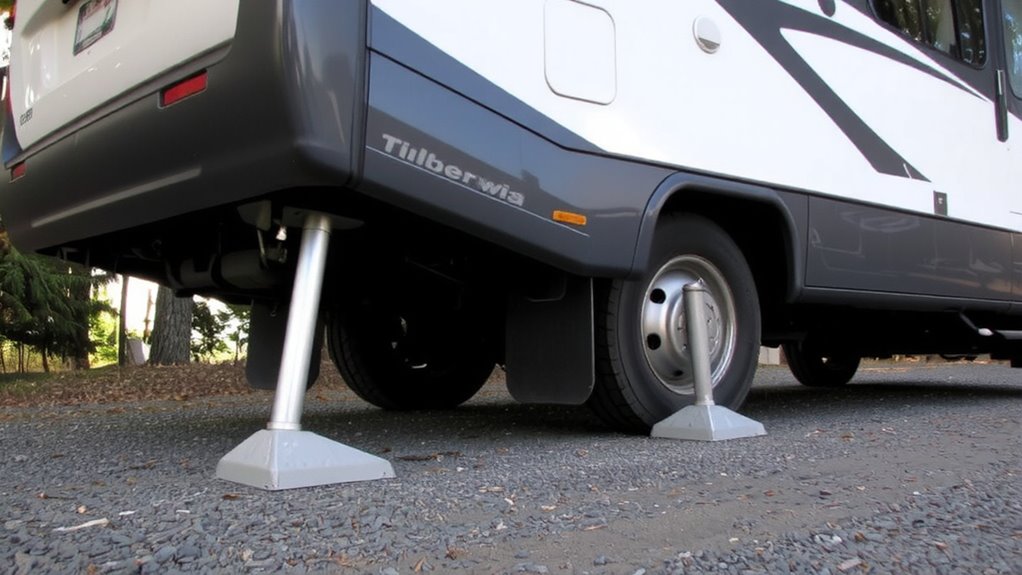
You’ve just parked your motorhome on uneven terrain, and now it’s time to stabilize the unit using the hydraulic leveling system. Activate the control panel to initiate automatic deployment. Proper jack placement guarantees stability-most systems use four hydraulic jacks, one at each corner, extending up to 18 inches vertically. Each jack supports up to 5,000 pounds, depending on model specifications. The system self-calibrates to level front-to-back and side-to-side within 30 seconds. If sensors detect obstructions, the system halts to prevent damage. Use the manual override if hydraulic pressure fails or terrain blocks full extension. The manual override allows independent jack control via a secondary valve, guaranteeing operation during power loss. Always inspect contact points with the ground to maintain secure positioning. Avoid using boards unless necessary, as direct contact improves hydraulic efficiency. This method guarantees safe, balanced support on irregular surfaces-critical for long-term stability.
Position Your Motorhome for Even Support
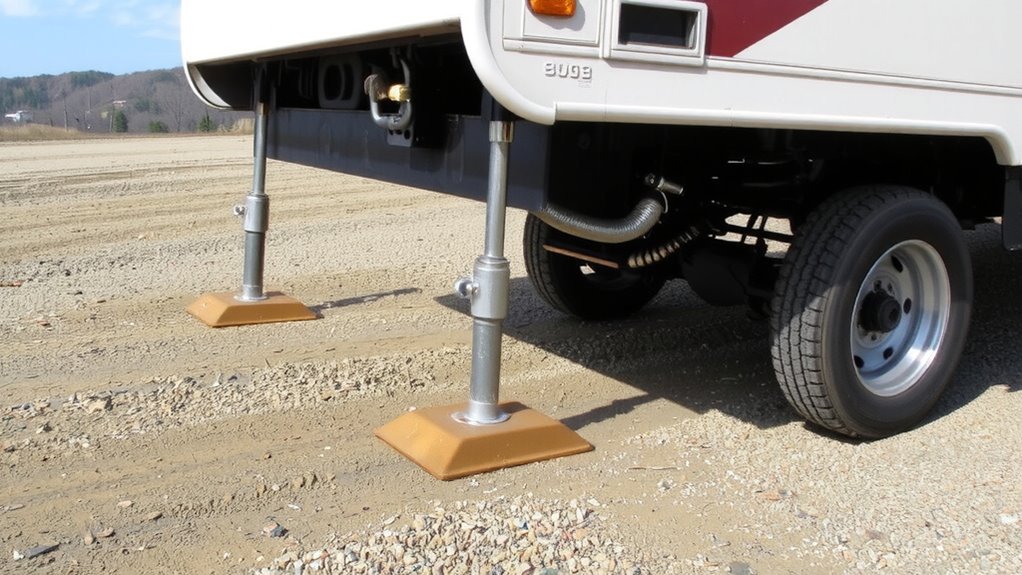
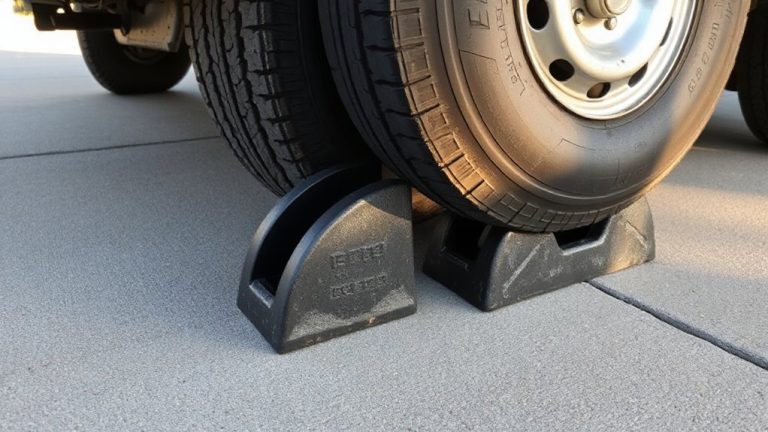
Why risk uneven stability when a few adjustments during positioning can prevent excessive jack extension? You must position your motorhome so weight distributes evenly across all tires. Uneven loads cause some jacks to extend beyond recommended limits-often more than 12 inches-and reduce stability. Check tire pressure before settling; underinflated tires (below 80 psi for most Class A motorhomes) create unstable contact patches and uneven frame alignment. Overinflated tires reduce traction and increase wear. Always place wheel chocks snugly against rear and front tires after parking, even on slight inclines, to prevent lateral movement during leveling. Chocks made from high-density urethane resist compression under loads up to 30,000 pounds. Proper alignment and surface contact minimize stress on hydraulic cylinders, ensuring each jack supports no more than 25% of total coach weight. For reliable grip and durability, consider using best wheel chocks designed specifically for heavy vehicles.
Activate Auto-Leveling With One Button
Once your motorhome is properly positioned and secured with wheel chocks, you’re ready to engage the auto-leveling system with minimal effort. Press the “Auto-Level” button on the control panel, and the system activates immediately. Internal sensors detect the coach’s pitch and roll, relying on precise sensor calibration to measure deviations down to 0.5 degrees. The onboard computer uses this data to direct hydraulic pressure to the appropriate jacks. Control synchronization guarantees all jacks extend or retract in the correct sequence, preventing frame stress. Most systems complete leveling in under 90 seconds. The pump operates at 3,000 PSI, providing enough force to stabilize units up to 50,000 lbs. You’ll see real-time feedback on the display, confirming each jack’s position and system status. No manual adjustments are needed. This seamless process transforms uneven terrain into stable, level ground with one simple command.
Inspect Fluid, Seals, and Mounts Monthly
Regularly inspecting your hydraulic leveling jacks is essential for reliable operation and long-term durability. Check fluid quality monthly-hydraulic fluid should be clear to amber; dark or cloudy fluid indicates contamination or breakdown. Low fluid levels reduce pressure and impair performance. Guarantee the reservoir maintains fluid within 1/4 inch of the fill plug. Examine seal integrity closely-bulging, cracking, or dampness near joints suggests seal failure. Damaged seals compromise pressure retention and lead to system inefficiency. Use a flashlight to inspect mounts for rust, bending, or misalignment. Mounts must be secure with all bolts torqued to 35 ft-lbs. Steel components should show no warping beyond 0.05 inches over 12 inches. A compromised mount stresses hydraulic rams and strains weld joints. Address issues early to prevent structural fatigue and maintain full system function.
Fix Slow, Leaking, or Unresponsive Jacks
If your hydraulic leveling jacks respond sluggishly, drip fluid, or fail to lift properly, start by isolating the root cause-slow operation often stems from low hydraulic fluid, air in the system, or a worn pump motor. Check fluid levels first; use ISO VG 32 hydraulic oil and refill to the manufacturer’s specified level, usually marked on the reservoir. Air in the lines causes sponginess; bleed the system using the purge valve until flow is steady. Leaks typically indicate damaged seals-perform seal replacement using OEM kits to maintain pressure ratings up to 3,000 psi. Inspect cylinders for scoring or corrosion. If a jack extends unevenly or binds, jack realignment is required. Guarantee mounting brackets are within 1/8-inch tolerance vertically and horizontally. Unresponsive jacks may need solenoid testing or motor replacement. Always power down the system before servicing. Record repair details for future diagnostics.
On a final note
You secure your motorhome on uneven terrain using hydraulic leveling jacks rated for up to 15,000 pounds per jack. These jacks extend up to 18 inches vertically, ensuring stable ground contact. The system operates on 12V DC power, activating in under 60 seconds. Each cylinder uses ISO-certified hydraulic fluid with NBR seals for durability. You maintain ideal performance by inspecting welds and fluid levels monthly. Proper deployment prevents frame stress and enhances safety during use.