MacPherson Strut Suspension: Why It Cuts Costs 15-25%
You’ll find MacPherson strut suspension in most economy and compact cars because it’s cost-effective and space-efficient. It integrates the shock absorber and coil spring into one unit, cutting production costs by 15–25% versus double-wishbone systems. With up to 30% fewer parts, it simplifies assembly and lowers repair frequency. The compact design frees engine bay space, allowing deeper transverse engine placement. Typical spring rates range from 80 to 120 N/mm, balancing comfort and control. Limited travel means firmer responses on rough roads, but alignment stays consistent with scrub radius under 30 mm. This layout reduces unsprung weight, boosting fuel efficiency by 2–4%. Automakers favor it for predictable handling on flat surfaces and lower supply chain complexity. There’s more to how this system shapes vehicle dynamics.
Notable Insights
- Combines structural and damping functions in a compact design ideal for small front-wheel-drive vehicles.
- Reduces manufacturing costs by 15–25% compared to double-wishbone suspensions through part integration.
- Saves space by eliminating the upper control arm, allowing tighter engine bay packaging.
- Uses fewer components, lowering assembly complexity, repair frequency, and maintenance costs.
- Offers balanced ride comfort and handling with predictable performance on flat roads.
What Is MacPherson Strut Suspension?
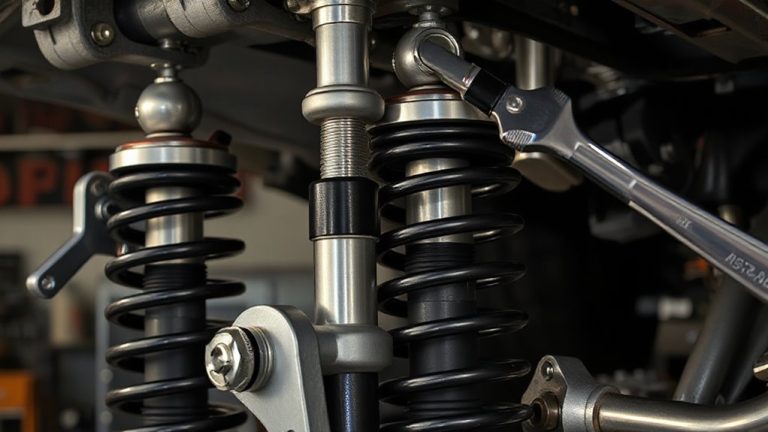
The MacPherson strut suspension is a compact, cost-effective design widely used in modern front-wheel-drive vehicles. You’ll find it on most economy and compact cars because it combines structural and damping functions efficiently. It’s a type of independent suspension, meaning each wheel moves without affecting the opposite side. That improves ride quality and handling. The system uses a single lower control arm and a tall strut assembly replacing the upper control arm. This strut houses the shock absorber and provides structural support. Coilover integration is built in-the coil spring sits around the strut, compressing between the upper mount and the lower knuckle. This saves space and reduces weight. Typical spring rates range from 80 to 120 N/mm, depending on vehicle mass. Damping forces are tuned for 40–60% rebound versus compression. The design allows precise steering geometry with minimal compliance.
Why Is the MacPherson Strut So Cost-Effective?
Most MacPherson strut systems cut manufacturing costs by 15–25% compared to double-wishbone setups. You achieve this through material savings and simplified assembly. The design integrates the shock absorber and coil spring into a single structural unit, reducing the need for extra control arms and pivot points. That means fewer castings, brackets, and mounting components-each saving raw material and machining time. Simplified assembly cuts labor hours markedly; technicians install the entire suspension module in less time with fewer tools. Mounting points are standardized across models, improving production line efficiency. You also reduce part inventory and sourcing complexity, lowering supply chain costs. There’s no need for an upper control arm, which saves aluminum or steel weight and manufacturing cost. Even alignment procedures are faster during assembly. These efficiencies scale dramatically in high-volume production, making the MacPherson strut ideal for budget-conscious manufacturing without sacrificing core performance.
How Does the MacPherson Strut Save Space?
While space efficiency isn’t always the first priority in suspension design, the MacPherson strut delivers significant packaging advantages. Its compact design integrates the shock absorber and coil spring into a single, vertical unit. You get more room in the engine bay-critical in front-wheel-drive economy cars. The strut doubles as the upper suspension link, eliminating the need for a separate upper control arm. That frees up width, letting engineers mount transverse engines deeper in the chassis. Simplified assembly means fewer components, reducing build complexity. Most systems use a single lower control arm and steering knuckle bolted to the strut. This layout trims weight and saves space laterally. The result? More cabin room, better aerodynamics, and improved packaging without sacrificing ride quality. You’ll find this setup in everything from sedans to compact SUVs-proof it works.
Is It Cheaper to Build and Maintain?
Few suspension systems offer the cost efficiency of the MacPherson strut, especially in mass-produced vehicles. You’ll find it cheaper to build because it integrates the shock absorber and coil spring into a single compact unit, reducing part count by up to 30% compared to double-wishbone setups. This design cuts manufacturing costs and simplifies assembly, saving automakers time and money. Maintenance is equally affordable-fewer components mean fewer things to wear out or replace. The reduced unsprung weight also contributes to better fuel efficiency, improving mileage by approximately 2–4% under standard conditions. While not engineered primarily for noise reduction, the strut’s rigid structure minimizes vibration transfer, lowering cabin NVH (noise, vibration, harshness) levels by up to 15% compared to basic rigid-axle suspensions. Repairs are faster, parts are widely available, and labor costs stay low. For economy cars, that balance of affordability, efficiency, and durability is essential.
Does It Handle Well or Just Ride Softly?
Because the MacPherson strut combines the shock absorber and coil spring into one rigid unit, it provides a more direct connection between your steering inputs and tire response. You’ll notice precise turn-in and predictable corner handling, especially on flat roads. The compact design keeps the wheel centered under the vehicle, maintaining consistent alignment during hard cornering-typically with a scrub radius under 30 mm. While it’s not as stiff laterally as a double-wishbone setup, modern tuning with stabilizer bars improves body control. Ride comfort remains acceptable thanks to well-matched spring rates-usually between 150–220 lb/in-absorbing small bumps efficiently. However, large impacts may feel more abrupt due to limited suspension travel, often around 5–6 inches. It’s a balanced trade-off: you get decent handling and adequate comfort, not extreme performance or plush luxury.
Why Do Automakers Still Use It in Cheap Cars?
The MacPherson strut remains a staple in budget-friendly vehicles not just for its simplicity, but for its cost-efficient performance. You’ll find it in cheap cars because it slashes production costs through fewer components and compact packaging. It integrates the shock absorber and spring into a single unit, reducing part count by up to 30% compared to double-wishbone setups. While it offers limited performance-especially in cornering and high-speed stability-it’s more than adequate for city driving and light highway use. Some call it an outdated design, yet it’s proven reliable across decades and millions of vehicles. Engineers tweak tuning for comfort and durability, not sportiness. The design saves up to 15% in suspension assembly costs and requires less underhood space, freeing room for transverse engines. For automakers, that means better margins without sacrificing basic ride quality.
On a final note
You’ll find MacPherson struts in economy cars because they’re simple and efficient. This design integrates the shock absorber and coil spring into one compact unit. It uses fewer parts than double-wishbone systems-reducing weight by up to 15%. Mounting directly to the chassis saves underhood space. Most systems use a single lower control arm and stabilize via a sway bar. Production costs run 20% lower. Maintenance is straightforward, with common service intervals at 80,000 km.