Nighttime Breakdown Survival Guide: Tips From Experts
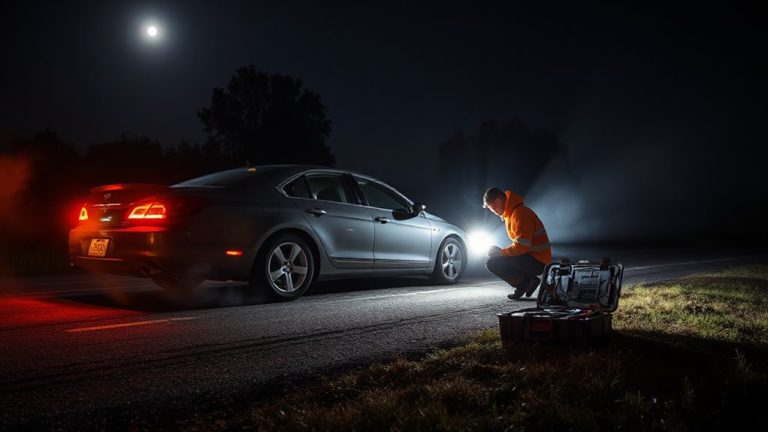
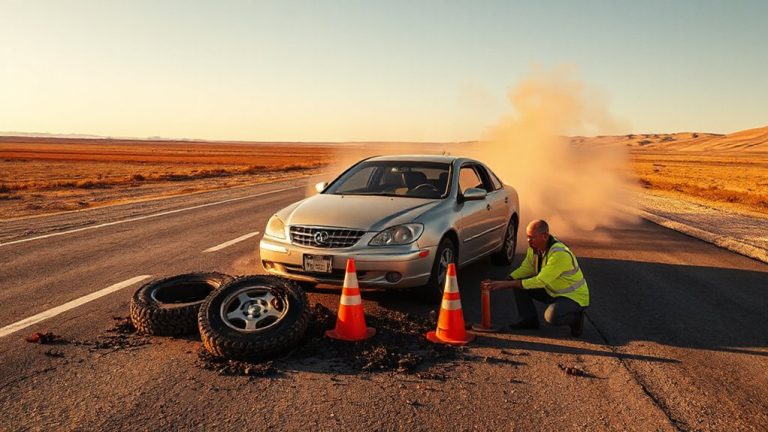
Pull over to the shoulder immediately if you lose power or hear strange noises at night. Most highway shoulders are at least 10 feet wide, providing a critical safety buffer. Activate hazard lights right away-they flash 60–120 times per minute and are visible up to 500 feet away. Stay in your car; modern cabins offer protection from traffic and extreme temperatures. Use interior lights sparingly-your battery lasts 4–6 hours. Signal with three quick flashlight flashes through the windshield. Call 911 and share GPS coordinates; most phones pinpoint location within 5 meters. Emergency services use AVL systems to dispatch the closest unit. Lock doors, keep windows slightly open, and wait safely. More actionable steps follow.
Notable Insights
- Move to the shoulder immediately if your vehicle loses power or makes strange noises at night.
- Turn on hazard lights right away to ensure visibility from up to 500 feet in the dark.
- Stay inside your car if outside conditions are dangerous due to fast traffic or low visibility.
- Signal for help safely by using hazard lights, reflective triangles, or three quick flashlight flashes.
- Call 911 immediately and share your exact location using GPS, mile markers, or road signs.
Move to the Shoulder Immediately
If you suddenly lose power or hear strange noises while driving at night, your first priority is to get off the roadway-fast. Safe parking on the shoulder minimizes collision risk from high-speed traffic. Most highways require at least 10 feet of paved shoulder width, but rural roads may have less-check your state’s DOT standards. Maintain control of the steering wheel and brake gently to avoid skidding. Once stopped, prepare for a quick exit if needed-especially on curves or blind hills where visibility drops below 500 feet. Park straight, set the parking brake, and shift to “Park” (automatic) or first gear (manual). Turn off all electronics except lights-but don’t activate hazards yet. Assess surroundings before opening any doors. A well-positioned vehicle allows emergency responders clear visual identification. Stay inside unless the location feels unsafe. Installing a reliable tire pressure monitoring system can help prevent nighttime breakdowns by alerting you to pressure issues before they become critical.
Turn on Hazard Lights Right Away
You’re stopped on the shoulder, and visibility is critical-turn on your hazard lights immediately. Hazard activation alerts other drivers, reducing collision risk. Your vehicle’s hazard lights flash at 60 to 120 cycles per minute, meeting FMVSS Standard No. 108 for visibility. They operate on a separate circuit, so they function even if your ignition is off. For immediate visibility, these lights must be seen from 500 feet away in darkness. That’s about one-tenth of a mile-the distance most drivers need to react at highway speeds. LED bulbs reach full brightness in 0.2 seconds, faster than halogen. This split-second advantage improves warning response. Dual-filament bulbs fail in only 3% of cases annually, according to NHTSA data. Use them without delay. Hazard activation isn’t optional-it’s a critical safety step. Immediate visibility saves lives when other drivers approach at night.
Stay in Your Car If Outside Is Risky
When visibility is low and traffic is moving at high speed, staying inside your vehicle is often the safest choice. Your car provides critical personal safety by shielding you from fast-moving vehicles, especially on highways where speed limits reach 65–70 mph. Modern vehicles have reinforced steel frames and laminated glass designed to withstand impacts, enhancing vehicle security during prolonged waits. Remaining inside reduces exposure to erratic drivers, poor weather, and uneven terrain. Lock all doors immediately to maintain vehicle security. Use interior lighting sparingly to conserve battery power-most car batteries lose charge within 4–6 hours with lights on. The cabin acts as a controlled environment, protecting against hypothermia or heat exposure. Do not exit unless absolutely necessary, such as imminent danger like fire or smoke. Staying put improves survival odds by minimizing risk factors. Let trained responders manage the scene.
Signal for Help Safely From Inside
Even when you can’t leave the vehicle, you still need to make your presence known to passing traffic and emergency responders. Activate your hazard lights immediately; they’re visible up to 500 feet away. If it’s safe, place reflective triangles 10, 100, and 200 feet behind your car. These meet DOT standards, measuring 12 inches per side with prismatic sheeting for 600-foot visibility. Avoid using flares inside the car, but if you can deploy them from the window using a stick or tool, do so carefully. Roadside flares burn at 2,000°F for 15–30 minutes and are visible up to a mile away. Never exit the vehicle on high-speed roads. Instead, keep windows slightly open to listen for responders. Use a flashlight to signal through the windshield-three quick flashes signal distress. Maintain visibility without compromising safety. For increased reflectivity and durability, consider carrying high-performance reflective warning triangles.
Grab Your Emergency Kit to Stay Visible
A well-stocked emergency kit guarantees you remain visible and protected until help arrives. Reflective gear, such as ANSI Class 2 safety vests, increases visibility by up to 300% at 1,000 feet under low-light conditions. Wear these vests whenever leaving your vehicle. Include at least one high-lumen flashlight-180 to 300 lumens-in your kit for reliable flashlight use. Choose models with IPX7 waterproof ratings and xenon or LED bulbs for extended beam distance (up to 200 meters). Pair the flashlight with extra lithium batteries, which perform better in cold temperatures. Attach reflective tape (minimum 2-inch width) to backpacks or outerwear to enhance peripheral visibility. Position signal flares or LED road flares 50 feet from your vehicle to create a visible perimeter. These items work together to maximize detection by approaching vehicles or rescuers. Proper visibility reduces collision risk markedly during nighttime breakdowns. A well-stocked emergency kit ensures all critical safety tools are readily available when stranded after dark.
Call 911 and Share Your Exact Location
How quickly can first responders reach you if you’re stranded on a dark roadside? Seconds count. Call 911 immediately. Emergency services prioritize location accuracy. Use your phone’s GPS to share exact coordinates-most devices provide latitude and longitude within 5 meters of precision. Enable location services before dialing. If unsure of your position, check road signs, mile markers, or nearby landmarks. Relay this data clearly. Emergency services use AVL (Automatic Vehicle Location) systems to dispatch the nearest units. Most respond within 8–12 minutes in urban zones, longer in rural areas. Don’t assume roadside assistance has tracking. Even with a subscription, live location sharing speeds arrival. Confirm your pin on the dispatcher’s map. Stay on the line until help is confirmed en route. Your precise input reduces search time. Accuracy is critical-like a diagnostic code for rescue. Every digit matters.
On a final note
You’re safer staying in your vehicle. Modern seat belts and reinforced safety cages provide critical protection from passing traffic. Activate hazard lights immediately-these 12-volt signal lamps flash at 60–120 cycles per minute, increasing visibility up to 500 feet. Keep windows closed and doors locked. Use reflective warning triangles or strobe flares placed 50–100 feet behind your car. A fully charged cell phone with GPS enables precise 911 location reporting-accuracy within 5–10 meters guarantees rapid response.