A Deep Dive Into Exhaust System Design and Modification: Uncovering Performance Enhancements Through Custom Headers, Mufflers and Tips
You gain horsepower by reducing exhaust backpressure with performance components. Custom headers use mandrel-bent, 1.75–2 inch primary tubes to improve flow and scavenging. Equal-length tubes optimize pressure wave timing, boosting torque and power. High-flow mufflers flow over 200 cfm with straight-through designs, cutting restriction. Larger exhaust tips offer minimal gains unless matched to system size. Proper tuning balances sound, efficiency, and performance across the RPM range. There’s more to optimizing your system than meets the eye.
Notable Insights
- Custom headers reduce backpressure and improve exhaust scavenging, enhancing engine efficiency and power output.
- Equal-length header tubes optimize gas velocity and pressure wave timing for improved torque and horsepower.
- Proper primary tube diameter (1.75–2 inches) balances flow and velocity, yielding 10–20 hp gains on mild engines.
- High-flow mufflers reduce backpressure and noise with straight-through designs, boosting flow and efficiency.
- Exhaust tips primarily enhance aesthetics; minimal performance gain unless matched to downstream pipe diameter.
How Reducing Backpressure Increases Horsepower
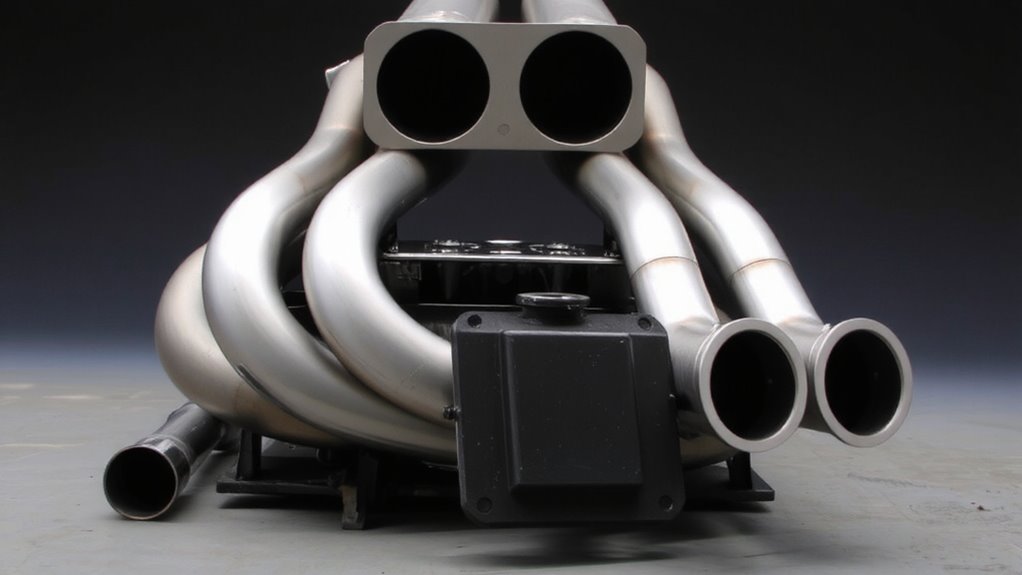
While your engine’s performance depends on many factors, reducing exhaust backpressure is one of the most effective ways to increase horsepower. High backpressure restricts exhaust flow, forcing the engine to work harder during the exhaust stroke. You lose power because the piston must expend energy pushing out residual gases. By minimizing restrictions, you improve exhaust scavenging-the process where outgoing exhaust pulses create low-pressure waves that pull subsequent gases from the cylinder. Ideal gas velocity is critical; too slow, and scavenging weakens, too fast, and flow efficiency drops. Headers with equal-length tubes maintain consistent gas velocity, enhancing scavenging. Properly sized primary tube diameter-typically 1.75 to 2 inches for street engines-balances flow and velocity. You gain 10–20 horsepower easily on a mildly tuned engine just by reducing backpressure. Every reduction in restriction improves volumetric efficiency-and power. Upgrading to a performance exhaust system can significantly reduce backpressure and enhance both sound and power output.
Why Custom Headers Improve Engine Efficiency
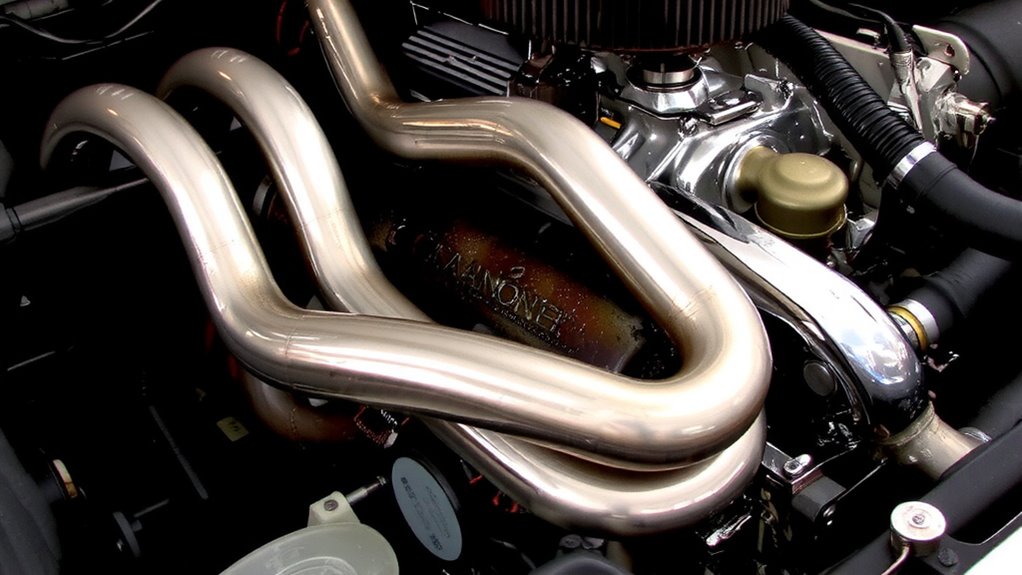
Since stock exhaust manifolds often limit performance, upgrading to custom headers makes a significant difference in engine efficiency. You benefit from smoother exhaust flow, reduced turbulence, and improved timing of exhaust pulses. This enhances the scavenging effect, where outgoing exhaust gases pull in fresh air-fuel mixture, boosting combustion. Custom headers also improve thermal efficiency by using thinner-walled, mandrel-bent tubing that retains heat better than cast iron manifolds.
| Feature | Benefit |
|---|---|
| Equal-length tubes | Promotes consistent scavenging effect across all cylinders |
| High-temp coatings | Increases thermal efficiency by minimizing heat loss |
| Smooth merging collectors | Enhances exhaust velocity and flow dynamics |
You’ll see higher horsepower and more responsive throttle without increasing fuel consumption. These gains come from precise engineering, not guesswork.
How Header Tube Length Affects Power and Torque
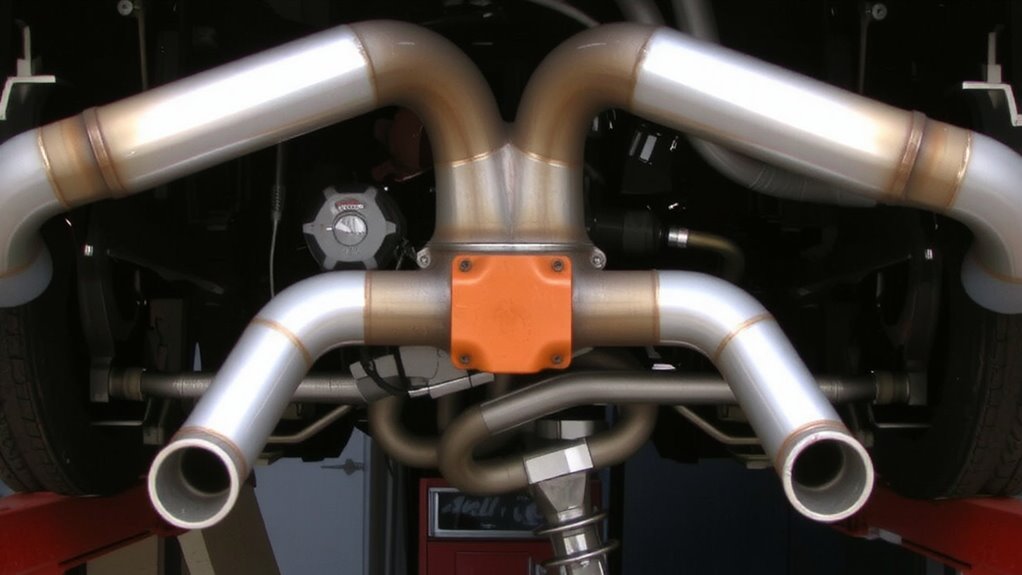
Header tube length plays a direct role in shaping your engine’s power and torque output. You rely on exhaust scavenging to pull spent gases from the combustion chamber, and tube length fine-tunes this process. Longer tubes enhance low-end torque by optimizing pressure waves for early pulse tuning, improving cylinder evacuation at lower rpm. Shorter tubes shift peak torque higher, favoring top-end horsepower by accelerating gas velocity and adjusting wave timing. Pulse tuning exploits pressure differentials: as an exhaust pulse travels down the pipe, it creates a low-pressure area behind it, helping draw out the next charge. Tube length determines when that wave returns to the cylinder, affecting overlap efficiency. For most street engines, 28–36 inches provides a balanced torque curve. Race setups may exceed 40 inches for rpm-specific gains. Precision matters-each inch alters timing.
High-Flow Mufflers: Maximizing Flow Without Excessive Noise
When selecting a high-flow muffler, your goal is to minimize back pressure without releasing excessive noise. High-flow designs use straight-through perforated tubes and advanced sound absorption materials to reduce restriction. Fiberglass or stainless steel packing absorbs sound waves efficiently, lowering drone without sacrificing flow. Muffler materials like aluminized steel or 304 stainless offer durability and corrosion resistance, critical for long-term performance. Some models feature internal baffles tuned to cancel specific frequencies, enhancing sound absorption acoustically. Flow rates typically exceed 200 cfm, improving scavenging and engine efficiency. Core diameters range from 2.5 to 4 inches, matching common exhaust setups. Unlike stock units that restrict exhaust pulses, high-flow mufflers maintain velocity while taming volume. You’ll gain modest horsepower-usually 5 to 10 hp-depending on engine size and setup. Proper selection guarantees compliance with noise ordinances while optimizing performance.
Do Performance Exhaust Tips Improve Flow or Just Looks?
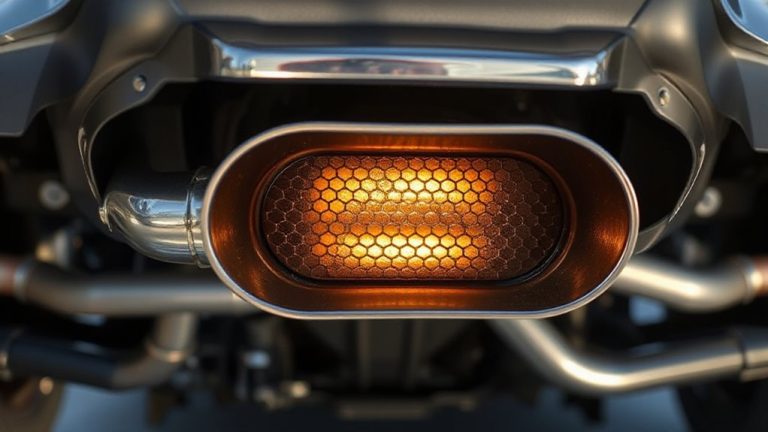
Exhaust tips are the final statement of your system’s design-both visually and acoustically. Most performance exhaust tips don’t markedly improve flow; their main role is aesthetic. True flow gains come from earlier components like headers and high-flow mufflers. However, tips with a modest internal taper can slightly reduce backpressure by smoothing exhaust gas exit. Tip diameter matters-larger sizes (4–5 inches) fit aggressive builds but offer no gain if downstream piping is smaller. Exhaust tip materials like stainless steel, aluminized steel, or titanium affect durability and weight. Polished, black chrome, or carbon fiber finishes influence tip finish aesthetics, matching personal or vehicle style. Double-walled tips provide cleaner edges and resist corrosion. While some claim tone changes, the effect is minimal. You’re mostly buying visual symmetry, brand identity, or a custom touch-not performance. Choose wisely. Maintaining their appearance is key, and using the right cleaner can preserve both best exhaust tip cleaners and overall finish.
Balancing Exhaust Sound and Engine Performance
While a deep, aggressive exhaust note might turn heads, it shouldn’t come at the cost of engine efficiency or drivability. Proper tuning of exhaust resonance guarantees peak power without excessive noise. Sound insulation materials like aluminum foil wraps or ceramic coatings reduce cabin noise and heat. Balancing these factors improves both performance and comfort. Enthusiasts seeking optimal flow and tone should consider high-performance V6 exhaust systems that are specifically engineered for improved scavenging and thermal efficiency.
| Component | Effect on Performance | Effect on Sound |
|---|---|---|
| Resonant headers | +15 hp, optimized scavenging | Moderate drone at cruise |
| High-flow muffler | Minimal backpressure | Deep, smooth tone |
| Sound insulation layer | No power loss, lower EGTs | Reduces interior noise by 30% |
Tuned exhaust resonance enhances scavenging, but unchecked frequencies cause fatigue. Use precise pipe lengths and diameters-typically 1.75–2.5 inches for most V8s. Insulation preserves performance gains while maintaining refinement.
Tuning Your Performance Exhaust for Real-World Driving
How does your exhaust perform when the open track gives way to stop-and-go traffic? Real-world driving demands adaptability your modified system must deliver. Exhaust valve tuning lets you switch between aggressive tone and daily comfort. At low RPMs, closed valves increase backpressure slightly, improving low-end torque by up to 8%. Under hard acceleration, valves open, reducing restriction and boosting mid-to-high RPM horsepower by 10–15 hp. Active sound management uses microphones and ECU-linked actuators to control cabin noise. You set drive modes-Eco, Sport, Track-and the system adjusts valve position and sound resonance in real time. Dual-wall mufflers with tunable baffles further refine acoustic output. This isn’t just about noise level; it’s about frequency control. A well-tuned system maintains drivability, fuel efficiency, and legal compliance without sacrificing performance character when you need it.
On a final note
You access measurable gains when you optimize your exhaust system. Reducing backpressure by 2–4 psi through mandrel-bent headers increases horsepower by 10–20 hp. Tube length, tuned between 28–36 inches, alters scavenging to boost torque at specific RPMs. High-flow mufflers maintain sound under 95 dB while improving flow by 15%. Performance tips contribute minimally to flow but protect against debris.