Maximizing Battery Life Through Proper Care and Maintenance Practices: Tips for Extending the Service Life of Your Car’s Starter Battery
You can maximize your car battery’s life by preventing sulfation through regular charging. Keep terminals clean and tight to guarantee solid conductivity. Avoid short trips; drive over 30 minutes to achieve a full 13.5–14.7V recharge. Test voltage twice yearly-12.6V is ideal, below 12.4V risks degradation. Limit deep discharges, as a 48Ah battery drains fast with lights on. Secure the battery to reduce vibration damage. Park in the garage to minimize thermal stress. There’s more to optimizing performance where routine meets environment.
Notable Insights
- Test your battery twice yearly with a multimeter to catch sulfation early and prevent failure.
- Clean terminals every six months to remove corrosion and ensure strong electrical connections.
- Take frequent 30+ minute highway drives to enable full charging and reduce sulfation risk.
- Secure the battery firmly to minimize vibration damage and preserve internal plate integrity.
- Park indoors when possible to reduce thermal stress and slow battery aging processes.
Watch for These Signs Your Car Battery Is Failing
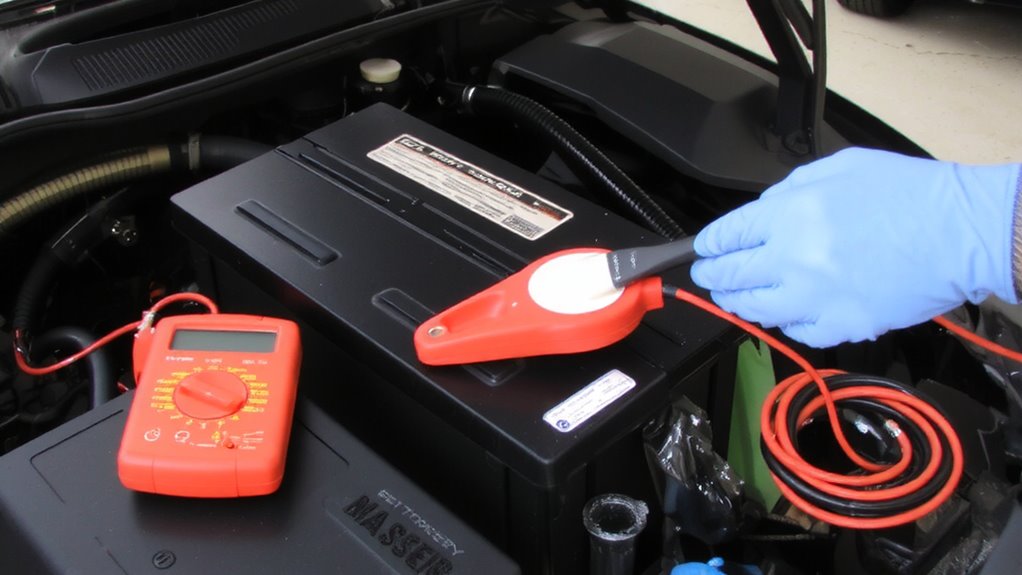
You might not think about your car battery until it fails, but noticing early symptoms can save you from getting stranded. A slow engine crank is one of the first signs-your starter motor draws 200–300 amps, and weak output means the battery can’t deliver. Dim headlights, even after a full charge, suggest voltage output below 12.4 volts. Sulfation buildup occurs when the battery remains undercharged, forming lead sulfate crystals that reduce capacity and efficiency. Left unchecked, it can cut battery life by half. Acid leakage often accompanies case swelling or damaged terminals, exposing components to corrosive electrolyte. This damage compromises conductivity and risks electrical shorts. A battery’s typical lifespan is 3–5 years; beyond that, failure risk increases sharply. Monitoring performance and voltage regularly helps catch degradation early. Replace the battery proactively to avoid breakdowns. Using a car battery maintainer can prevent sulfation and extend battery life by keeping it optimally charged during periods of inactivity.
Clean Corroded Terminals Before They Cause Trouble
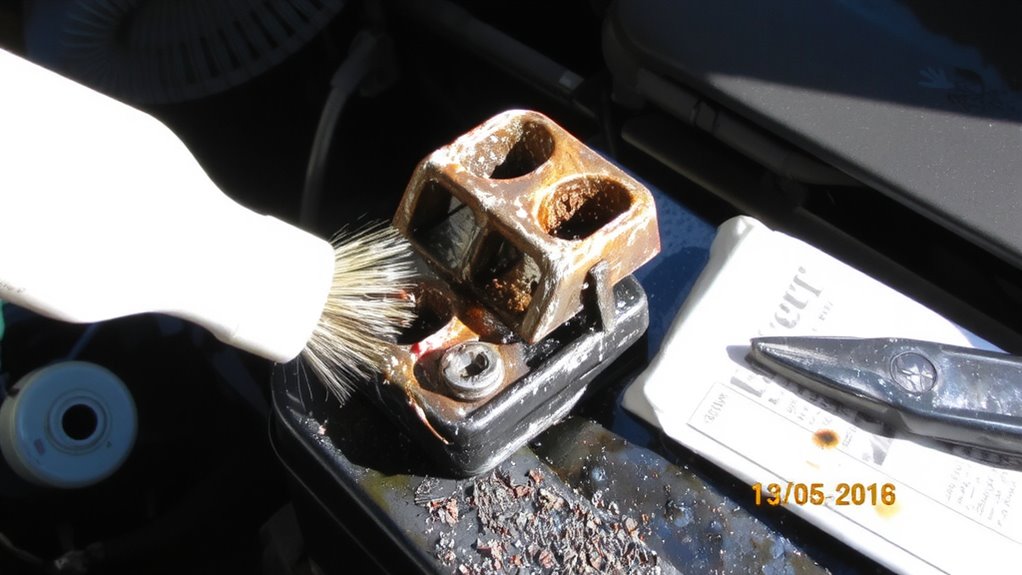
When corrosion builds up on battery terminals, it disrupts the critical electrical connection between the battery and your vehicle’s starting system. This resistance can prevent sufficient current-often over 200 amps during cranking-from reaching the starter motor. Visible corrosion, usually white or greenish, forms from sulfuric acid vapor reacting with metal. Terminal cleaning is simple: disconnect the battery, scrub terminals and cables with a baking soda–water solution, then rinse and dry. Use a wire brush for stubborn deposits. After cleaning, apply a thin layer of petroleum jelly or corrosion-prevention spray to inhibit future buildup. Corrosion prevention includes using felt washers soaked in anti-corrosion solution and guaranteeing tight connections to reduce arcing. Check terminals every six months. Clean, protected terminals guarantee maximum conductivity and reduce voltage drop, preserving starting power and extending battery life. Proper terminal cleaning and corrosion prevention are essential maintenance steps.
Shut Off Lights and Devices When the Engine’s Off

Leaving electrical systems active while the engine is off drains the battery faster than most realize. Even a single set of left lights can draw 10–15 amps, depleting a standard 48 amp-hour battery in under five hours. Your car’s starter battery isn’t designed for prolonged discharging. Unlike deep-cycle batteries, it delivers high cranking amps-typically 500 to 800 cold cranking amps (CCA)-but recovers poorly when deeply discharged. A drained battery undergoes sulfation, where lead sulfate crystals harden on plates, reducing capacity and lifespan. Electronics like infotainment systems or phone chargers may draw only 1–2 amps, but over time, this parasitic drain adds up. Always verify that headlights, interior lights, and accessories are off after exiting the vehicle. Using automatic shutoff features or installing a voltmeter can prevent avoidable failures. Preventative discipline protects against avoidable strain. Regular use of a battery maintenance kit can help monitor charge levels and prevent deep discharge.
Take Longer Drives to Fully Recharge Your Battery
Because short trips prevent the alternator from fully replenishing the battery’s charge, taking longer drives is essential for maintaining ideal battery health. You should drive for at least 30 minutes at highway speeds to enable deep charging. During short commutes, your battery undergoes shallow charging, which promotes sulfation and reduces capacity over time. Extended cycling-regular full charge and discharge cycles-helps maintain electrolyte balance and electrode integrity. A fully functional alternator outputs 13.5 to 14.7 volts, sufficient to recharge a standard 12V lead-acid battery during sustained operation. Deep charging reverses surface charge and guarantees the core cells reach peak voltage. Without it, the battery remains chronically undercharged, weakening performance. Frequent extended drives of 45 minutes or more restore charge reserves and stabilize internal chemistry. This practice prolongs cycle life and sustains cranking power, especially in stop-start driving conditions. You’ll maximize longevity by avoiding constant partial charges.
Test Your Battery Twice a Year for Hidden Weakness
Regularly testing your battery twice a year helps uncover hidden weaknesses before they lead to failure. Most starter batteries last 3–5 years, but battery age alone doesn’t tell the full story. Even within its expected lifespan, your battery can degrade due to frequent charge cycles. Each time you start the engine, you complete a partial charge cycle that reduces capacity over time. After 300–500 cycles, performance often declines markedly. Use a digital multimeter to check voltage: 12.6V indicates a full charge, while below 12.4V suggests sulfation. Conduct a load test at 50% of cold cranking amps (CCA) for 15 seconds; voltage must stay above 9.6V. Testing biannually, especially before winter and summer, guarantees problems are caught early. You’ll avoid inconvenient failures and extend service life by monitoring both battery age and cumulative charge cycles. For more accurate diagnostics, consider using a car battery tester designed to assess both charge level and overall health.
Fasten the Battery Tight to Avoid Vibration Damage
Even when your battery is functioning well, improper mounting can lead to serious damage. Secure mounting prevents excessive movement that weakens internal components. Most automotive batteries are designed to fit specific trays with hold-down brackets or bolts. Use the manufacturer-recommended fasteners-typically M6 or M8 threaded bolts-to achieve proper clamping force. Without secure mounting, vibration prevention fails, allowing the battery to shift during driving. Constant shaking damages lead plates and can cause internal short circuits. Over time, this leads to reduced capacity and early failure. Vibration also accelerates wear on terminals and casing, increasing the risk of acid leaks. A tightly fastened battery should not move more than 1/8 inch in any direction. Check the hold-down system during routine maintenance. Replace worn or missing parts immediately. Proper installation guarantees durability and maintains performance under daily road stresses.
Park in the Garage to Protect Against Extreme Temperatures
Parking your vehicle in the garage isn’t just about convenience-it’s a simple step that markedly reduces battery stress from temperature extremes. Extreme heat accelerates internal corrosion, while cold slows chemical reactions, reducing cranking power. A garage provides passive climate buffering, maintaining stable ambient conditions. Effective garage insulation minimizes thermal swings, keeping interior temperatures 10–15°F milder than outdoors. This stable environment supports consistent temperature regulation, critical for lead-acid battery performance. Batteries exposed to 90°F+ lose capacity twice as fast versus those stored at 70°F. In winter, a garage keeps electrolyte solutions from nearing freezing, preserving charge efficiency. Studies show garage-parked vehicles maintain up to 25% longer battery life. Even modest insulation-R-5 walls, sealed doors-improves thermal retention. Consistent temperature regulation prevents expansion and contraction of internal plates, reducing wear. Parking inside isn’t foolproof, but it’s a proven method to extend service life.
On a final note
Your car battery’s lifespan depends on consistent maintenance. A fully charged 12-volt lead-acid battery typically lasts 3–5 years. Regularly check voltage; below 12.4 volts indicates undercharge. Clean terminals prevent resistance, ensuring efficient current flow. Secure mounting reduces vibration damage, a leading cause of internal failure. Short trips prevent full recharging; aim for drives over 20 minutes. Park in temperatures between 32°F and 77°F when possible. Test every six months for peak reliability.