Exhaust Header Flange Guide: Materials, Heat Limits & Fit
Your exhaust header flange seals the manifold to the header, preventing leaks with precision-machined flatness under 0.0015” per inch. It handles over 1,500°F using stainless steel or Inconel 625, maintaining strength and corrosion resistance. The bolt pattern-4, 6, or 8 bolts-must match exactly to preserve gas flow and scavenging. A warped or misaligned flange disrupts pulse timing, dulling sound and costing 3%–5% power. Consistent alignment sharpens exhaust tone and guarantees peak performance. You’ll discover how material and design choices directly impact durability and acoustic tuning.
Notable Insights
- The header flange ensures a leak-free seal between manifold and header, preserving exhaust flow and engine performance.
- Precision bolt patterns and flatness maintain pulse timing, enhancing exhaust scavenging and volumetric efficiency.
- High-temperature materials like stainless steel or Inconel prevent warping and cracking under thermal stress.
- Flange design influences exhaust sound by maintaining tuned pulse dynamics and resonance characteristics.
- Misalignment or warping disrupts gas flow, reducing horsepower and dulling exhaust tone.
What the Exhaust Pipe Header Flange Actually Does
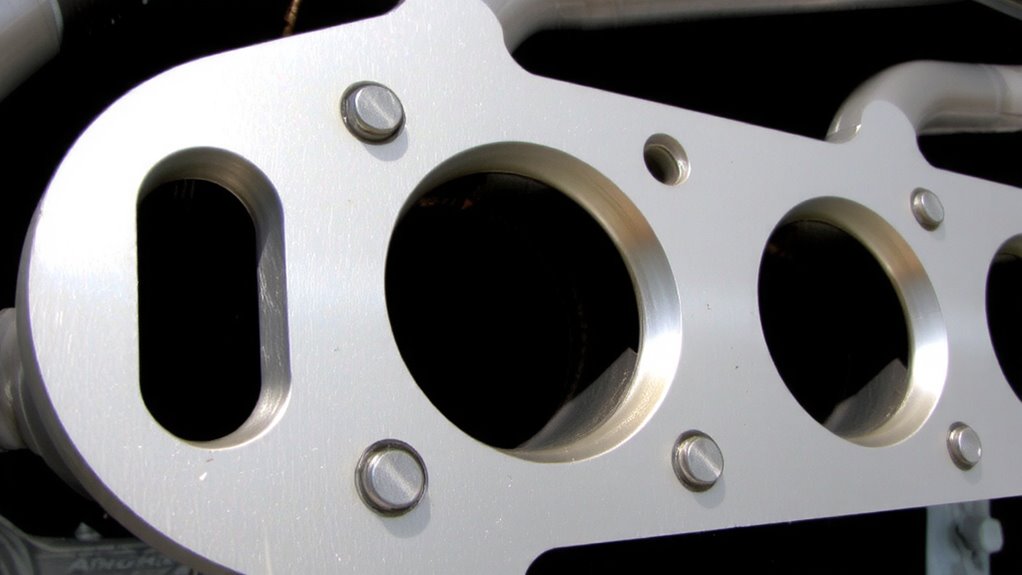
Think of the exhaust pipe header flange as the anchor point where your engine’s exhaust gases begin their journey out of the vehicle. It seals the exhaust manifold to the header, guaranteeing no gas leaks occur under high pressure and temperature. The flange must withstand extreme conditions, so manufacturers use strong materials like forged steel or stainless steel. Bolt patterns vary by engine type-common ones include 4, 6, or 8 bolts-and must match the manifold exactly for a proper seal. Misaligned bolt patterns cause leaks and reduce efficiency. Thermal expansion is a key concern: as the engine heats up, metal expands. Flanges are designed with slight tolerances to accommodate this expansion without warping or cracking. They maintain structural integrity from idle to redline. Proper torque specifications, usually between 25–35 ft-lbs, guarantee long-term durability. This flange isn’t just metal-it’s a critical junction for performance and safety.
How Header Flange Design Boosts Exhaust Flow and Power
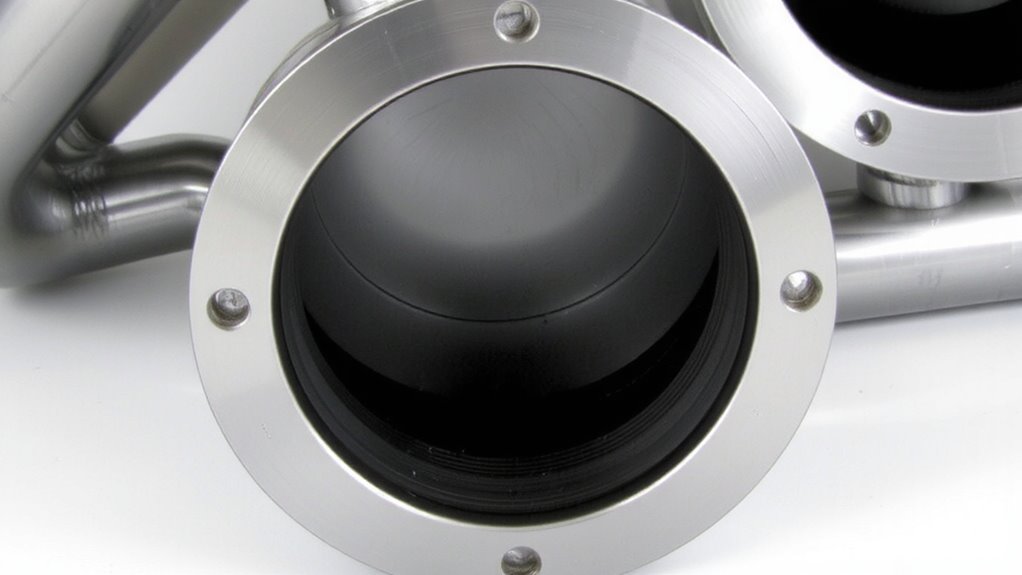
When designed correctly, the header flange plays a crucial role in maximizing exhaust flow and engine power. You rely on precise flow dynamics to move exhaust gases efficiently from the cylinder head to the exhaust pipe. A well-shaped flange guarantees smooth shifts at the port exit, reducing turbulence and maintaining gas velocity. This design enhances pressure balancing across cylinders, preventing backflow and scavenging losses. Ports aligned with exact bolt patterns-typically 5/16” or M10-maintain a leak-free seal under high thermal cycling. Even a 0.002” warp can disrupt flow, so flatness tolerances are kept under 0.0015” per inch. Optimized port contours match the manifold’s primary tubes, minimizing flow separation. Think of it like an aerodynamic funnel-every angle matters. Proper flange geometry sustains pulse energy, improving volumetric efficiency. That’s how smart design translates directly into measurable horsepower gains-typically 3% to 5% in performance-tuned setups-without altering engine displacement.
Best Materials for High-Stress Exhaust Header Flanges
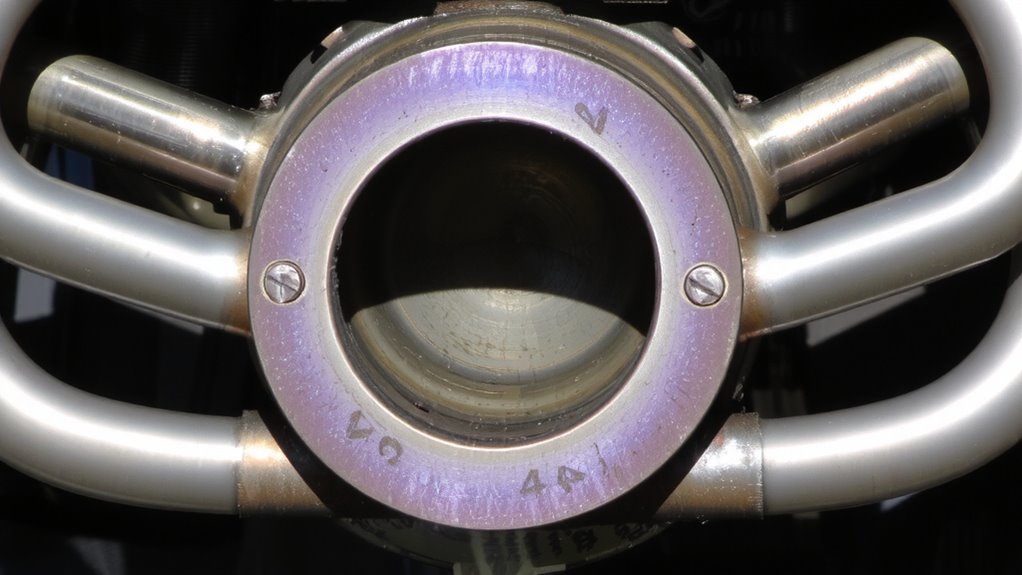
Stainless steel flanges handle extreme heat and pressure better than most alternatives. You’ll want this when exhaust gases exceed 1,500°F under load. Grade 304 and 321 stainless steel offer excellent corrosion resistance, critical for longevity in wet or salty environments. Their thermal conductivity remains low-around 14.4 BTU/hr·ft·°F for 304-helping contain heat within the exhaust stream. This minimizes premature component aging. Unlike mild steel, stainless won’t form scale or crack under repeated thermal cycling. Inconel 625 flanges go further, tolerating temperatures up to 2,000°F with superior oxidation resistance, though they cost considerably more. For high-stress applications like turbocharged engines, forged stainless or Inconel guarantees dimensional stability. Thickness typically ranges from 0.375 to 0.5 inches, providing strength without adding excessive weight. Bolthole patterns stay precise under expansion, maintaining seal integrity.
How Your Header Flange Shapes the Exhaust Sound
Why does your exhaust note change depending on the header flange design? The flange’s thickness, bolt pattern, and surface flatness directly influence exhaust resonance. Even minor variations in flange geometry alter how exhaust pulses merge and travel downstream. A precision-machined flange maintains consistent pipe alignment, preserving tuned header dynamics for ideal sound tuning. Misaligned or warped flanges disrupt pulse timing, creating erratic pressure waves that dull the exhaust note. You’ll notice a sharper, more aggressive tone when the flange supports uniform exhaust flow. This isn’t just about volume-resonance harmonics shift based on how well the flange seals and aligns the system. Proper fitment sustains the designed sound profile by preventing energy loss. You’re not just bolting on a part-you’re fine-tuning the engine’s sonic signature through controlled exhaust resonance and exacting sound tuning.
Why Poor Flange Fit Causes Leaks and Performance Loss
A misaligned or poorly machined header flange doesn’t just dull your exhaust tone-it sets the stage for leaks and lost power. Flange misalignment prevents proper gasket sealing, allowing exhaust gases to escape at critical junctions. Even a 0.003-inch gap can bleed off pressure, reducing scavenging efficiency and sapping horsepower. Over time, thermal cycling intensifies the issue, promoting thermal warping in low-quality materials. You’ll often see warping above 1,200°F, especially in mild steel flanges. This distortion breaks the seal, creating inconsistent exhaust flow. Leaks disrupt sensor readings and upset air-fuel ratios. Your ECU compensates, but fuel economy and throttle response suffer. Precision-machined flanges made from stainless steel or forged alloys resist warping and maintain flatness within ±0.0015 inches. A tight, flat fit preserves backpressure, maximizes exhaust velocity, and sustains engine efficiency. You need that integrity to keep every bit of performance intact. Upgrading to high-flow exhaust pipes can further enhance exhaust scavenging and overall engine output.
Upgrading Your Header Flange: Power Gains vs. Cost and Effort
Ever wonder how much power you’re leaving on the table with a stock header flange? Upgrading can yield 5–15 horsepower by improving exhaust flow and scavenging efficiency. Performance header flanges, especially those CNC-machined from 304 stainless steel, offer superior surface finish and dimensional accuracy. They improve sealing integrity and reduce backpressure. Proper installation requires flange alignment tools to prevent gasket misalignment and exhaust leaks. These tools guarantee exact bolt hole correspondence between manifold and pipe. You should also apply header flange lubrication, like nickel-based anti-seize, on bolt threads to prevent galling and maintain clamp load. This lubrication extends flange life and simplifies future removal. While headers cost $200–$600 and demand several hours of labor, the gains in throttle response and exhaust efficiency justify the effort for performance-focused builds.
Common Header Flange Failures and How to Spot Them
Though often overlooked, the header flange is a critical junction in your exhaust system, and when it fails, performance and reliability suffer. You’ll typically notice power loss, exhaust leaks, or unusual noises. Warping patterns commonly develop due to uneven thermal expansion, especially in cast iron or poorly heat-treated steel flanges. A warp exceeding 0.002 inches across the surface can compromise the seal. Cracking tendencies are highest at bolt holes and sharp corners, where stress concentrates. Stainless steel headers resist this better, thanks to superior fatigue strength. Inspect regularly for hairline fractures or soot staining-clear signs of leakage. Use a straightedge and feeler gauge to check flatness. Replace flanges showing visible cracks or deformation. Early detection prevents damage to headers, gaskets, and nearby components.
On a final note
Your header flange directly influences exhaust efficiency and engine performance. A precisely machined 3/8-inch thick 304 stainless steel flange guarantees warp resistance under 1,500°F temperatures. Proper port alignment maintains exhaust velocity, improving scavenging and adding up to 5% horsepower. Leak-free sealing prevents air intrusion, preserving backpressure balance. Incorrect fitment disrupts gas flow, reducing torque. Upgraded flanges with laser-cut profiles enhance durability and sound consistency.