Safety Precautions When Working Under Vehicles Equipped With Manual Transaxles
Turn off the engine and remove the key-this locks the steering and cuts power only when the transmission is in neutral. Set the parking brake firmly and chock both sides of the rear wheels with 4-inch durable blocks. Disconnect the battery’s negative terminal first using a 10mm wrench to prevent electrical hazards. Use two 3-ton jack stands on reinforced frame points; never rely on a jack alone. Make certain the transaxle is level and mounts are intact before positioning yourself underneath, where greater safety details await.
Notable Insights
- Turn off the ignition and remove the key only when the transmission is in neutral to prevent accidental startup.
- Engage the parking brake and secure wheels with chocks to prevent unintended vehicle movement.
- Disconnect the battery’s negative terminal first to eliminate electrical hazards during under-vehicle work.
- Use jack stands rated at least 3 tons on reinforced frame points; never rely solely on a hydraulic jack.
- Inspect transaxle mounts for damage and avoid high-risk pinch points near shift and clutch linkages.
Turn Off Ignition and Remove Keys
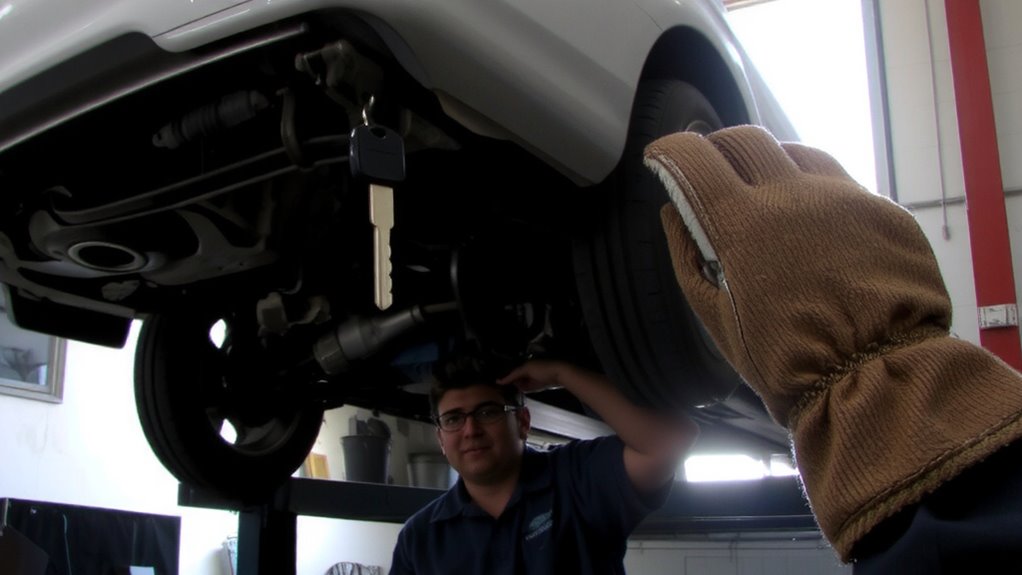
While you’re preparing to work beneath a vehicle with a manual transaxle, the first critical step is turning off the ignition and removing the keys. This simple action prevents accidental engine start-up and reduces risk of injury. Ignition switch failure, though rare, can cause unintended electrical activation, making key removal essential. The key removal protocol requires the transmission to be in neutral and the ignition fully off before extracting the key. Most modern ignition systems use a steering lock mechanism that engages only when the key is removed, adding another layer of safety. Without key removal, electrical circuits may remain live, posing risks during undercarriage work. Always verify the key is out and stored away from the workspace. Treat every vehicle as if its ignition system is compromised. Following this protocol guarantees you eliminate preventable hazards before sliding under the chassis.
Engage Parking Brake and Block Wheels
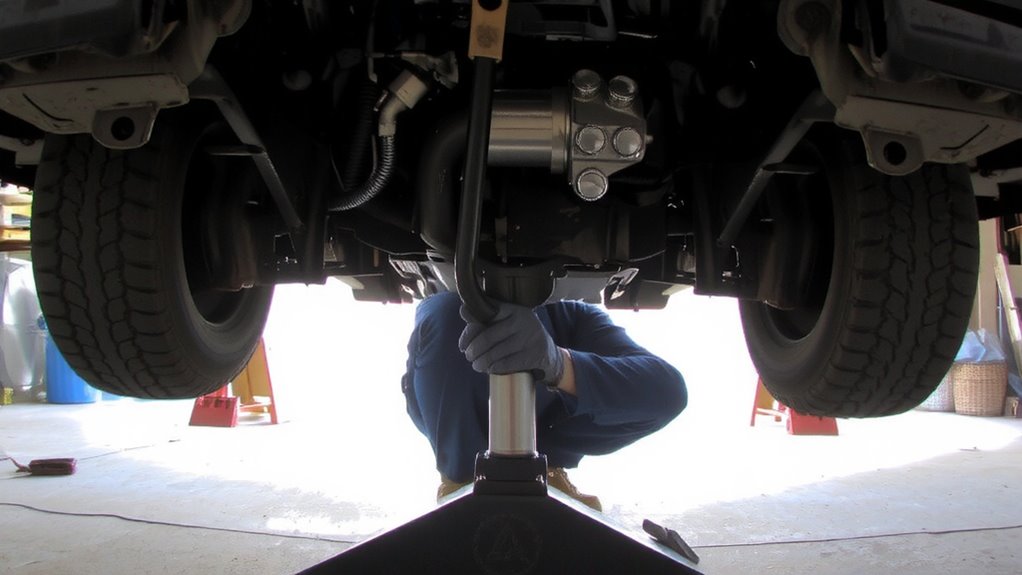
Even if the engine is off, a vehicle can still roll without proper restraint, so engaging the parking brake and blocking the wheels is essential before working underneath. Always perform brake engagement fully by pulling the lever until you feel resistance, ensuring the rear brakes are firmly applied. This mechanical lock prevents transmission creep, even in manual transaxle systems. Complement this by placing wheel chocks against the tires to eliminate movement. Use rigid, high-traction wheel chocks made of durable polymer or rubber, at least 4 inches tall, to resist displacement. Position them on both sides of a rear tire if the vehicle is on level ground, or both front and rear of a non-driven wheel on inclines. Proper chocking distributes force and prevents slippage. Never rely solely on the parking brake-combine it with wheel chocks for redundant safety. This dual method guarantees stability, protecting you during undercarriage work.
Disconnect Battery to Eliminate Electrical Risk
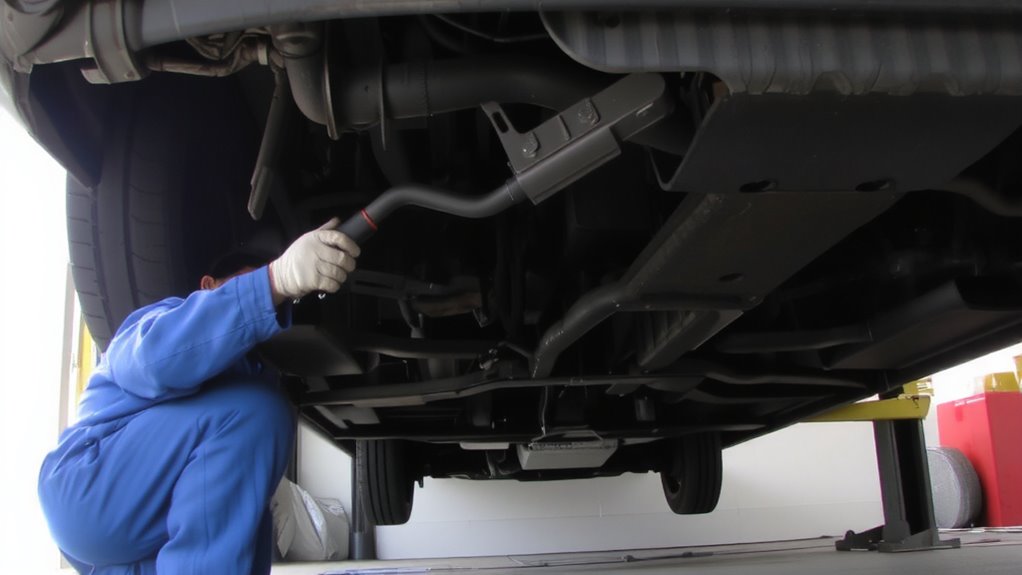
Since electrical systems can pose serious risks during under-vehicle work, disconnecting the battery is a critical safety step you shouldn’t skip. Always disconnect the negative terminal first to minimize the chance of electrical shorts. If you accidentally bridge power to ground with a tool, it can cause sparks, damage circuits, or even ignite flammable gases. Inspect for battery corrosion before disconnecting-white or greenish deposits can conduct electricity and increase risk. Clean terminals with a wire brush and baking soda solution if needed. Once corrosion is cleared, use a 10mm wrench for most vehicles to loosen the clamp. Secure the disconnected cable away from the terminal. This simple action de-energizes the chassis, eliminating the risk of unintended activation of electrical components while you’re beneath the vehicle. Including a roadside emergency kit can provide essential tools and supplies for safe battery maintenance and unexpected breakdowns.
Use Jack Stands Rated for Manual Transaxle Vehicles
You’ve already disconnected the battery to remove electrical hazards, but staying safe under a vehicle means addressing the far greater risk of crushing weight. Always use jack stands rated for manual transaxle vehicles-they handle extra mass from drivetrain components. The jack rating must exceed your vehicle’s weight; for most manual transaxle models, this means 3-ton (6,000 lb) minimum capacity per stand. Never rely on the hydraulic jack alone. Verify stand placement on reinforced frame points or axle brackets, not plastic covers or suspension parts. Adjust stand height so the vehicle rests securely without pinching. Incorrect stand placement shifts load distribution, increasing collapse risk. Use stands with anti-slip pads and non-binding spindles. Position them symmetrically to maintain balance. A single failed support point can lead to total instability. Your life depends on proper jack rating and precise stand placement-treat both with uncompromising attention. For reliable lifting performance, choose a Top Bottle Jack that matches your vehicle’s weight requirements.
Disconnect Clutch and Shift Linkages Safely
Before removing any components, make sure the clutch and shift linkages are fully disengaged to prevent unexpected movement during service. Disconnect the clutch linkage at the release lever to eliminate tension, ensuring the clutch remains disengaged. This step is essential for safe clutch inspection, allowing you to evaluate the release bearing, pressure plate, and disc without resistance. For shift linkage, detach the cable or rod from the transaxle lever, verifying neutral position before separation. Proper linkage alignment must be maintained or noted to guarantee smooth reassembly and accurate gear selection. Misalignment can cause difficult shifting or premature wear. Use labeled bags to store hardware and mark linkage positions with paint or scribe lines. Always support disconnected linkages to avoid stress on brackets. These procedures enhance safety and improve repair accuracy, especially on front-wheel-drive platforms where space is limited.
Avoid Pinch Points at Transaxle Linkage Joints
Keep your hands clear of transaxle linkage joints once the clutch and shift linkages are disconnected, as these pivoting points can close suddenly under component tension or vehicle movement. Even slight chassis flex can shift components, creating pinch hazards at pivot points. Always perform joint inspection before working near linkages-check for wear, misalignment, or spring tension. Never rely on memory; verify each joint’s status with a visual and physical check. Use glove protection to guard against abrasions and pinching, but avoid loose-fitting gloves that could snag. Keep fingers away from clevis pins, selector forks, and shift rails.
| Hazard Zone | Risk Level |
|---|---|
| Shift linkage pivot | High |
| Clutch lever joint | High |
| Selector rod connector | Medium |
| Mounting bracket bolt | Low |
| Control arm bushing | Low |
Confirm Vehicle and Transaxle Stability Before Working Underneath
Even when the engine’s off and the keys are out, never assume the vehicle or transaxle is stable until you’ve verified it with a systematic inspection. Start by confirming the vehicle is on a level surface, ensuring proper vehicle alignment to prevent unintended movement. Position wheel chocks on both front and rear of the tires. Use jack stands rated for the vehicle’s weight-never rely solely on a hydraulic jack. Inspect transaxle positioning: mounts should show no cracks, collapse, or excessive wear. Misaligned mounts can shift under load, compromising safety. The transaxle must be level and securely fastened to avoid imbalance. Always test stability by gently pushing the vehicle side-to-side and checking for play. Confirm that suspension components aren’t compressed or sagging. Proper setup prevents accidents. Your safety depends on these verified conditions-take the extra minutes to double-check. For added reliability, choose a top-rated car jack that matches your vehicle’s weight and lifting requirements.
On a final note
Always secure the vehicle before working beneath it. Use jack stands rated for at least 3 tons-never rely on hydraulic jacks alone. Disconnect the battery to prevent accidental ignition. Engage the parking brake and block wheels to stop unintended movement. Manual transaxles add complexity; disconnect clutch and shift linkages carefully. Watch for pinch points near linkage joints. Confirm stability in all directions-any shift could be fatal. Safety isn’t optional; it’s your primary tool.