How a Car Battery Starts Your Engine: Volts, Amps & CCA
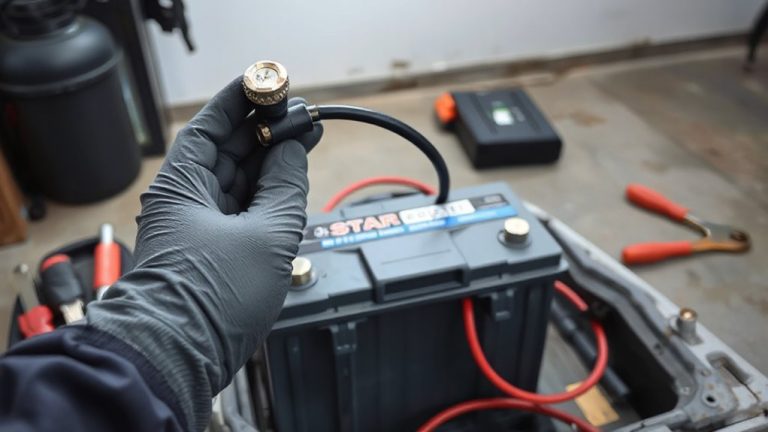
Your car battery delivers 12 volts to the starter motor, supplying over 200 amps to crank the engine. Thick copper cables guarantee minimal resistance, typically under 0.1 ohms. It powers the initial combustion sequence by engaging the flywheel via the starter. The lead-acid design uses lead dioxide and sponge lead plates with sulfuric acid to generate current. A fully charged battery reads 12.6–14.4 volts. You’ll discover how charging cycles and maintenance affect long-term performance.
Notable Insights
- The battery delivers 12 volts to the starter motor, enabling it to engage the flywheel and rotate the crankshaft for engine startup.
- It powers essential systems like alarms and onboard computers when the engine is off, maintaining memory with minimal current draw.
- A weak battery may cause slow cranking or dim headlights due to insufficient voltage or inability to supply high current.
- Alternators recharge the battery using a three-stage process to restore charge efficiently while preventing overvoltage or undercharging.
- Regular maintenance includes terminal inspections, voltage testing, and checking CCA to ensure reliable performance and longevity.
How a Car Battery Starts Your Engine
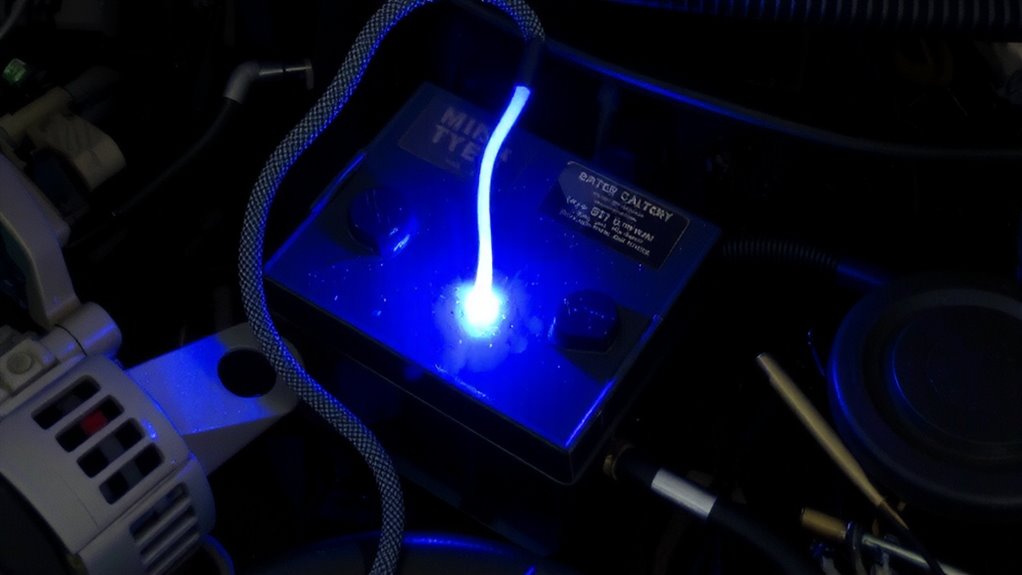
When you turn the key or press the start button, the battery delivers a jolt of 12 volts to the starter motor, kicking off the engine’s startup sequence. This surge enables the starter to engage the flywheel, rotating the crankshaft and initiating combustion. Your car battery relies on lead-acid battery chemistry, where lead dioxide and sponge lead plates react with sulfuric acid to produce electrical energy. A fully charged battery provides 12.6 to 14.4 volts, critical for overcoming electrical resistance in cables and connections. Excessive resistance reduces voltage at the starter, potentially causing slow cranking or failure. Thick copper cables minimize resistance, typically below 0.1 ohms in healthy systems. Cold cranking amps (CCA)-usually 400 to 800 in standard batteries-measure performance at 0°F. This precise electrical output guarantees reliable engine turnover, even under demanding conditions. For drivers heading to sandy destinations, using a car organizer for beach trips can help protect vehicle interiors from salt, sand, and moisture that may indirectly affect electrical components over time.
What Your Car Battery Does Beyond Starting
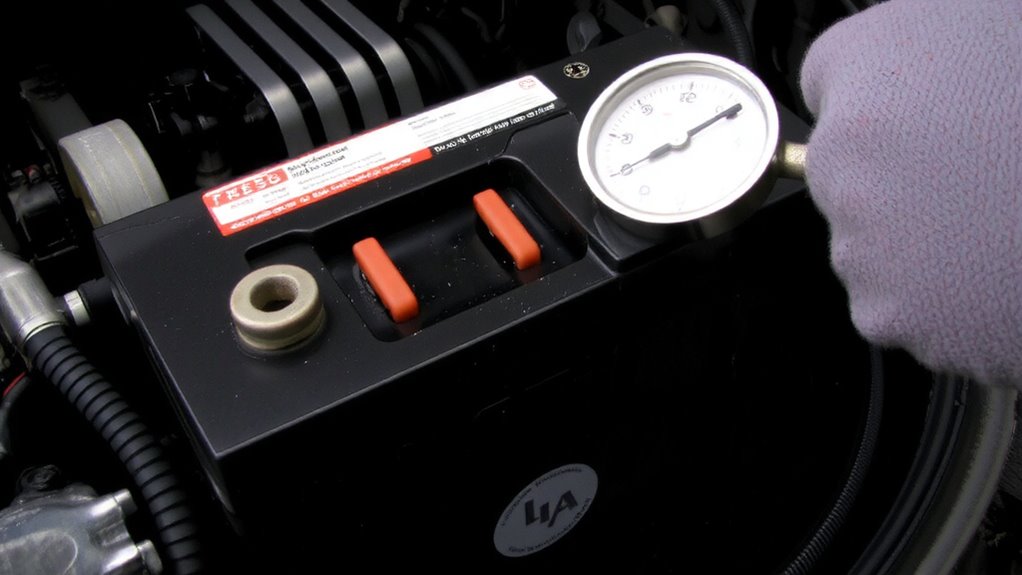
What keeps your car’s electronics alive when the engine’s off? Your battery provides essential battery backup, powering systems like alarms, clocks, and onboard computers. Without it, your car wouldn’t retain settings or respond to key fobs. Once off, the battery supports memory storage in modules, drawing just milliamps-typically 20–50 mA-to maintain data. During operation, it stabilizes voltage for consistent power distribution across 12-volt systems. Even with the alternator running, the battery absorbs voltage spikes, protecting sensitive electronics. It acts as a buffer, ensuring steady current despite fluctuating electrical loads. Most automotive batteries deliver 400–600 cold-cranking amps and operate at 12.6 volts when fully charged. This reserve capacity supports accessories during high demand, preventing system crashes. Reliable power distribution depends on clean terminals and proper cable connections, minimizing resistance. The battery isn’t just for starting-it’s central to your vehicle’s electrical integrity.
Signs Your Car Battery Is Losing Charge
Though you might not notice at first, a weakening car battery often reveals itself through subtle changes in performance. You may observe dim headlights, especially at idle, indicating insufficient voltage output-healthy batteries maintain 12.6 volts when fully charged, but a drop below 12.2 volts suggests a partial charge. Slow engine crank during startup is another sign; the starter motor requires 200+ amps, and a weak battery can’t sustain that demand. Electrical accessories like windows or radios may also respond sluggishly. Corroded terminals hinder conductivity, increasing resistance and reducing effective voltage delivery. Check for white or greenish deposits on the battery posts-these impair connection and can mimic low-charge symptoms. A multimeter test at rest should read over 12.4 volts. Persistent issues after a full charge cycle usually mean internal degradation, not just surface problems. Using a car battery tester can provide a more accurate assessment of your battery’s health and overall performance.
Why Short Drives and Weather Drain Your Battery
Ever wonder why your battery struggles after frequent short trips? Short drives don’t give the alternator enough time to fully recharge the battery. Most charging occurs after 20+ minutes of driving; trips under 10 minutes lead to chronic undercharging. Over time, this reduces charge capacity and weakens cold cranking performance. Cold cranking amps (CCA) measure the power available at 0°F to start the engine. A battery drained by short trips may only deliver 40% of its rated CCA. Cold weather thickens engine oil and increases starting resistance, demanding even more power. Meanwhile, parasitic drain-ongoing power use by systems like alarms or clocks-slowly depletes charge when parked. Combined with short drives, this accelerates discharge. In winter, a weakened battery can die within days. Prevent failure by taking longer drives or using a maintenance charger. For optimal long-term care, consider using a battery maintainer to preserve charge during periods of inactivity.
What Happens in a Car Battery Charging Cycle
A battery weakened by short drives and cold temperatures can’t rely on the engine alone to recover its full charge, which is why understanding the charging cycle matters. Your alternator supplies 13.5 to 14.8 volts during operation, triggering electrochemical reactions that convert lead sulfate back into lead and lead dioxide. This process restores the battery’s stored energy. Voltage regulation guarantees this stays within safe limits-too high, and you risk electrolyte loss; too low, and the battery remains undercharged. The charging cycle has three stages: bulk, where up to 70% charge returns at constant current; absorption, with regulated voltage maintaining peak input; and float, a maintenance phase. These electrochemical reactions reverse discharge effects, extending battery life. Proper voltage regulation prevents damage and maintains efficiency. You’re not just running the engine-you’re actively recharging a complex chemical system designed for repeated cycles.
Simple Steps to Maintain Your Battery
If you want your car battery to deliver reliable performance and long service life, regular maintenance is essential. Perform terminal inspection every three months to check for corrosion, loose connections, or pitting on lead terminals. Corrosion increases electrical resistance, potentially hindering proper current flow during engine cranking. Use a voltmeter to verify resting voltage-12.6 volts indicates a full charge. Conduct battery cleaning with a solution of baking soda and water to neutralize acid buildup. A wire brush removes corrosion effectively without damaging terminals. Make certain the battery case is free of cracks and electrolyte levels are maintained in non-sealed units. Keep the top surface dry to prevent parasitic drain. Secure mounting prevents vibration damage. These steps support maximum conductivity and reduce failure risk, keeping your electrical system functioning efficiently under demand.
When to Replace Your Car Battery: and Why
Your battery won’t last forever, even with consistent care. Battery age is a primary factor in replacement timing, typically requiring service every 3 to 5 years. Most lead-acid batteries degrade after 36 to 60 months due to internal sulfation and reduced charge capacity. You’ll notice slow engine crank times or dim headlights, signaling weakened performance. Corrosion buildup on terminals-white or blue crusty deposits-increases resistance and disrupts electrical flow, reducing efficiency. Cleaning helps temporarily, but heavy corrosion may indicate internal electrolyte leakage and advanced wear. Cold cranking amps (CCA) decline over time; if your battery can’t deliver 75% of rated CCA, replacement is necessary. Voltage readings below 12.4 volts at rest suggest insufficient charge retention. Don’t wait for total failure. Proactively test annually after three years to avoid unexpected breakdowns. Replace when performance metrics fall out of spec.
On a final note
You rely on your car battery to deliver 12 volts of direct current to the starter motor. It provides up to 200 amps during cold cranking, enabling ignition. Beyond starting, it stabilizes voltage for sensitive electronics. Repeated short trips prevent full charging; alternators need 20+ minutes at highway speeds. Batteries last 3–5 years, with capacity measured in amp-hours (Ah) and cold cranking amps (CCA). Replace them proactively to avoid failure.