Understanding the Function of the Distributor Cap in Older Vehicles: How It Controls Spark Timing to Ensure Proper Combustion Within Each Cylinder
Your distributor cap directs high-voltage current from the ignition coil to the right spark plug at the correct time. It works with the spinning rotor, which transfers voltage through carbon contacts to each cylinder’s terminal. The cap guarantees precise spark timing by maintaining a 0.25–0.30 inch gap between rotor and terminals. Metal contacts inside align with a 4–8 cylinder firing order, guiding up to 45,000 volts without arcing. Cracks or carbon tracking disrupt the ignition path, causing misfires. Proper timing, regulated by centrifugal weights and vacuum advance, guarantees peak cylinder pressure occurs just after top dead center for efficient combustion. Replacement every 30,000–40,000 miles maintains reliability. You’ll discover how inspection and maintenance prevent common failures.
Notable Insights
- Distributor cap directs high-voltage current from the ignition coil to the correct spark plug at the right time.
- Internal metal terminals and rotor alignment ensure precise spark delivery to each cylinder.
- Carbon contacts between rotor and terminals maintain consistent electrical connection during rotation.
- Proper rotor-to-terminal gap (0.25–0.30 inches) prevents misfiring and ensures reliable ignition timing.
- Worn or cracked caps disrupt spark paths, causing misfires and poor combustion due to incorrect timing.
What Is a Distributor Cap?
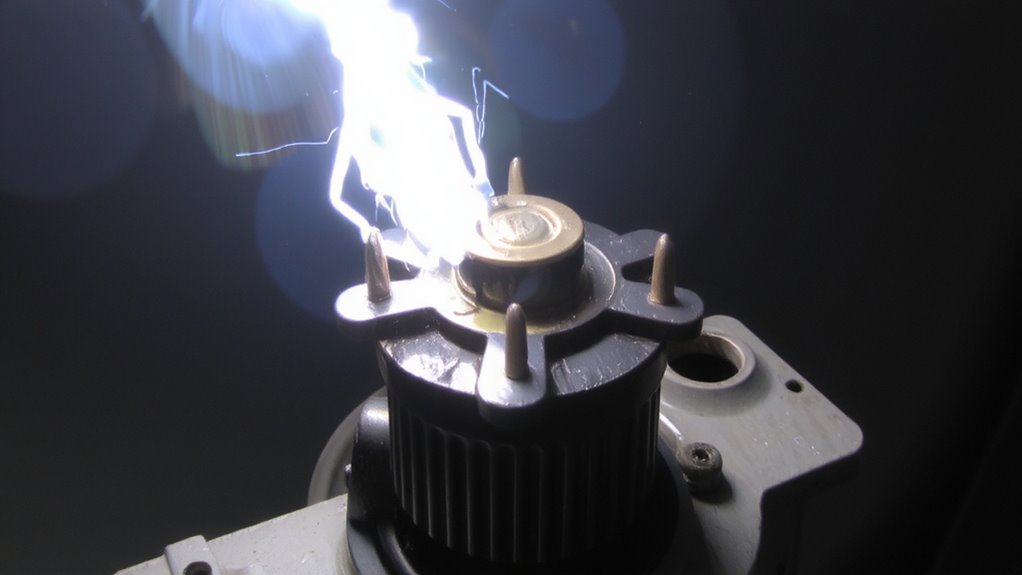
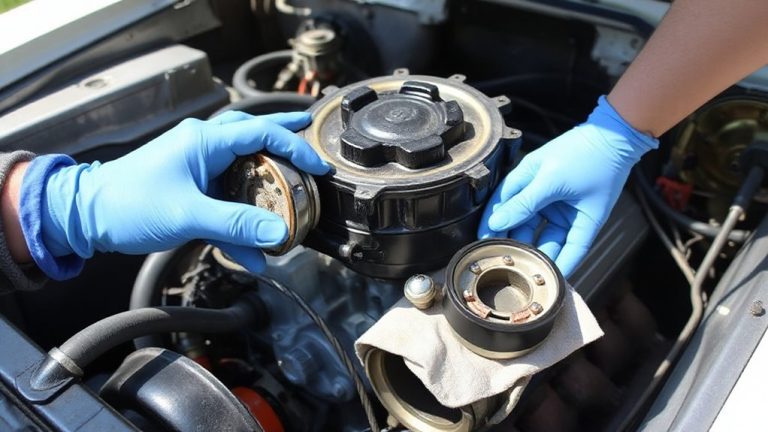
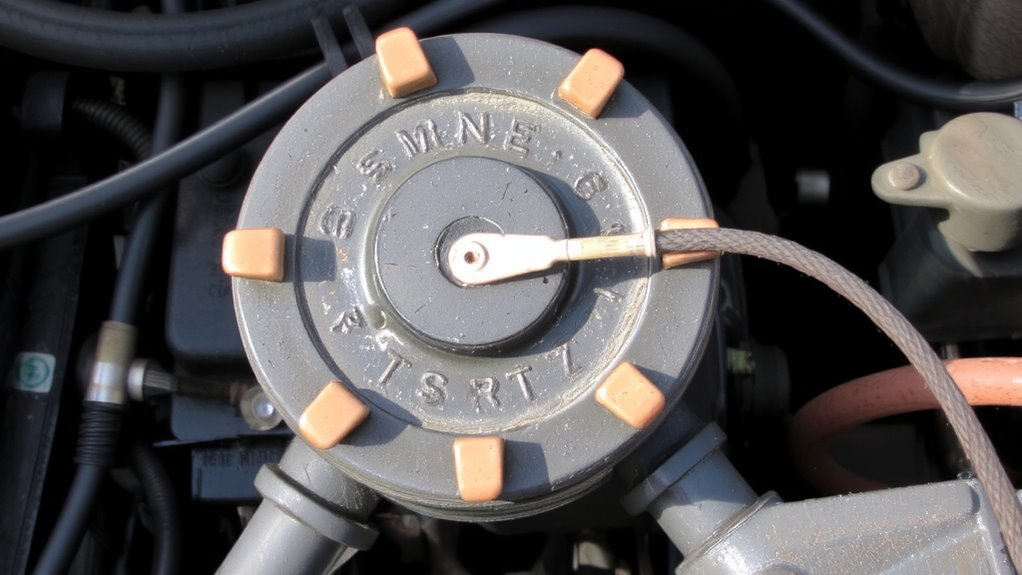
Think of the distributor cap as the traffic director of your engine’s ignition system. It guides high-voltage current to the correct spark plug at the right time, central to the distributor function. Made typically of durable phenolic or plastic resin, the cap houses metal contact terminals-one for each cylinder, usually four to eight. These terminals connect to ignition components like spark plug wires and the rotor. Internally, carbon contacts link the rotor to each terminal, ensuring consistent spark delivery. The cap mounts securely atop the distributor shaft, aligned precisely to maintain timing accuracy. With a typical outer diameter of 4 to 6 inches, it’s designed to resist high voltage-often up to 45,000 volts-without arcing or degrading. Over time, carbon tracking and wear can impair performance, so regular inspection is critical. This simple part plays a crucial role in ensuring reliable combustion.
How the Distributor Rotor and Cap Work Together
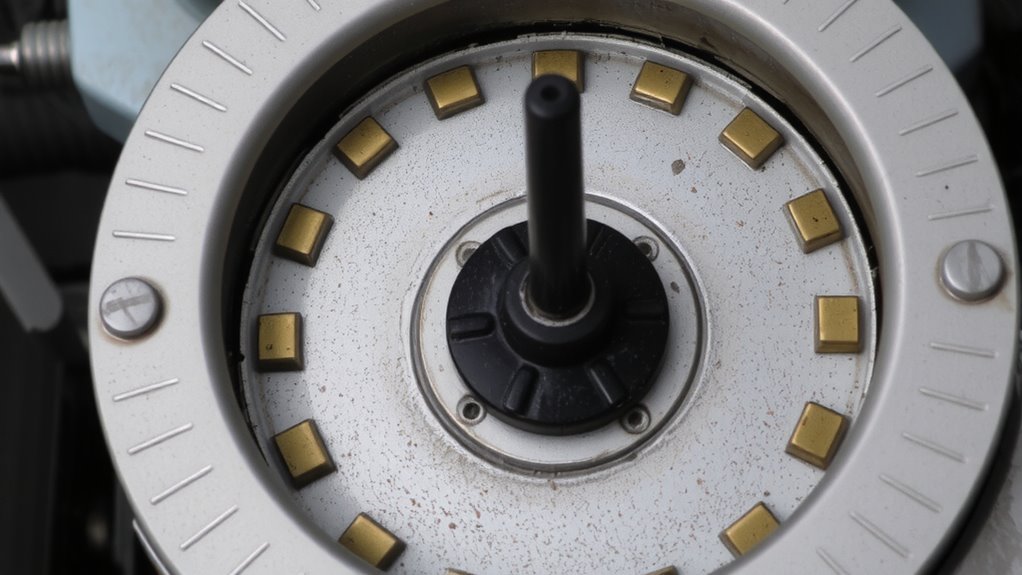
Your engine relies on precise timing between the distributor cap and rotor to ignite the air-fuel mixture. The rotor spins inside the cap, transferring high-voltage current from the coil to individual spark plug terminals. Proper rotor alignment guarantees each spark reaches the correct cylinder at the right moment. Misalignment, even by 2–3 millimeters, disrupts ignition sequence and reduces engine efficiency. The cap’s internal contacts distribute current, but over time, cap corrosion develops due to moisture and heat exposure. Corrosion increases electrical resistance, causing misfires or hard starts. Caps typically last 40,000 miles, but environmental factors accelerate wear. A compromised seal allows contaminants, worsening cap corrosion. You should inspect the rotor and cap every 15,000 miles. Replace them together to maintain synchronization and prevent premature failure. Their combined function is critical for reliable combustion.
How Spark Timing Is Controlled by the Distributor
While the distributor cap and rotor deliver high-voltage current to the spark plugs, it’s the distributor’s internal mechanisms that precisely control when each spark occurs. You rely on this timing to guarantee efficient combustion. The contact points inside the distributor regulate the dwell angle-the number of degrees the cam keeps the points closed-typically between 28° and 32° in most engines. This affects how long the coil charges, directly influencing spark strength. At the same time, ignition advance adjusts timing based on engine speed and load. Centrifugal weights and vacuum diaphragms inside the distributor shift the rotor’s position, advancing spark timing up to 30° before top dead center. This optimization guarantees peak cylinder pressure occurs at the ideal moment. Proper dwell angle and ignition advance work together to maximize power, fuel economy, and engine longevity under varying operating conditions.
Signs of a Bad Distributor Cap
A failing distributor cap often reveals itself through erratic engine behavior. You might notice misfires, rough idling, or difficulty starting. These issues commonly stem from cracked insulation or carbon tracking inside the cap. Cracked insulation disrupts the high-voltage path, causing spark loss. Carbon tracking occurs when conductive carbon trails form on the cap’s inner surface, creating short circuits. Over time, moisture and heat degrade the cap’s plastic housing, accelerating wear.
| Symptom | Cause | Effect on Engine |
|---|---|---|
| Misfiring | Cracked insulation | Loss of spark to cylinder |
| Rough idle | Carbon tracking | Uneven combustion |
| Hard starting | Damaged terminals | Weak or no spark |
| Stalling | Erosion and moisture | Intermittent ignition failure |
Ignition system performance drops noticeably when these faults develop, interfering with precise spark timing and reducing engine efficiency. Immediate inspection is recommended.
How to Check and Replace a Distributor Cap
Faulty ignition performance often traces back to the distributor cap, making inspection a critical step in maintaining reliable engine operation. Begin by disconnecting the battery and removing the cap from the distributor housing. Examine the interior and exterior for cracks, carbon tracks, or corrosion-clear signs of distributor wear. Check each terminal for pitting or erosion, as damaged contacts disrupt spark delivery. Measure spark gaps between the rotor and cap terminals; they should be 0.25 to 0.30 inches. Misaligned or widened spark gaps cause misfires and hard starts. Compare the old cap to the new one, ensuring terminal alignment and fit match your engine’s specs. Reinstall the wires in firing order, seating them firmly. A proper replacement restores precise spark timing, ensuring efficient combustion and smooth engine performance. Replace caps every 30,000 miles as part of routine maintenance.
Why Modern Ignition Systems No Longer Use Distributor Caps
You’ve just seen how maintaining a distributor cap can keep older engines running smoothly, but that component has vanished from today’s vehicles for good reason. Modern engines use electronic ignition systems that eliminate the need for mechanical distributors. Instead of relying on spinning rotors and timed voltage distribution, today’s engines employ individual coil packs-one per cylinder or pair of cylinders. These coil packs deliver more precise spark timing and higher voltage, typically 30,000 to 45,000 volts, with less energy loss. Electronic ignition systems rely on engine control units (ECUs) and sensor inputs-like crankshaft position and load-to trigger sparks within milliseconds of ideal timing. This accuracy enhances fuel efficiency, reduces emissions, and improves performance. Without moving parts or exposed contacts, coil packs also require less maintenance. The shift from distributor caps to electronic ignition marks a fundamental upgrade in reliability, precision, and durability.
On a final note
You rely on the distributor cap to route high-voltage current precisely to each spark plug. It works with the rotor to direct ignition pulses in firing order, typically made of durable phenolic material measuring 3–4 inches in diameter. Timing accuracy depends on its alignment and wear condition. Even minor carbon tracking or cracks disrupt spark delivery. Modern systems replace this with coil-on-plug designs, improving reliability and eliminating timing drift.