How to Use a Battery Maintainer to Extend Your Car Battery’s Lifespan
You keep your car battery healthy by connecting a smart battery maintainer that delivers 1.5 to 2 amps at 12 volts. It prevents sulfation by maintaining voltage between 12.4V and 12.7V. Always connect the red clamp to the positive terminal first, then the black to a clean ground. Turn the unit on only after secure attachment. Modern maintainers switch to float mode at 13.6V, avoiding overcharge. They’re safe for months of use. You’ll discover better storage strategies and avoid common mistakes with the right setup.
Notable Insights
- Connect the battery maintainer correctly by attaching the positive clamp first, then the negative to a grounded metal surface away from the battery.
- Use a smart charger that automatically switches to float mode to prevent overcharging and maintain optimal voltage between 12.4V and 12.7V.
- Ensure the maintainer matches your battery type-such as AGM, lead-acid, or gel-to preserve chemistry and prevent damage.
- Store the car battery in a cool, dry place and keep it connected to a maintainer during long-term inactivity to prevent sulfation.
- Perform regular maintenance by checking connections for corrosion and ensuring the charger operates in safe, ventilated conditions.
What a Battery Maintainer Does (And Why Use One)
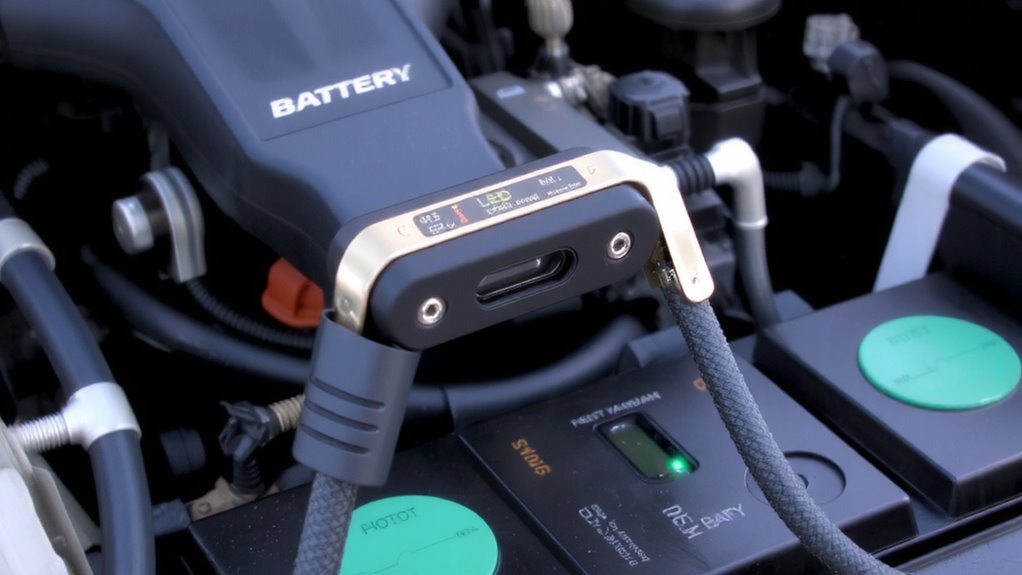
While your vehicle sits idle, the battery slowly loses charge due to natural self-discharge and parasitic drain from onboard electronics. A battery maintainer prevents this by delivering a low, regulated current that matches the battery’s self-discharge rate. Unlike standard chargers, it won’t overcharge because it monitors voltage and stops when the battery reaches full capacity. This is essential for preserving battery chemistry, especially in lead-acid and AGM types, which degrade faster if left partially charged. Frequent deep discharges also shorten charging cycles, reducing lifespan. A maintainer keeps the charge between 12.4V and 12.7V, ideal for long-term storage. It simulates continuous driving conditions, preventing sulfation-the buildup of lead sulfate crystals that impair performance. By stabilizing voltage and minimizing unnecessary charging cycles, the device extends battery life by up to three years. You simply connect it and forget it-no monitoring needed.
Hook Up Your Battery Maintainer the Right Way
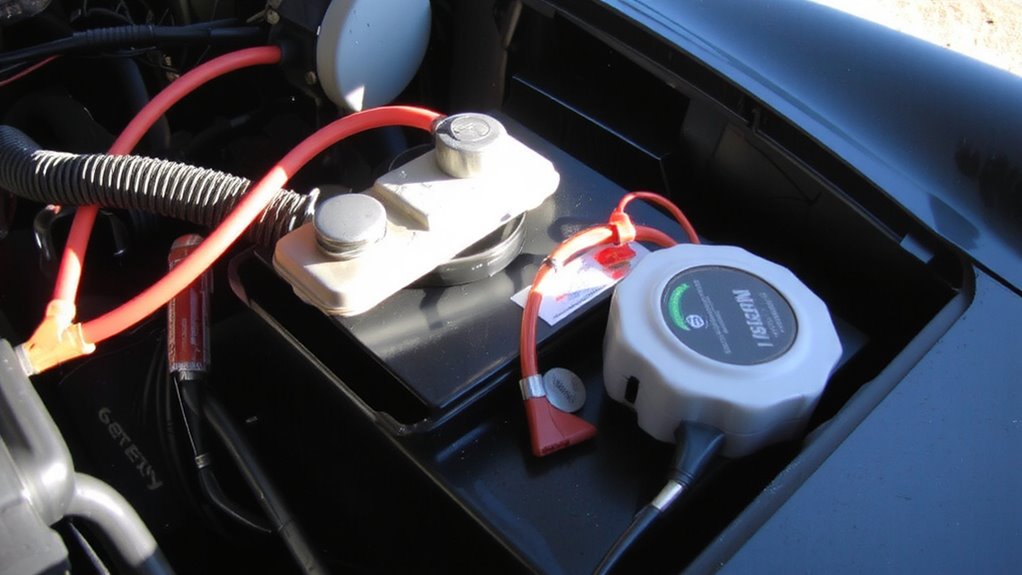
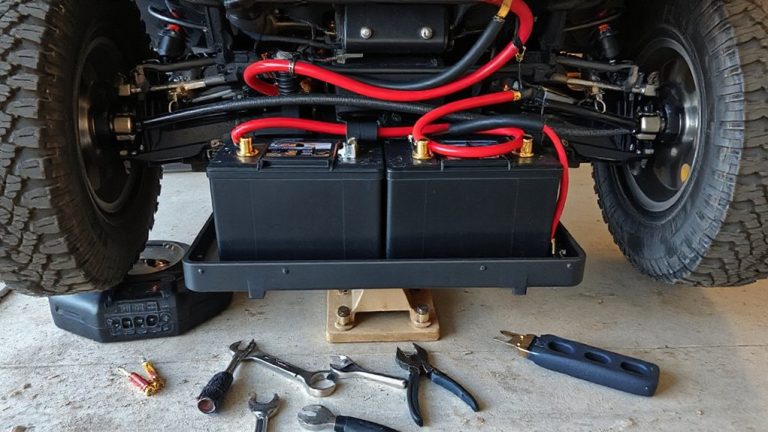
Since improper connection can damage your battery or create a safety hazard, always follow the correct sequence when hooking up your battery maintainer. Begin by turning off the charger. Connect the positive (red) clamp to the battery’s positive terminal first-this guarantees proper polarity. Then attach the negative (black) clamp to the negative terminal or a solid metal ground point away from the battery. Proper polarity prevents reverse charging, which can destroy the battery or damage onboard electronics. Secure connections are critical-loose clamps increase resistance, generate heat, and reduce charging efficiency. Use only clean, corrosion-free terminals for best results. Most maintainers output 1.5 to 2 amps at 12 volts, delivering a slow, controlled charge. The correct hook-up sequence protects both you and your battery, guaranteeing safe, reliable maintenance over weeks or months. For optimal long-term performance, consider pairing your maintainer with one of the best 12-volt batteries available, such as those highlighted in top-rated battery comparisons.
Choose the Right Battery Charger for Your Car
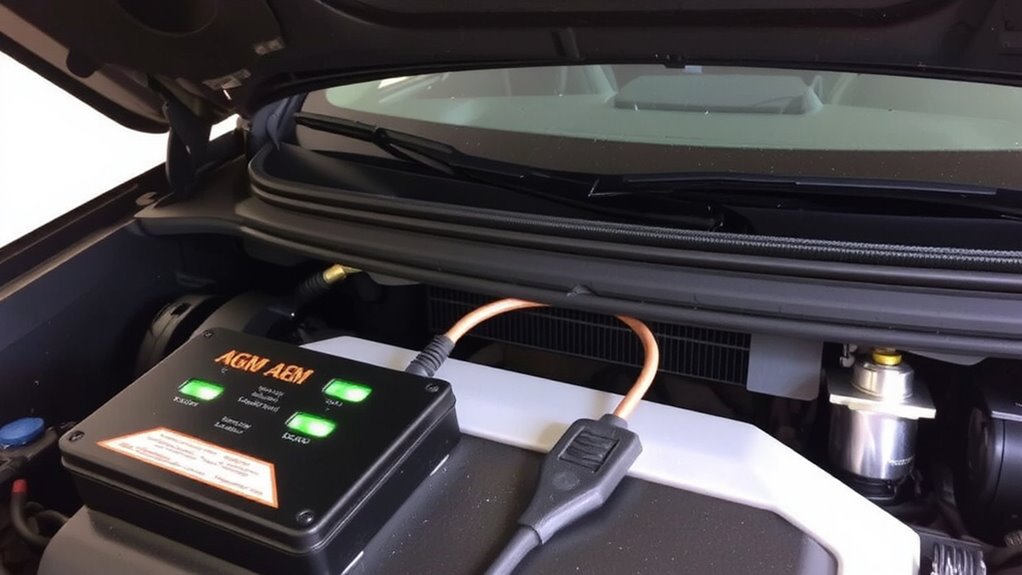
If you want your car battery to stay in top condition without risking damage, picking the right charger matters more than most realize. You must guarantee charger compatibility with your battery type-lead-acid, AGM, or gel-since using the wrong charger can cause irreversible damage. Most modern chargers support multiple chemistries, but always verify before connecting. Set the correct voltage settings: 12 volts for standard car batteries, not 6 or 24. A charger with automatic voltage detection reduces error risk. Look for models with microprocessor control that adjust output based on charge level. Chargers offering trickle, float, and desulfation modes extend battery life. Avoid old, non-regulated models-they overcharge easily. Prioritize smart chargers with safety features like reverse polarity and short-circuit protection. Proper selection prevents undercharging and thermal runaway, preserving capacity over time. For reliable performance, consider one of the Best 12-Volt Batteries that pairs well with advanced chargers to maximize longevity.
Debunking 5 Dangerous Battery Maintainer Myths
When it comes to keeping your car battery in peak condition, relying on outdated or incorrect information can lead to costly damage-so it’s critical to clear up common misconceptions about battery maintainers. One myth is that they cause battery explosions; modern maintainers use smart circuitry to prevent overcharging, reducing explosion risks considerably. They operate at 1.5 to 2 amps and switch to float mode at 13.6 volts, maintaining safe charge levels. Another false claim is that they increase corrosion risks; in reality, proper voltage regulation minimizes gassing, which reduces acid buildup and terminal corrosion. A third myth involves damage to vehicle electronics-maintainers are designed with reverse polarity protection and surge suppression. They’re also fully automatic, eliminating user error. High-quality models meet UL 2056 safety standards, ensuring safe, long-term connection without hydrogen gas accumulation or thermal runaway. You can trust these devices to protect both battery and vehicle.
Can You Leave a Battery Maintainer On Too Long?
While modern battery maintainers are built for long-term use, leaving one connected indefinitely requires understanding the device’s charging stages and safety mechanisms. You can leave a quality maintainer on for weeks or months without overcharging risks-thanks to automatic float mode. Once your battery reaches full charge, typically around 14.4 volts, the maintainer switches to a lower maintenance voltage of about 13.6 volts. This prevents overcharging risks by reducing current flow. Advanced models monitor battery conditions and adjust output to avoid voltage spikes. These spikes, if present, can damage sensitive electronics or degrade battery plates over time. Maintainers with microprocessor controls use three-stage charging: bulk, absorption, and float. Each stage guarantees suitable voltage regulation. As long as your unit has safety certifications and automatic shut-off or float mode, continuous connection is safe and effective.
Best Ways to Store Your Car Battery Long-Term
Your car’s battery health during long-term storage hinges on proper preparation and the right equipment. First, fully charge the battery before storage-ideal to 12.6–12.8 volts. Store it in a cool, dry place with temperature control; ideal temperatures range from 32°F to 77°F (0°C to 25°C) to minimize self-discharge and prevent freezing or overheating. Avoid concrete floors unless the battery is sealed, as older models could discharge faster. Guarantee proper ventilation around the battery to disperse any hydrogen gas emitted during charging or storage. Use a smart battery maintainer that automatically cycles to keep voltage ideal without overcharging. A compatible and efficient option is a lithium battery charger, which ensures safe and optimal charging for modern lithium-based automotive batteries. Disconnect parasitic drains by removing the negative terminal if not using a maintainer. Check voltage every six weeks if stored long-term. With these steps, you preserve capacity and avoid sulfation, extending battery life markedly.
Fix Common Battery Maintainer Problems Fast
Why does your battery maintainer seem ineffective despite being connected? You might be facing simple issues like loose clamps or corroded terminals. Start with troubleshooting connections-ensure the positive and negative leads are securely attached to the correct battery terminals. A loose or dirty connection can prevent proper current flow. If the maintainer not charging, check the power source and LED indicators. Most maintainers operate at 1.5–2.5 amps; no light means no power delivery. Verify the outlet and fuse. Below is a quick-reference table:
| Issue | Solution |
|---|---|
| No LED light | Check outlet, fuse, and power supply |
| Maintainer not charging | Inspect clamps and cable integrity |
| Intermittent operation | Clean battery terminals and tighten connections |
| Overheating unit | Disconnect; verify compatibility with battery type |
| Incorrect voltage output | Use a multimeter to test output (should be 13.6–14.4V) |
On a final note
You preserve battery health with consistent voltage regulation. A quality maintainer delivers 1.5 to 2.0 amps at 12.8 to 14.4 volts, preventing sulfation. Continuous use is safe-modern units auto-switch to float mode at 13.2–13.8 volts. Connect directly to terminals, ensuring polarity alignment: red to positive, black to negative. Lithium or AGM batteries require specific charging profiles. Proper setup maintains charge without overvoltage. Storage at 50–70°F optimizes longevity.