Understanding the Function of the Exhaust Pipe Muffler in Modern Vehicles: How It Affects Sound Quality and Overall Vehicle Handling Characteristics Through Its Design and Material Composition
Your muffler reduces engine noise by 15 to 30 dB using chambers, baffles, and fiberglass packing to cancel sound waves. It shapes exhaust tone and flow with tuned resonators and straight-through or chambered designs. Larger cores (2.25–3.5 inches) cut turbulence and backpressure, improving throttle response. Stainless steel lasts over 10 years; aluminized steel offers 5–7 years. Ideal backpressure (1.5–2.5 psi) aids scavenging. Upgraded designs boost power by 5–15 hp. Further details reveal how each component fine-tunes performance.
Notable Insights
- Mufflers reduce engine noise by 15–30 dB using chambers, baffles, and sound-absorbing materials to disrupt exhaust resonance.
- Internal design elements like chamber size and baffle placement shape exhaust tone by targeting specific sound frequencies.
- Straight-through muffler designs with larger core diameters minimize flow turbulence and improve exhaust scavenging efficiency.
- Stainless steel mufflers offer superior durability, resisting corrosion and heat up to 1,500°F, extending service life beyond 10 years.
- Performance mufflers reduce backpressure by up to 40%, increasing horsepower and throttle response while maintaining street-legal noise levels.
What a Muffler Does in Your Exhaust System
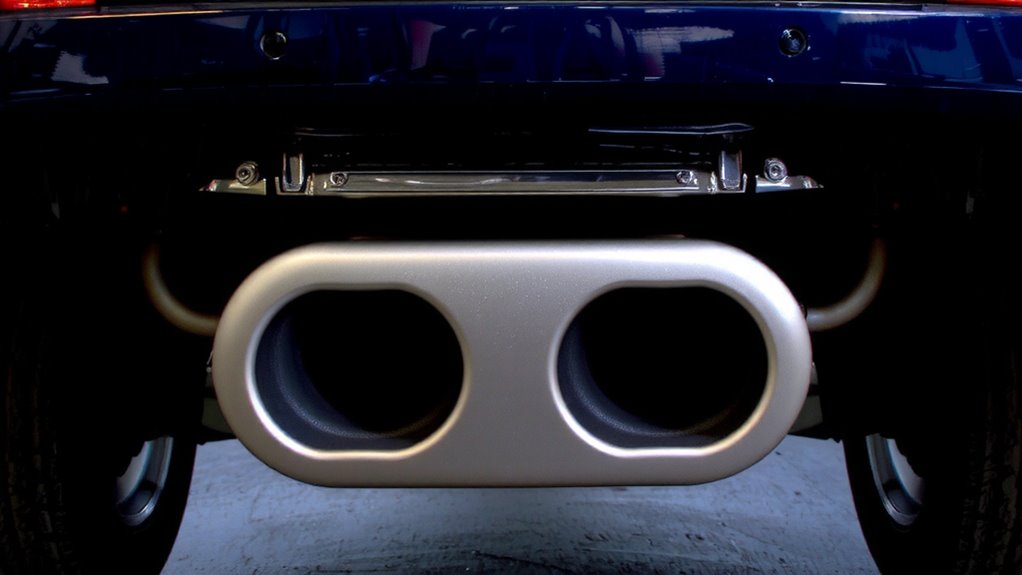
A muffler is a critical component in your vehicle’s exhaust system, engineered to reduce engine noise. It achieves this through precise noise cancellation techniques that counteract sound waves produced by combustion. As exhaust gases exit the engine, they create pressure pulses that generate exhaust resonance-a natural vibration at specific frequencies. The muffler disrupts these sound waves using internal chambers, baffles, and perforated tubes tuned to reflect and dissipate acoustic energy. Most modern mufflers use absorption and reflection principles, combining fiberglass packing and resonator sections to weaken sound intensity. This process reduces decibel levels by 15 to 30 dB, depending on design. Effective noise cancellation improves cabin comfort and guarantees compliance with legal noise standards. You rely on the muffler daily, even if you never hear its success. Without it, engine noise would overwhelm the driving experience.
How Muffler Design Affects Sound and Exhaust Flow
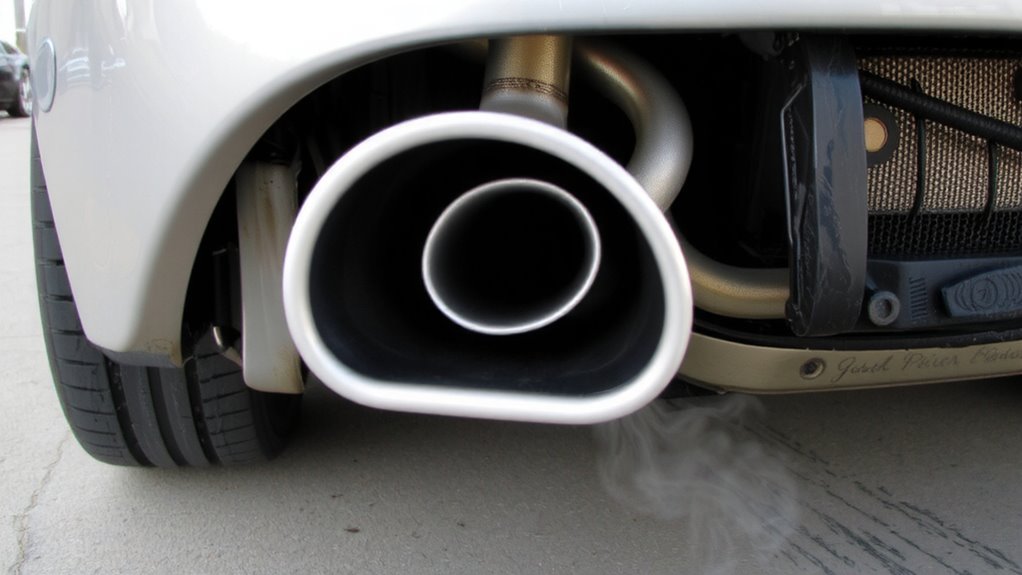
You hear the rumble of an engine not just because of combustion, but because of how the muffler shapes that sound. Muffler design controls noise through chamber resonance, where sound waves reflect and cancel each other inside tuned chambers. A well-designed muffler uses specific chamber sizes and baffle placements to target frequencies, reducing drone and harshness. Internal tubes and perforations manage flow turbulence, which occurs when exhaust gases change speed or direction abruptly. High turbulence increases backpressure, hurting engine efficiency. Smooth changes and larger diameters-typically 2.25 to 3 inches-minimize disruptions. Straight-through designs reduce turbulence better than reverse-flow models. Chamber resonance and flow turbulence together influence both sound quality and exhaust flow. Balancing these factors allows ideal performance, ensuring noise reduction without sacrificing power.
Stainless vs. Aluminized Steel: Durability and Performance Differences
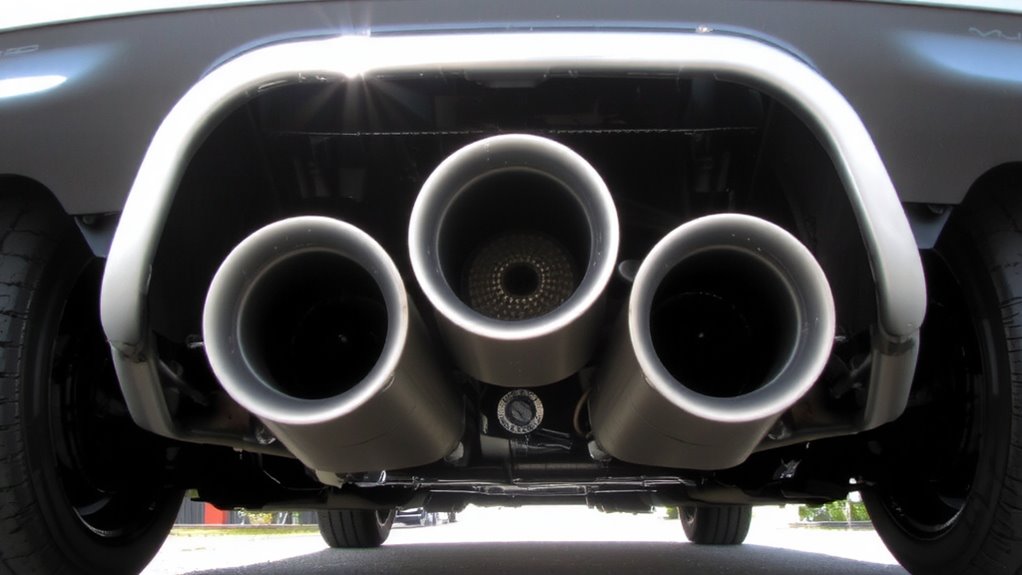
Over 90% of modern exhaust systems rely on either stainless or aluminized steel, each offering distinct trade-offs in longevity and performance. You’ll find stainless steel lasts longer, often exceeding 10 years, thanks to superior corrosion resistance and high heat tolerance up to 1,500°F. It contains at least 16% chromium, which forms a protective oxide layer. Aluminized steel, meanwhile, uses a thin aluminum-silicon coating over carbon steel, providing decent heat tolerance up to 1,200°F but less corrosion resistance. It typically lasts 5 to 7 years, especially in humid or salty environments. While aluminized is cheaper and widely used in stock systems, stainless handles exhaust heat and moisture more effectively. Upgraded systems often use 409-grade stainless for the balance of cost and durability. Your choice impacts maintenance frequency and long-term reliability.
How Backpressure Influences Fuel Economy and Throttle Response
Though often overlooked, backpressure plays a critical role in shaping both fuel economy and throttle response in modern exhaust systems. Too much backpressure restricts exhaust flow, forcing your engine to work harder and reducing fuel efficiency. However, some backpressure is necessary for ideal low-end torque and exhaust scavenging. Proper pulse tuning uses exhaust gas pulses to create low-pressure waves that draw out subsequent exhaust gases, improving cylinder evacuation. This enhances combustion efficiency and increases throttle responsiveness. Performance exhaust systems aim for a balanced 1.5 to 2.5 psi backpressure at wide-open throttle. Below this range, you lose scavenging benefits; above it, power and fuel economy drop. Muffler design directly affects this balance by altering flow dynamics. You need enough restriction to support pulse tuning, but not so much that it hampers exhaust scavenging or engine breathing under load.
Performance vs. Stock Mufflers: Sound, Power, and Efficiency Compared
What if your muffler could do more than just quiet the engine-what if it could release hidden performance? Performance mufflers are engineered for higher exhaust flow, reducing backpressure by up to 40% compared to stock units. This improves horsepower by 5–15 hp, depending on engine size and configuration. Stock mufflers restrict flow to dampen sound, often using baffles and absorptive materials that hinder efficiency. Performance models use straight-through or chambered designs with larger core diameters (typically 2.5–3.5 inches) for greater throughput. They’re ideal for custom tuning, enhancing throttle response and power bands. In racing applications, stainless steel or aluminized steel construction guarantees durability under extreme heat. While stock mufflers prioritize quiet operation, performance variants balance sound-offering a deep, aggressive tone-without sacrificing fuel efficiency. Sound levels increase moderately, from 75 dB stock to 85–90 dB, meeting most street-legal standards. For example, top GR86 owners often see noticeable gains when installing a best GR86 exhaust system.
On a final note
Your muffler controls sound and optimizes exhaust flow. It uses tuned chambers and perforated tubes to cancel sound waves, reducing noise by 20–40 decibels. Design impacts backpressure; performance models lower it by up to 1.5 psi, improving throttle response. Stainless steel lasts 10–15 years versus aluminized steel’s 5–7. Less backpressure can improve fuel economy by 1–2 mpg. Stock units favor quiet operation; performance mufflers trade noise for flow.