How to Choose Wheels With High Load Ratings for Heavy SUVS
Choose wheels rated for at least 2,500 pounds per wheel to match your heavy SUV’s GVWR. Load index numbers like 110 (2,337 lbs) indicate max capacity-never go below OEM specs. Steel wheels, 5–7 mm thick, handle impact better; aluminum saves weight but can crack under hard hits. Pick 17–20 inch sizes with correct bolt patterns like 6×135 or 8×165.1. Confirm JWL or VIA certification stamped on the back-this proves fatigue and radial load testing. Stronger ratings prevent cracks and failure.
Notable Insights
- Match wheel load ratings to your SUV’s GVWR, ensuring each wheel supports its share of the total weight.
- Choose a load index of 100 or higher, with 110 supporting 2,337 lbs per tire for heavy-duty capacity.
- Select wheels with JWL or VIA certification to verify proven strength and fatigue resistance under load.
- Prefer steel wheels for impact resistance or forged aluminum for lightweight strength in heavy-duty applications.
- Ensure correct bolt pattern, backspacing, and tire clearance to maintain stability and prevent clearance issues.
Understand Your SUV’s Load Index and Weight Limits
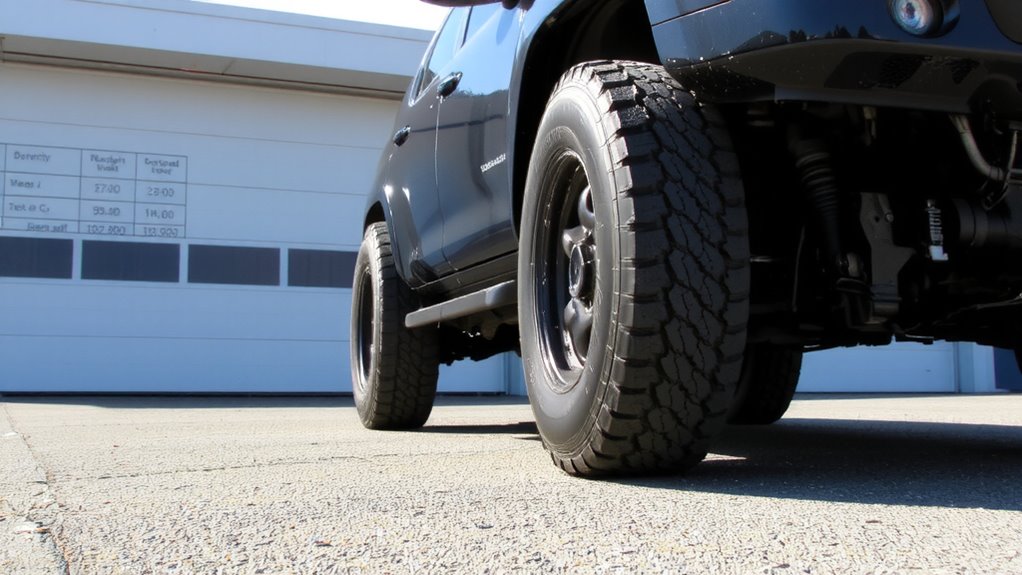
While your SUV might seem built to handle almost anything, exceeding its load index or weight limits can lead to dangerous tire failure or poor handling. Every SUV has a specified maximum load capacity, documented on the placard inside the driver’s door. Staying within this limit guarantees structural integrity and safe performance. Maintaining correct tire pressure is essential-it directly affects load-bearing capability. Underinflated tires overheat and degrade faster, especially under heavy loads. Proper cargo distribution also prevents uneven stress across axles, which can compromise stability. Load index ratings, typically between 100 and 120 for heavy SUVs, indicate how much weight each tire can carry. For example, a load index of 110 equates to 2,337 pounds per tire. Always balance payload with manufacturer specs. Ignoring these factors risks blowouts, reduced braking efficiency, and loss of control, particularly on long hauls or hot days.
Match Wheel Load Ratings to Your Vehicle’s Requirements
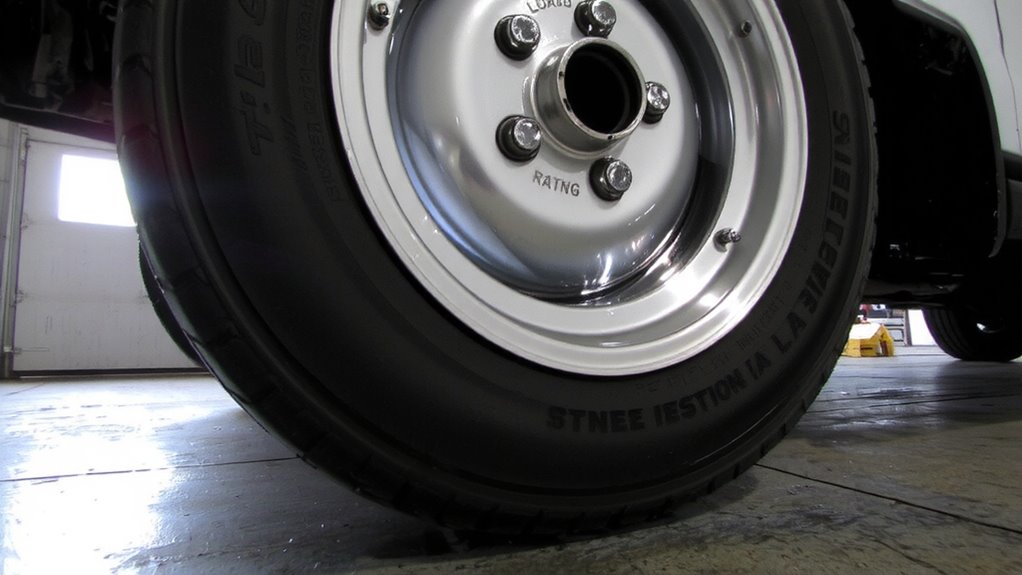
Since your heavy SUV relies on proper load distribution for safety and performance, you need wheels with load ratings that meet or exceed the vehicle’s specified requirements. Each wheel must support a portion of the gross vehicle weight rating (GVWR), so mismatched load ratings compromise structural integrity. Proper load distribution prevents uneven stress on axles and suspension components. Wheels rated too low increase the risk of material fatigue, especially under sustained heavy loads or high temperatures. Material fatigue can lead to microscopic cracks, particularly around the bolt pattern and spokes, which may progress to wheel failure. Load ratings are measured in pounds per wheel-common ratings for heavy SUVs range from 2,500 to 3,500 lbs. Always verify the load index matches your OEM specifications. Exceeding minimum ratings enhances durability without sacrificing performance.
Compare Steel vs. Aluminum for Heavy-Duty Performance
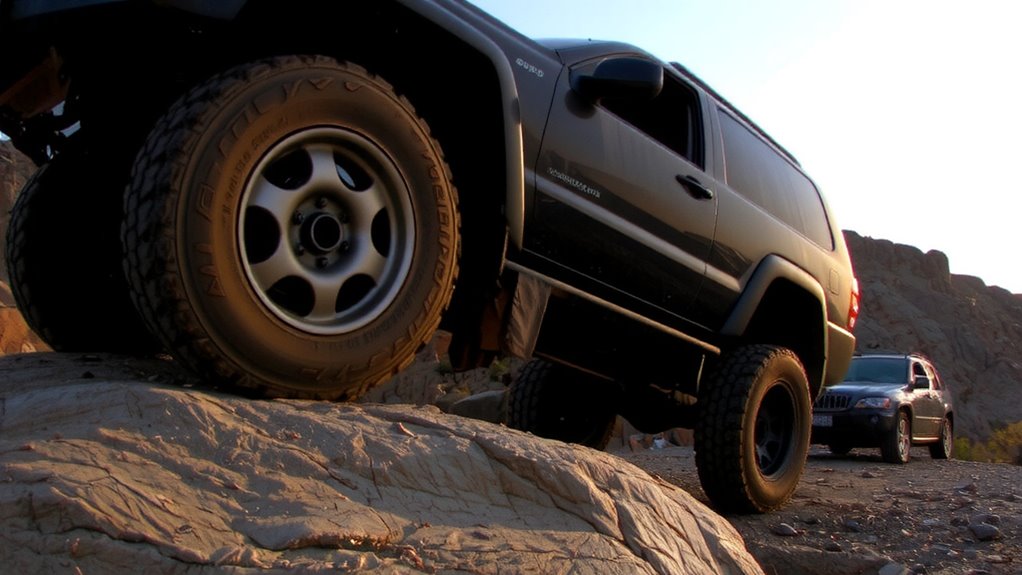
Steel and aluminum wheels perform differently under the stress of heavy-duty SUV use, so your choice impacts long-term durability and capability. Steel wheels handle extreme loads and rough terrain better due to superior impact resistance. They’re typically thicker-around 5 to 7 millimeters in critical sections-and bend before breaking, making them ideal for off road durability. Aluminum wheels are lighter, improving fuel economy and acceleration, but they’re more prone to cracking under abrupt impacts. Forged aluminum variants offer better strength but come at a higher cost. Cast aluminum wheels, while common, have lower tolerance for sudden shocks. Steel’s malleability allows it to absorb punishment without catastrophic failure, a key factor when traversing rocky trails or uneven surfaces. If you prioritize off road durability and impact resistance over aesthetics and weight savings, steel is the more reliable choice for heavy-duty applications.
Pick the Right Wheel Size for Strength and Stability
A 17- to 20-inch wheel diameter is often ideal for heavy SUVs, balancing strength, stability, and ride quality under demanding conditions. Larger wheels can compromise durability, while smaller ones may limit tire clearance and load capacity. Always match your wheel’s bolt pattern to your SUV’s specifications-common configurations include 5×120, 6×135, or 8×165.1 mm. Incorrect fitment risks alignment and safety. Top SUV rims are designed to meet these demands while enhancing both performance and aesthetics. Ensure adequate tire clearance to prevent rubbing under heavy loads. Wheel backspacing affects handling and suspension clearance-verify compatibility.
| Diameter (in) | Bolt Pattern (typical) | Max Tire Clearance (in) |
|---|---|---|
| 17 | 6×135 | 32.5 |
| 18 | 5×120 | 33 |
| 20 | 8×165.1 | 34 |
| 19 | 6×139.7 | 33.5 |
| 20 | 5×114.3 | 34 |
Check for Load-Safe Wheel Certifications (JWL/VIA)
Safety starts with certification-when it comes to carrying heavy loads, your wheels must meet strict industry standards. Look for JWL or VIA certifications, which confirm a wheel passed rigorous load testing and stress analysis. These ratings mean each wheel endured forces exceeding real-world conditions, simulating potholes, bumps, and sudden impacts. JWL, a Japanese standard, requires wheels to handle 900 kg (1,984 lbs) of radial load and pass fatigue testing for 100,000 cycles. VIA certification goes further, mandating both radial and lateral load testing under controlled lab conditions. Certified wheels undergo detailed stress analysis to identify weak points in design or materials. You can trust these ratings-they’re not just labels, they’re proof of engineering integrity. Always verify the certification mark stamped on the back of the wheel. Without JWL or VIA, you’re guessing whether the wheel can safely support your SUV’s loaded weight-don’t take that risk.
Skip These Common Upgrades That Risk Load Safety
Beware the allure of flashy designs and lightweight builds-some upgrades compromise the very strength your heavy SUV depends on. Overlooked modifications like low-offset wheels or reduced spoke count weaken load-bearing capacity. Many unsafe aftermarket parts lack JWL/VIA certification, meaning they haven’t passed rigorous load and impact testing. Never sacrifice load rating for style; your SUV’s gross vehicle weight rating (GVWR) demands wheels rated to exceed it-typically Load Range E or higher. Aluminum wheels with insufficient thickness (below 6mm in critical areas) risk cracking under sustained stress. Steel wheels below 18-gauge thickness warp under heavy loads. Always verify load ratings in manufacturer specs-not marketing copy. Using wheels with inadequate tensile strength (below 50,000 psi) increases failure risk. Stick to proven designs engineered for 6,000+ lbs per wheel. Skip the shortcuts-your load safety depends on it. A proper coolant type ensures optimal engine performance and longevity, especially under heavy load conditions.
On a final note
Choose wheels rated for your SUV’s exact load requirements. A wheel’s load index must meet or exceed your vehicle’s GVWR. JWL and VIA certifications verify strength under stress. Steel wheels handle heavy loads better but add weight. Aluminum offers lighter mass but requires thicker spokes and rims for equivalent durability. Match bolt patterns precisely-common sizes are 5×139.7mm or 6×139.7mm. Larger diameters reduce sidewall height, affecting ride and load capacity.