Creating a Monthly Maintenance Schedule for Stored Vehicles
Check fluids and test your battery monthly to prevent degradation. Engine oil loses viscosity over time, coolant can form sediment, and brake fluid absorbs moisture-keep it below 3.5% water content. Use a multimeter to confirm your battery holds at least 12.6 volts when resting. Top off tires to 32–35 psi to prevent flat spots, and move the vehicle every few weeks. Seal all entry points larger than 1/4 inch to block pests. Start the engine monthly and run it for 15 minutes to reach full operating temperature. This burns off condensation and recharges the battery through the alternator, which outputs 60–120 amps. Driving 10 miles occasionally helps maintain tire shape and brake function. Proper upkeep now guarantees reliable performance when you’re ready to use the vehicle again, with more details available on each step.
Notable Insights
- Check engine oil, coolant, brake fluid, and transmission fluid monthly for degradation or contamination.
- Test battery voltage monthly; ensure it reads at least 12.6V when resting.
- Inspect tire pressure monthly and inflate to manufacturer specs to prevent flat spots.
- Start the engine monthly and run until it reaches operating temperature to recharge the battery and burn off moisture.
- Move the vehicle every few weeks to maintain tire shape and prevent brake corrosion.
Check Fluids and Test the Battery Every Month
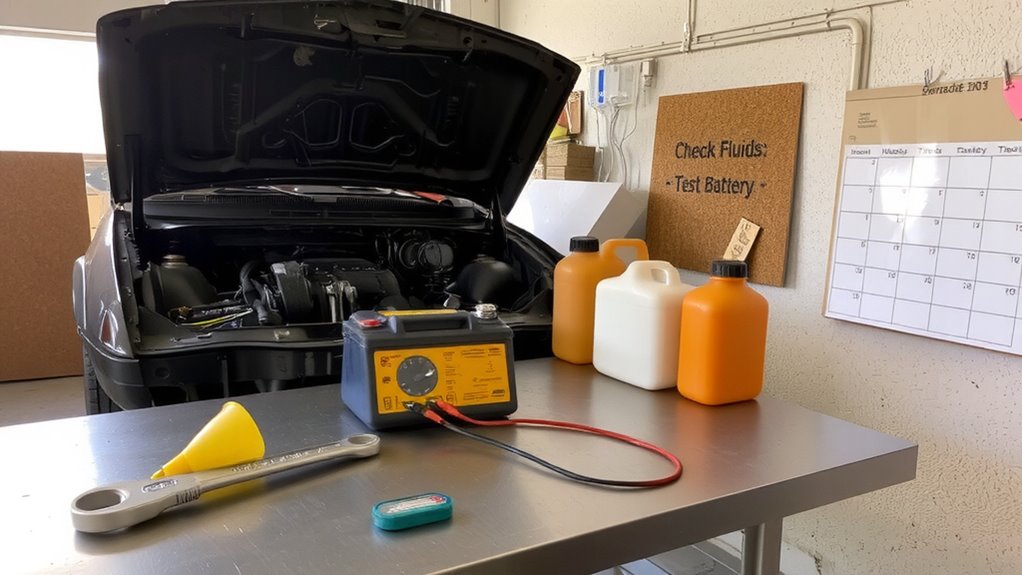
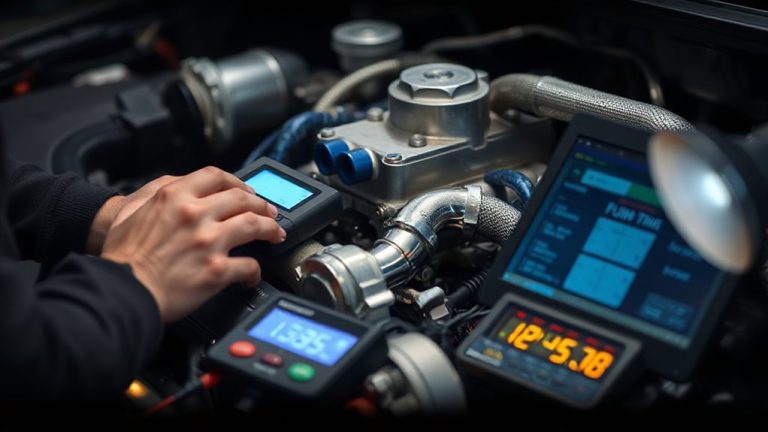
While time sits still for a stored vehicle, the fluids and battery don’t get a break. You must check fluid levels monthly to prevent internal damage. Engine oil degrades over time, losing viscosity and protective properties. Coolant can develop sediment, risking corrosion. Inspect brake fluid for moisture contamination-it’s hygroscopic and should be below 3.5% water content. Transmission and power steering fluids should be at manufacturer-specified levels and free of discoloration or sludge. Test the battery every 30 days. Voltage should read 12.6 volts or higher when resting. Clean battery terminals to remove corrosion, which increases resistance and reduces conductivity. Reconnect a fully charged battery after inspection. Use a maintenance charger with a float mode to avoid overcharging. These steps preserve critical systems and guarantee reliability upon restart. For best results, use a dedicated battery terminal cleaner to ensure thorough removal of corrosion and optimal electrical contact.
Inflate Tires and Prevent Flat Spots During Storage
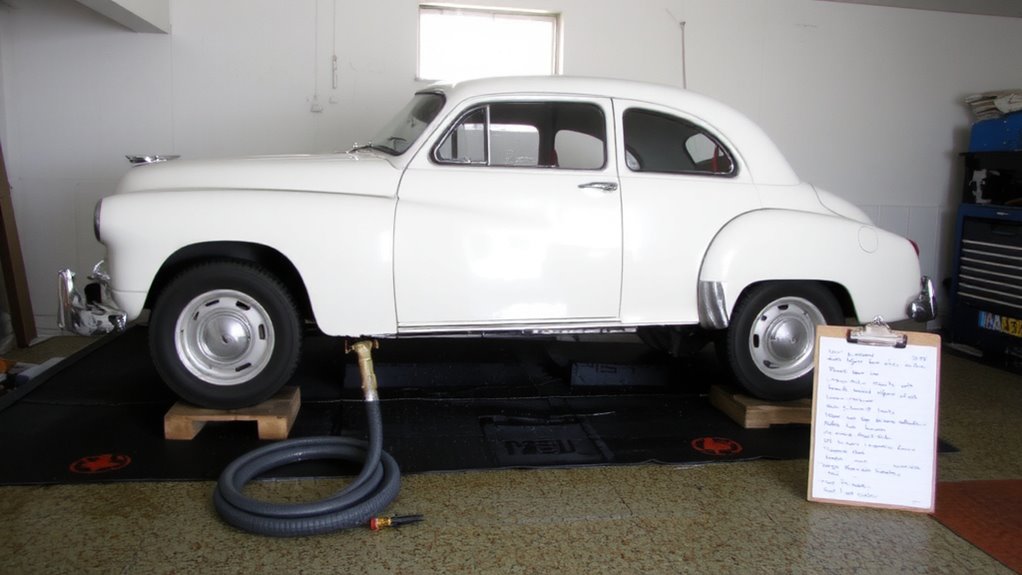
Since tires bear the full weight of a stored vehicle, they’re vulnerable to flat spots if left underinflated or motionless for too long. You should check tire pressure monthly, making certain it matches the manufacturer’s specification-usually 32 to 35 psi for passenger vehicles. Underinflation increases sidewall flex, accelerating flat spot formation. Overinflation, above 40 psi, risks bead damage and uneven wear. To prevent deformation, move the vehicle slightly every few weeks or use tire savers. Proper wheel alignment isn’t critical during storage, but misaligned wheels before storage can worsen pressure distribution. Misalignment causes uneven contact patches, promoting irregular wear. If your vehicle sits more than three months, inflate to recommended cold pressure and confirm alignment was correct before storage. This preserves tread integrity, makes certain safety, and extends tire life. For accurate readings, use a reliable tire pressure gauge when checking monthly inflation levels.
Seal Entry Points to Keep Pests Out
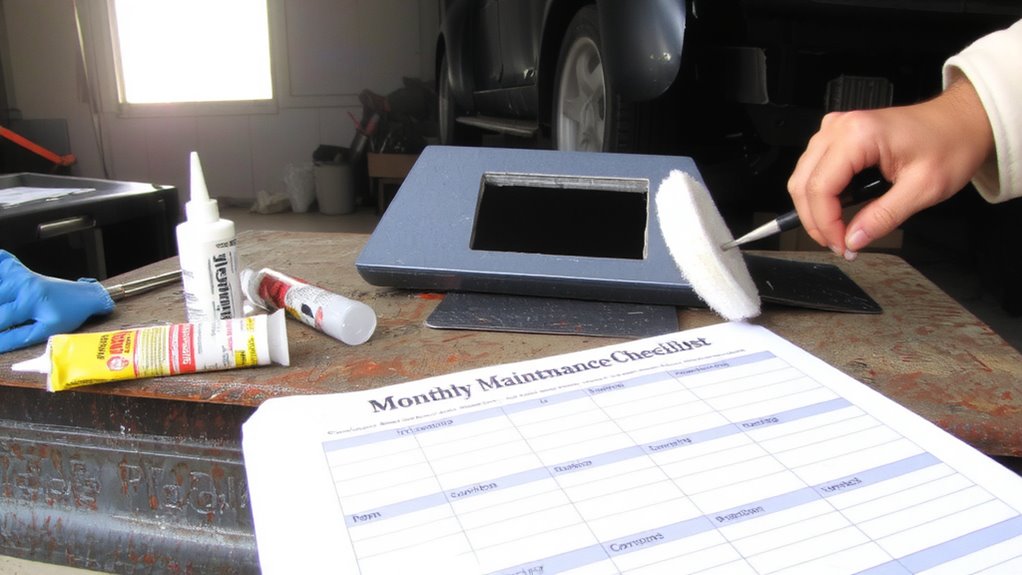
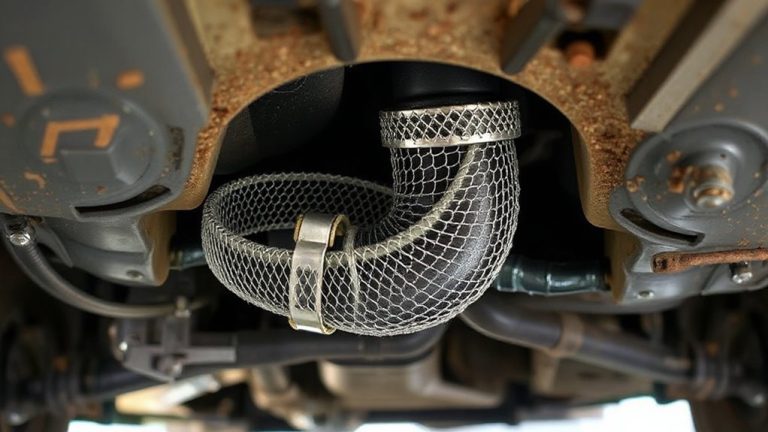
Rodents and insects can compromise your stored vehicle’s interior and wiring if given access, so blocking entry points is a necessary step in long-term storage prep. Rodent prevention starts with inspecting all seams, vents, and gaps larger than 1/4 inch-common access points. Seal them using steel wool, metal mesh, or automotive-grade foam inserts. Replace worn weather stripping around doors, hood, and trunk, as damaged seals create easy entry. High-quality EPDM rubber weather stripping resists UV rays and temperature extremes from -40°F to 250°F. Install adhesive-backed urethane barriers in cabin air intakes and firewall openings. Use HVAC vent covers or fine-mesh screens (minimum 18_mesh) on ducts. Conduct a flashlight inspection monthly, focusing on wheel wells and undercarriage grommets. Preventative sealing not only aids rodent prevention but preserves electrical integrity and cabin materials. Properly sealed entry points maintain environmental control inside the vehicle, reducing decay risks during inactivity.
Run the Engine and Recharge the Battery Monthly
Ideally, you should start the engine and let it run for at least 15 minutes once a month during storage. This guarantees proper engine warm up, reaching the ideal operating temperature of 180–200°F, which helps burn off moisture and prevents internal corrosion. Running the engine activates the alternator, enabling effective battery charging and maintaining a charge above 12.4 volts for 12V lead-acid batteries. Without regular use, batteries self-discharge at 1–2% per month, risking sulfation damage. A full charge typically takes 30–60 minutes of driving or idling, depending on alternator output (usually 60–120 amps). Always use a battery tender if the vehicle stays idle longer. Never rely solely on idling for battery charging unless the engine reaches full operating temperature. Regular engine warm up preserves lubrication integrity and guarantees fuel system functionality. To ensure accurate monitoring of your battery’s health, consider using one of the best battery testers for reliable results.
Move the Vehicle to Maintain Tire and Brake Health
Running the engine monthly keeps the battery charged and the internals protected, but staying stationary for months can still harm your vehicle’s tires and brakes. Flat spots can develop on tires due to constant pressure on the same contact patch. Moving your vehicle every 3–4 weeks prevents permanent deformation and tread damage. Ideally, drive it at least 10 miles to warm the tires and restore proper shape. This movement also aids in tire rotation, promoting even wear if you’re storing long-term. Perform a brake inspection while moving the vehicle-listen for scraping or grinding, which may indicate seized calipers or rust buildup on rotors. Moisture accumulation during storage can corrode brake components. Shifting the vehicle disrupts this process, maintaining brake pad and rotor integrity. Even short movements help preserve hydraulic pressure in the brake lines. Combine monthly driving with visual inspections to catch issues early.
On a final note
You must maintain stored vehicles monthly to prevent degradation. Check engine oil, coolant, and brake fluid levels; top off as needed using manufacturer-specified types. Inflate tires to 35–40 psi to prevent flat spots. Start the engine monthly, letting it reach 180°F operating temperature for 10 minutes. Recharge the 12-volt battery if voltage drops below 12.4V. Move the vehicle to relieve brake pressure and rotate tires. Seal cabin and hood openings with foam or mesh to block rodents.