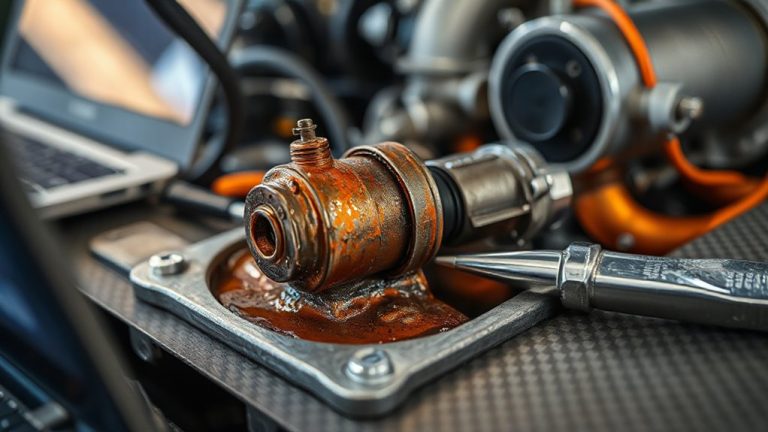
Troubleshooting Hot Start Issues Related to Fuel Pressure Regulators
Your engine won’t start when hot because a failing fuel pressure regulator can’t maintain 35–65 psi under high underhood temperatures. This causes fuel to pool or vaporize, flooding the engine or disrupting combustion. You might smell fuel or see black exhaust smoke. Check for wet spark plugs or fuel in the vacuum line-clear signs of regulator failure. Unlike vapor lock, pressure drops don’t resolve after 10 minutes with a bad regulator. Proper idle timing (10–14° BTDC) won’t matter if fuel pressure isn’t stable. Diagnose further to confirm.
Notable Insights
- A failing fuel pressure regulator can cause hot start issues due to low fuel pressure or fuel leakage into the intake.
- Check for fuel odor and wet spark plugs, which may indicate a ruptured regulator diaphragm or engine flooding.
- Test fuel pressure when hot; pressure below 35 psi or a drop >5 psi in 5 minutes suggests regulator failure.
- Distinguish vapor lock from regulator failure by observing if symptoms resolve after 10–15 minutes; regulator issues persist.
- Inspect the vacuum line connected to the regulator for fuel, confirming a damaged diaphragm and rich fuel condition.
Why Your Engine Won’t Start When Hot
Heat soak is the usual suspect when your engine refuses to start after running. High underhood temperatures cause fuel to vaporize in the lines, disrupting flow. You lose prime, and the engine cranks but won’t catch. Heat affects sensors and ignition timing, delaying spark events critical for combustion. Incorrect timing, even by 3–5 degrees, can prevent hot starts. Check your timing with a digital timing light and compare readings to factory specs-most engines need 10–14 degrees BTDC at idle. Perform a compression test to rule out mechanical failure; healthy cylinders show 135–160 psi with less than 10% variation. Low compression suggests valve damage from overheating. A proper test uses a calibrated gauge, wide-open throttle, and all spark plugs removed. While fuel pressure regulators may contribute, focus first on ignition timing and mechanical integrity. These diagnostics isolate the root cause efficiently.
Common Symptoms of a Bad Fuel Pressure Regulator
What makes your engine run rough or stall after warming up? A failing fuel pressure regulator is often the culprit. You’ll notice a rough idle, especially when the engine is warm. This happens because the regulator can’t maintain proper fuel pressure-typically 35–55 psi for most port-injected engines. When it leaks, excess fuel floods the intake manifold. That’s why you smell fuel odor around the engine or exhaust. The vacuum-controlled diaphragm inside the regulator may be ruptured, letting fuel enter the intake vacuum line. This rich fuel condition misfires the spark plugs and destabilizes combustion. Fuel isn’t burned efficiently, so emissions rise and performance drops. Black smoke from the tailpipe often accompanies these symptoms. Ignoring them risks damaging the catalytic converter. A bad regulator doesn’t just hurt starts-it harms running conditions, efficiency, and engine longevity.
Testing Fuel Pressure on a Hot Engine
How can you confirm whether fuel pressure drops when the engine’s hot? Use a fuel pressure gauge to test the system after reaching normal operating engine temperature. Attach the gauge to the fuel injection test port or rail. Run the engine, then shut it off-pressure should hold steady. Most systems require 35–65 psi, depending on the vehicle. If pressure drops more than 5 psi in five minutes, the regulator may be failing. High engine temperature can worsen weak seals, causing pressure bleed-down. This leads to hard hot starts because injectors don’t deliver enough fuel. Don’t test cold-results won’t reflect real-world conditions. The fuel system must stabilize at full operating temperature. Monitor the gauge as the engine cools slightly. A consistent drop points to regulator or check valve issues. Accurate testing guarantees you’re not replacing parts needlessly.
Inspecting for Fuel Leaks and a Flooded Engine
Still getting a no-start after checking fuel pressure? Inspect for fuel leaks and a flooded engine. A strong fuel odor under the hood suggests leakage or over-rich conditions. Check the fuel lines, regulator, and injectors for wetness or drips. If the engine floods, unburned fuel soaks the spark plugs, preventing ignition.
| Symptom | Likely Cause | Action | ||
|---|---|---|---|---|
| Fuel odor | Leaking regulator | Replace regulator | ||
| Wet spark plugs | Engine flooding | Clean or replace spark plugs | ||
| Hard start when hot | Exceed | Hard start when hot | Excess fuel in combustion chamber | Clear chamber, verify pressure |
Remove the spark plugs if needed-they should be dry and lightly tan. Wet, gasoline-soaked spark plugs confirm flooding. Let the cylinders dry, then retry. Make sure fuel pressure returns to zero after shutdown. Persistent pressure points to a faulty regulator.
Vapor Lock or Bad Regulator? How to Tell
Could vapor lock be masquerading as a faulty fuel pressure regulator? Yes-heat soak and high ethanol content often cause vapor lock, not regulator failure. Vapor lock occurs when fuel in the lines overheats, forming vapor bubbles that block flow. Modern fuels with 10–15% ethanol absorb more moisture and vaporize easier, increasing risk. A bad regulator typically causes low fuel pressure (below 35 psi on most port-injected systems), while vapor lock shows normal pressure when cold but erratic delivery when hot. If the engine cranks but won’t start after shutdown in high heat, wait 10–15 minutes-the symptom may resolve as components cool. Regulators fail due to diaphragm leaks or spring fatigue, not temperature swings. Use a fuel pressure gauge to monitor real-time readings; fluctuation over ±5 psi suggests mechanical failure, not vapor lock.
Replacing the Fuel Pressure Regulator
While you may suspect fuel system issues after diagnosing hot start problems, replacing the fuel pressure regulator requires careful preparation and the right tools. Disconnect the battery before starting to prevent accidental ignition. Relieve fuel pressure using the Schrader valve on the rail. Fuel contamination can damage the new unit, so inspect and flush the system if debris or dirt is present. Remove the vacuum hose and mounting bolts, then extract the old regulator. Install the new regulator with correct regulator orientation-ensure the fuel inlet, vacuum port, and return line align per manufacturer specs. Typical rail pressure should sit between 35–55 psi, depending on your engine. Use a new O-ring to seal the connection and prevent leaks. Reconnect all lines, restore power, and prime the system. Check for proper operation and pressure stability at idle and under load.
On a final note
You now have the tools to diagnose hot start issues linked to a faulty fuel pressure regulator. A properly functioning regulator maintains fuel pressure within 3–6 psi of the specified range. Deviations indicate failure. Inspect vacuum lines, test pressure when hot, and verify no fuel in the return line. Replace the regulator if pressure drops or leaks occur. This restores correct rail pressure, preventing flooding or vapor lock.