Trunk Lid Gas Strut Replacement Threshold Determined by Opening Effort
You’ll notice it takes more effort to lift your trunk lid when gas struts degrade past their replacement threshold. Struts typically rated at 500–900 Newtons lose lift capacity as internal nitrogen pressure drops. A 15% pressure loss reduces performance noticeably. When measured force falls below 80% of the original rating-around 400–720 N-replacement is required. Weak struts increase opening effort and create hinge strain. This gradual failure mode means signs build slowly, often going unnoticed until full malfunction occurs. You’re likely experiencing the early stages of this issue, and understanding the exact cause will clarify your next steps.
Notable Insights
- Opening effort increases noticeably when gas struts lose over 15% of internal pressure due to seal failure.
- A trunk lid requiring more than 15 pounds of lift force likely has struts below 80% of rated output.
- If the lid slams shut or can’t stay open at 90 degrees, replacement is needed.
- Uneven lift or one-sided effort indicates asymmetric strut wear, requiring paired replacement.
- Failed struts increase manual effort; when lift feels stiff or unbalanced, replace both units.
Why Your Trunk Feels Harder to Open
Most vehicles rely on two gas struts to support the trunk lid, and when one fails, you’ll immediately notice the difference. You now must lift nearly the full weight of the lid manually. A typical trunk lid weighs between 35 and 55 pounds, and without balanced strut assistance, opening becomes noticeably harder. Trunk seal friction increases resistance, especially in colder temperatures when rubber stiffens and binds against the body frame. Over time, hinge rust buildup restricts pivot movement, adding mechanical drag. Corrosion between hinge knuckles can increase required lift force by up to 15 pounds. Even minor misalignment from rust accumulation creates binding. These factors compound the effort needed, making it feel like you’re fighting the system. Regular inspection of seals and hinges helps reduce unnecessary resistance.
How Trunk Gas Struts Fail Over Time
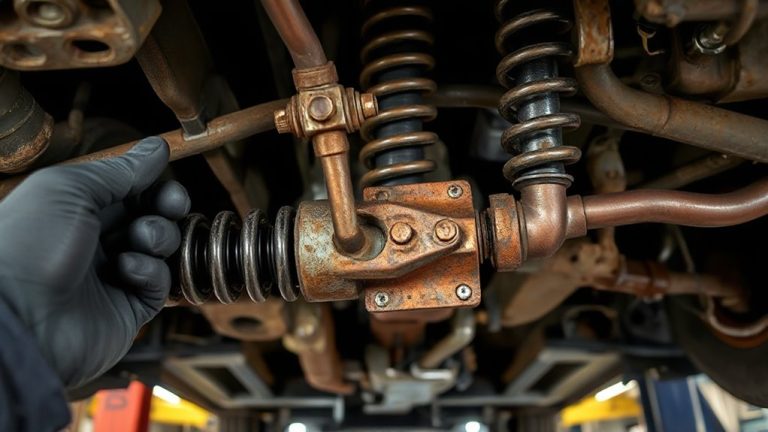
While they’re built to last, trunk gas struts eventually wear out from repeated use and environmental exposure. Over time, corrosion buildup on the chrome-plated rod restricts smooth operation and compromises the seal integrity. This corrosion acts like sandpaper, accelerating wear each time the strut extends or retracts. Inside, pressurized nitrogen gas and hydraulic fluid maintain lift force-typically 300 to 600 newtons per strut, depending on model specs. But with age, the piston seal failure allows gas to leak past the piston head, reducing internal pressure. Once pressure drops more than 15%, lift performance noticeably declines. Seal degradation often stems from temperature extremes, from -40°F to 250°F, common under vehicle hoods. Unlike sudden breaks, failure progresses gradually, diminishing assist force over hundreds of cycles. Even high-quality struts last only 75,000 to 100,000 cycles under ideal conditions.
5 Warning Signs Your Struts Are Worn Out
A single weak strut can reduce trunk lid support by up to 50%, and you’ll likely notice it the first time the lid won’t stay open on its own. You may hear suspension noise-metallic creaks or thuds-during opening, indicating failed gas pressure or loose mounting. Hinge stiffness often accompanies worn struts, as increased mechanical load shifts to pivot points. Struts typically last 50,000 to 70,000 cycles; beyond that, nitrogen leakage reduces damping force below 40 lbf, the threshold for reliable lift. The lid might slam shut unexpectedly or require one hand to hold it up-clear signs of insufficient extension force. Uneven gaps between the trunk and bodywork suggest asymmetric strut performance. While some resistance is normal, pronounced stiffness or noise during operation signals end-of-life wear. Replace both struts simultaneously to maintain balanced support and prevent premature wear on hinges or seals.
How to Test Trunk Strut Strength at Home
Trunk lid stability starts with strut integrity, and you can assess it in minutes using simple hands-on checks. DIY testing helps determine if struts provide adequate support. Close the trunk fully, then open it slowly and feel for smooth resistance. Weak struts cause uneven lift or sudden drops. For accurate force measurement, use a luggage scale to record extension force at full stroke.
| Test Method | Expected Result |
|---|---|
| Manual Lift Check | Smooth, controlled motion |
| Drop Test | No sudden closing |
| Scale Pull Test | Matches OEM force rating |
| Hold Position | Stays open at 90 degrees |
Compare results to manufacturer specs. If force measurement falls below 80% of rated output, replacement is needed. These checks guarantee reliable performance without tools.
Choose and Replace Trunk Struts the Right Way
You’ve tested your trunk struts and confirmed they’re below 80% of their rated force-now it’s time to select and install replacements correctly. Choose struts matching your original equipment manufacturer (OEM) specifications: force rating (measured in Newtons), stroke length, and mounting dimensions. Most passenger vehicles require 500–900 N per strut. Incorrect force values strain hinges and compromise trunk alignment. Install new struts slowly to avoid pinching. Secure end fittings tightly to prevent disengagement. After installation, check trunk alignment-uneven gaps or misaligned edges indicate improper fit or mounting. Misalignment accelerates weatherstrip wear and can stress the latch mechanism. Apply a silicone-based lubricant to hinges and pivot points; hinge lubrication reduces friction and prevents binding. Avoid grease, which attracts dirt. Properly installed struts last 5–7 years or 80,000 cycles. Replace both struts simultaneously to maintain balanced support.
On a final note
Your trunk lid should open smoothly with minimal effort. Worn gas struts lose nitrogen pressure over time, reducing lift force below the 200–300 N threshold needed for reliable operation. Most fail after 50,000 cycles or 5–7 years. Replace both struts simultaneously using OEM-specified force ratings and mounting dimensions. Proper replacement restores easy access and prevents lid droop. Test new struts by opening the trunk cold-smooth, controlled motion confirms correct performance.