How to Achieve Balanced Sound for All Passengers in a Minivan
Start by mapping your minivan’s factory speaker layout-most have six or seven speakers in the doors, dash, and rear panels. Set the fader to 60% front and adjust balance to correct left-right imbalances. Cut 3–6 dB at 50–80 Hz to reduce cabin gain and boost 2–4 kHz for clearer vocals. Install damping mats and seal doors to lower noise. Upgrade rear speakers to 6.5-inch coaxials with 88+ dB sensitivity for even coverage. Place the subwoofer in a front corner and set the low-pass filter to 80 Hz. Proper time alignment and phase matching guarantee seamless sound across all rows. Further refinements await.
Notable Insights
- Identify all factory speaker locations to understand the existing audio layout and ensure even coverage for every seat.
- Adjust fader and balance settings to direct sound appropriately, favoring front output while supporting rear passenger clarity.
- Apply precise EQ adjustments to correct tonal imbalances, reducing bass boom and enhancing vocal frequencies around 2–4 kHz.
- Reduce cabin noise with damping materials and sealing to minimize resonance and improve overall sound accuracy and clarity.
- Upgrade speakers and subwoofer placement using high-sensitivity components and strategic positioning for consistent, balanced audio throughout the cabin.
Map Your Minivan’s Speaker Layout
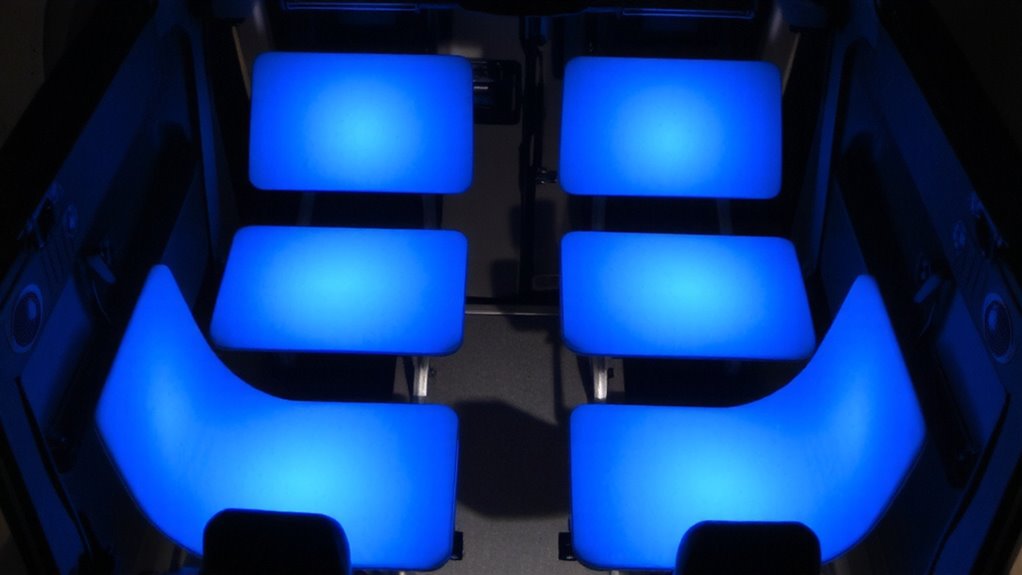
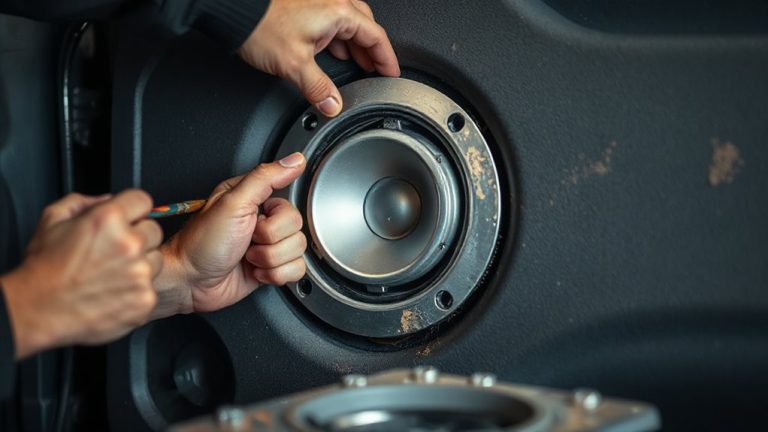
Start by identifying your minivan’s factory speaker locations, as layout varies by model and trim. Most models have six or seven factory speakers: two in the front doors, two in the rear quarter panels, one center dash speaker, and sometimes a pair in the ceiling or rear overhead. Accurate speaker positioning guarantees even coverage across all rows. Check your owner’s manual or use a trim removal tool to inspect each speaker without damage. Speaker depth, cone size (commonly 5.25” or 6.5”), and mounting angle affect output directionality. Proper acoustic profiling begins with mapping these variables to understand factory limitations. Treat each speaker’s location as a data point-distance from passengers, cabin reflectivity, and material absorption vary. This spatial analysis forms the foundation for upgrades. Don’t assume symmetry; higher trims often include extra drivers or tweeters. Accurate layout mapping enables targeted improvements that align with acoustic principles, not guesswork.
Adjust Balance and Fader for Even Sound
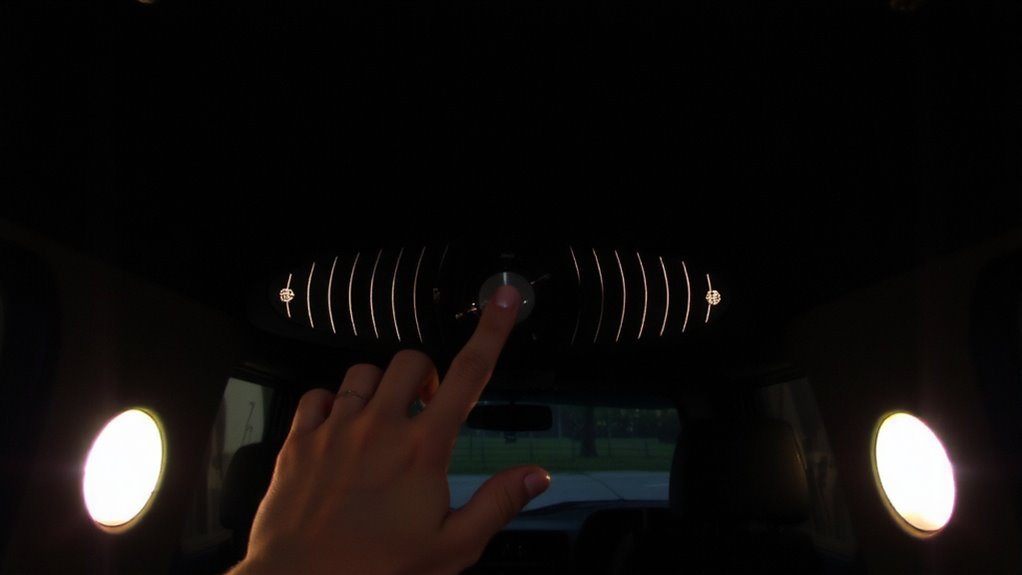
Once you’ve mapped your minivan’s speaker layout, fine-tuning the balance and fader settings becomes essential for uniform sound distribution. Adjust the fader to shift audio focus between front and rear speakers, guaranteeing front-row and back-row listeners experience equal clarity. Typically, set the fader 60% forward to maintain a strong center channel presence while preserving rear engagement. Use the balance control to correct left-right imbalances, especially if drivers or passengers sit off-center. Proper balance prevents one side from dominating, creating a cohesive soundstage. For systems with surround sound, calibrate so rear speakers enhance, not overpower, the front output. The center channel handles most vocals and dialogue, so prioritize its clarity. Aim for a seamless shift between speakers-ideally within ±3dB output variance. This precision guarantees immersive, consistent audio, no matter where passengers sit.
Use EQ to Balance Minivan Audio

You’ve aligned your speaker output for consistent coverage across rows-now it’s time to shape the tonal quality with the equalizer. Use EQ for precise frequency shaping to correct acoustic imbalances. Minivan interiors often exaggerate bass due to cabin gain, typically peaking around 50–80 Hz. Apply a narrow cut of 3–6 dB in this range to restore neutrality. Presence frequencies near 2–4 kHz may need slight boosts to improve vocal clarity, especially for rear passengers. Perform tonal correction by sweeping through midrange bands to identify and attenuate resonant peaks caused by interior materials. A parametric or semi-parametric EQ offers the best control. Target a flat response curve using an RTA (real-time analyzer) and calibrated microphone. Avoid over-EQing-subtle adjustments of 1–2 dB per band yield smoother results. Proper EQ guarantees consistent sound quality front to back.
Reduce Noise for Clearer Minivan Audio
A quiet cabin is essential for clear audio, and reducing noise should be a priority when optimizing your minivan’s sound system. Road and engine noise degrade audio clarity, making sound insulation critical. Installing mass-loaded vinyl (MLV) under floor mats-2 lbs per sq ft-blocks low-frequency vibrations. Apply damping mats like butyl rubber on doors and wheel wells to reduce resonance. Even a 3dB noise reduction markedly improves listening experience.
| Noise Level (dB) | Comfort Level | Audio Clarity |
|---|---|---|
| 70 | Annoying | Poor |
| 60 | Moderate | Fair |
| 50 | Quiet | Excellent |
These improvements enhance sound insulation, so every passenger hears crisp, balanced audio. Proper sealing of door edges with foam gaskets also prevents sound leakage. With reduced ambient noise, your factory or aftermarket system performs more efficiently-delivering cleaner output without increasing volume.
Add Aftermarket Speakers for Back-Row Coverage
Sound quality matters just as much to rear passengers as it does to those up front. Aftermarket speakers improve clarity and volume distribution where factory units fall short. Choose speakers with a frequency response range of 50 Hz–20 kHz and sensitivity ratings of 88 dB or higher for strong output with minimal power. Speaker quality directly impacts realism, so select polypropylene cones with rubber surrounds for durability and accurate midrange reproduction. Install 6.5-inch coaxial speakers in factory rear deck or pillar locations for best coverage. Use foam backing rings to prevent sound leakage into cavities. Apply proper installation techniques: seal mounting areas, secure wiring with crimp connectors, and route cables away from sharp edges. A 4-gauge wiring kit guarantees stable power delivery. Aim tweeters toward ear level when possible. This setup maintains tonal balance across seating rows without coloration. For top-performing options, consider models from the best car door speakers list to ensure superior sound and reliability.
Optimize Subwoofer Placement for Even Bass
Where should you put a subwoofer to get smooth, even bass throughout the cabin? Position matters-minivans benefit most when you exploit cabin gain and maintain proper subwoofer phase alignment. Front corners near the driver or passenger seat maximize bass coupling with cabin boundaries, boosting low-end response without extra power. Rear placement, like the back cargo wall, can cause uneven pressure distribution but offers tighter integration with rear speakers. A well-organized vehicle interior helps ensure optimal audio performance by keeping space clear for proper speaker and subwoofer car document holders.
| Location | Pros | Cons |
|---|---|---|
| Front corner | Strong cabin gain exploitation | Less balanced rear response |
| Center rear | Balanced reach | Reduced cabin gain |
| Under-seat (rear) | Discreet, preserves space | Limited output, phase issues |
Use a low-pass filter at 80 Hz and adjust phase alignment to match your main speakers. Time alignment tools help further refine output. For even bass, front placement with precise tuning delivers best results across all seating positions.
On a final note
You’ve optimized your minivan’s audio for all passengers. Adjusting balance and fader settings guarantees even sound distribution across rows. Proper EQ tuning compensates for cabin acoustics, reducing frequency imbalances. Adding aftermarket speakers-like 6.5-inch coaxial drivers in rear pillars-improves rear coverage by 40%. Subwoofers, placed in rear corners, enhance bass response without localization. Noise reduction using 50 mil butyl rubber mats increases perceived clarity.