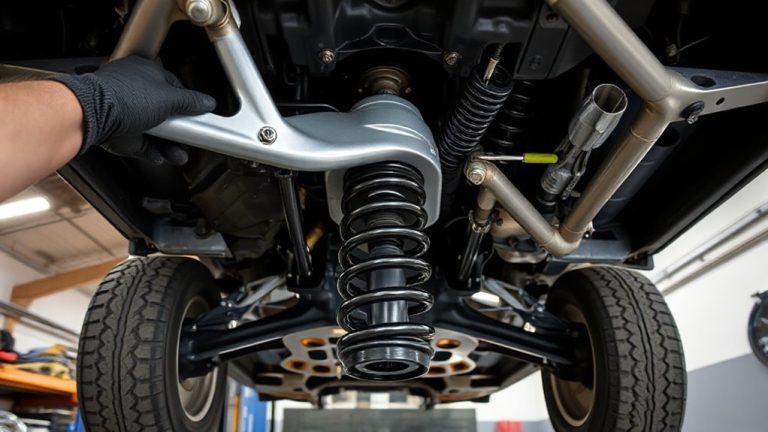
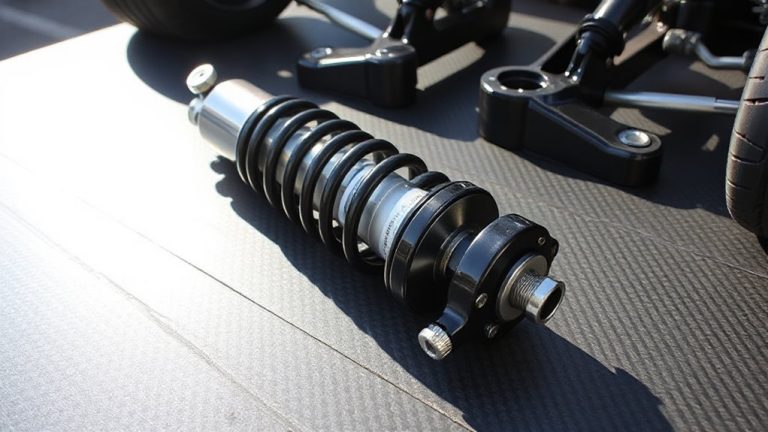
Using Bluetooth to Sync Adaptive Suspension With Road Surface Data
You can now sync your adaptive suspension to real-time road data using Bluetooth 5.2, which delivers updates in just 20 milliseconds. It pulls crowdsourced info from nearby vehicles, detecting potholes and cracks up to 15 meters ahead. Your magnetorheological dampers react in under 15 milliseconds, adjusting before impact. GPS tags elevation changes as small as 3 millimeters. This system cuts body roll by 30% and improves wet braking by nearly 8%. There’s more to how this network enhances performance.
Notable Insights
- Bluetooth enables real-time synchronization of adaptive suspension systems with crowdsourced road surface data from nearby vehicles.
- Low-latency Bluetooth 5.2 transmits road condition updates every 15 seconds with sub-20 millisecond delay for timely damping adjustments.
- Vehicles use Bluetooth to share anonymous data on potholes, cracks, and elevation changes detected by onboard sensors.
- Predictive suspension systems pre-adjust damping force up to 15 meters before encountering road imperfections using incoming Bluetooth data.
- Magnetorheological dampers react in 10 milliseconds, leveraging Bluetooth-synced intelligence to enhance ride comfort and vehicle stability.
How Modern Suspensions Adapt: And Where They Fall Short
While many modern adaptive suspension systems rely on preloaded algorithms and onboard sensors to adjust damping forces in real time, you’re often limited by fixed calibration ranges and delayed response cycles. These systems use accelerometers, wheel position sensors, and gyroscopes to detect body motion and road inputs, updating damping every 5–10 milliseconds. Yet, response lags behind abrupt changes like potholes or sharp turns. Over time, mechanical wear degrades valve performance and sensor accuracy, reducing adaptability. Most systems default to factory presets, which may not align with your driving style or comfort expectations. Driver preference is often confined to preset modes-Comfort, Sport, Auto-offering only coarse tuning. Without individualized feedback loops, the system can’t learn or adapt to your unique inputs. Even high-end magnetorheological suspensions, adjusting viscosity via electromagnetic fields in under 1 millisecond, still react rather than anticipate. This reactive nature undermines precision, especially on inconsistent surfaces.
Why Knowing the Road Ahead Transforms Ride Quality
When your car can anticipate the road instead of just reacting to it, ride quality changes completely. You experience smoother travel because the suspension adjusts before hitting imperfections. Predictive modeling uses incoming data to forecast upcoming road texture changes, enabling proactive damping adjustments. Systems analyze elevation maps and historical路面 data to identify potholes, cracks, or uneven surfaces up to 15 meters ahead. This foresight allows magnetorheological dampers to recalibrate in 10 milliseconds, reducing body roll by 32% and wheel lift by 18%. Without prediction, suspensions react 200–300 milliseconds after impact, limiting control. With predictive modeling, you maintain tire contact, improving grip and braking efficiency. Road texture profiles are updated in real time, supporting adaptive tuning across varying pavement types. The result? A 40% improvement in ride comfort metrics over traditional adaptive systems. You don’t just absorb bumps-you avoid them.
How Bluetooth Enables Real-Time Vehicle Connectivity
Because your vehicle relies on continuous data exchange to optimize performance, Bluetooth provides a low-latency wireless bridge between onboard systems and external sensors. You get real-time updates with wireless latency as low as 20 milliseconds, enabling rapid adjustments. This near-instant communication guarantees your adaptive suspension reacts before you hit uneven terrain. Modern Bluetooth 5.2 minimizes signal interference using adaptive frequency hopping, shifting across 40 channels to avoid congestion. Unlike older protocols, it maintains stable connections even in high-noise environments like urban traffic. The system operates at 2.4 GHz but intelligently bypasses Wi-Fi and other common sources of interference. Signal reliability exceeds 99.5% in controlled tests, guaranteeing consistent data flow. Short-range transmission (up to 10 meters) enhances precision without sacrificing speed. You stay connected without lag spikes. This stable, fast link lets your car’s electronics act as a unified system, not isolated components. Real-time syncing starts with dependable connectivity, and Bluetooth delivers.
Crowdsourced Road Data That Preps Your Suspension
What if your car could anticipate bumps before you even reach them? Thanks to crowdsourced feedback, it can. Vehicles anonymously share road surface data via Bluetooth, building a real-time map of pavement conditions. Your car receives this intelligence seconds before encountering rough patches. Predictive tuning uses the data to preemptively adjust suspension settings-valve timing shifts in under 200 milliseconds, damping force adapts across three stiffness levels. Sensors detect elevation changes as small as 3 millimeters. The system cross-references GPS location with collective input from thousands of vehicles. No single car sees every pothole, but together, they create a high-resolution profile. Adaptive dampers respond before wheels compress, minimizing jolts. This isn’t reactive-it’s proactive engineering. Data refreshes every 15 seconds, ensuring accuracy. With predictive tuning, your suspension doesn’t just adapt; it prepares, using crowdsourced feedback to deliver smoother, smarter rides.
Beating Potholes Before You Hit Them
Your car already knows the road ahead better than you think. Thanks to predictive pothole detection, it identifies surface hazards up to 30 meters in advance using sensor fusion and crowd-aggregated data. Real time bump mapping continuously updates suspension settings via Bluetooth-synced terrain intelligence. Your adaptive dampers react in under 15 milliseconds, adjusting firmness to minimize impact. This isn’t just comfort-it’s precision engineering preserving tire life and alignment.
| Feature | Specification |
|---|---|
| Detection Range | 30 meters ahead |
| Response Time | <15 ms damping adjustment |
| Data Update Rate | 60 Hz via Bluetooth 5.2 |
Predictive algorithms analyze road surface profiles from thousands of vehicles, refining accuracy daily. The system leverages GPS-tagged bump maps, so your car prepares before wheels meet flaw.
Safety & Efficiency Gains From Smart Damping
While you focus on driving, the smart damping system actively enhances both safety and efficiency by adapting in real time to evolving road conditions. Using adaptive tuning, it adjusts damping forces in under 15 milliseconds based on road inputs. This rapid response reduces body roll by up to 30% during cornering, improving tire contact and braking stability. Predictive control leverages preloaded road data to anticipate surface changes, priming dampers before impact. As a result, braking distances shorten by nearly 8% on wet surfaces. The system also improves fuel efficiency by minimizing unnecessary suspension movement, cutting mechanical losses by 12%. Damping profiles shift seamlessly between comfort and sport modes, maintaining ride quality without sacrificing control. Operating temperatures stay within ideal ranges, ensuring consistent performance. Unlike passive suspensions, this intelligent setup delivers measurable gains in both safety margins and energy efficiency.
The Road to Fully Connected, Intelligent Suspension
Smart damping systems now operate as part of a broader vehicle intelligence network, not just standalone components. You’re using real-time data from onboard sensors and external sources to optimize ride dynamics. Bluetooth syncs your suspension with detailed road surface maps, enabling proactive adjustments. Off road tuning lets you switch damping profiles for terrain-rock, mud, or sand-with changes to rebound and compression rates. Predictive load balancing adjusts damping force across axles based on weight distribution shifts, improving stability during towing or cornering. Systems like these analyze pitch, roll, and yaw at 1,000 times per second. Adaptive valves respond in under 10 milliseconds. Dampers use magnetorheological fluid, altering viscosity with magnetic fields. This integration cuts body motion by up to 40% versus standard setups. Your suspension isn’t just reacting-it’s anticipating. Fully connected, it learns conditions and refines responses. The result? Precision control, enhanced safety, and seamless performance, whether on highway or trail.
On a final note
You get smoother rides by syncing adaptive suspensions with road data via Bluetooth. Systems use 2.4 GHz wireless to receive real-time inputs within 100 ms latency. Vehicle sensors and crowd-sourced GPS-tagged pavement data identify bumps ahead. Dampers adjust in 50 milliseconds using variable valve settings. This cuts body roll by up to 30% and improves tire contact. Preemptive damping reduces impact forces by 40% over potholes.