Exploring Wax Bonding Mechanisms for Maximum Long-Term Surface Protection
You need strong wax adhesion to protect your car’s paint for months. Proper bonding forms a 0.5 to 2-micron hydrophobic layer that resists UV, acid rain, and wash cycles. Wax sticks through molecular attraction, not stickiness-van der Waals forces link wax to the high-energy paint surface. Contaminants reduce this bond, so clean, clay-barred paint is essential. Polymers boost durability with crosslinked films that last up to 6 months. Synthetic waxes bond covalently to silica, outperforming natural carnauba, which degrades in 4–8 weeks. Learn how surface prep and chemistry determine real-world protection.
Notable Insights
- Wax bonds to paint via molecular attraction and van der Waals forces, requiring clean, decontaminated surfaces for optimal adhesion.
- Surface energy of the clear coat influences wax spread and bonding strength, reduced by oxidation and contaminants.
- Proper decontamination using clay bars and pre-wash steps removes bonded pollutants that compromise wax adhesion.
- Polymers in synthetic waxes form crosslinked, durable films that resist degradation from UV, heat, and washing.
- Synthetic waxes bond covalently to silica or quartz in paint, offering longer-lasting protection than organic carnauba alternatives.
Why Wax Adhesion Matters for Car Paint
While many focus on a wax’s shine, its real value lies in how well it sticks to your car’s clear coat. Strong wax adhesion directly impacts wax durability, ensuring protection lasts 3–6 months under normal conditions. Poor bonding leads to premature breakdown from UV exposure, acid rain, and car washes. When wax adheres properly, it forms a hydrophobic barrier that repels contaminants and reduces surface tension, preventing water spotting. This sustained protection preserves paint clarity by minimizing oxidation and micro-marring. Lab tests show properly bonded waxes maintain >90% contact angle after 20 wash cycles. Without firm adhesion, the wax layer becomes uneven, causing hazing and diminished light reflection. Paint clarity depends on a uniform, intact wax film. Think of adhesion like foundation-without it, even high-performance waxes fail. You need molecular-level bonding to the clear coat, achieved through compatible surface energy and proper application technique. Adhesion isn’t optional-it’s essential.
How to Prep Paint for Maximum Wax Bonding
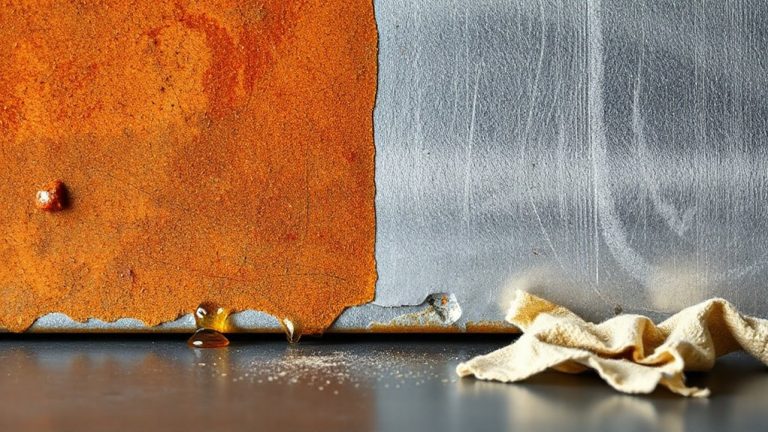
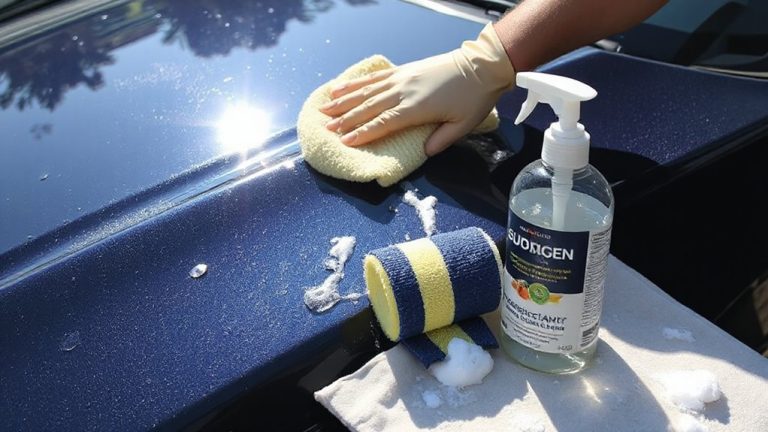
Since wax can only bond effectively to a clean and properly prepared surface, your first step is removing contaminants that interfere with adhesion. Surface cleaning alone isn’t enough-you need dedicated paint decontamination to eliminate embedded pollutants like iron particles, tree sap, and industrial fallout. Start with a pH-neutral car wash, then follow with a clay bar treatment to extract contaminants from the pores of the finish. This guarantees a smooth, contaminant-free surface for maximum wax bonding. For beginners, using a complete car clay bar kit can simplify the process and ensure you have all the necessary components for effective decontamination.
| Step | Process | Purpose |
|---|---|---|
| 1 | Pre-wash with snow foam | Loosens grit and grime |
| 2 | Two-bucket wash method | Prevents swirl marks |
| 3 | Clay bar gliding with lubricant | Removes bonded contaminants |
| 4 | Deionized water rinse | Prevents mineral spotting |
Allow the surface to dry completely before wax application. Proper paint decontamination creates the foundation for long-term protection and superior wax performance.
How Does Wax Actually Stick to Your Car?
Wax adheres to your car’s surface through molecular attraction and surface bonding, not just physical stickiness. Your paint’s surface energy determines how well wax molecules bond. High surface energy promotes stronger molecular attraction, allowing wax to spread evenly and form a durable layer. Contaminants or oxidation reduce surface energy, weakening adhesion. Cleaner, well-prepped paint has higher surface energy, improving wax contact. Wax molecules, typically long-chain hydrocarbons, align with the paint’s polar groups through van der Waals forces. This creates an invisible protective film roughly 0.5 to 2 microns thick. The bond isn’t mechanical-it’s chemical affinity at a microscopic level. Without proper surface energy, wax beads or slides off. Think of it like water on a waxed surface versus a dry sponge. Proper adhesion starts before application, relying on clean, contaminant-free paint to maximize bonding potential and guarantee long-term protection. Choosing the right wax type and quality can significantly impact durability and gloss, making best car wax picks a crucial consideration for long-term protection.
How Polymers Extend Wax Protection
Although wax offers solid protection on its own, pairing it with polymers markedly enhances durability and surface resilience. You’ll notice longer-lasting performance because polymers form a fortified matrix over the wax layer. This matrix improves crosslinking efficiency, creating tighter bonds between molecules for superior adhesion and resistance. Unlike traditional waxes alone, polymer-infused formulas slow polymer degradation from UV exposure and chemical contaminants.
| Feature | Benefit |
|---|---|
| High crosslinking efficiency | Increases film strength and scratch resistance |
| Low polymer degradation rate | Extends protective life up to 6 months |
| Hydrophobic polymer chains | Boosts repellency without wax buildup |
| Thermal stability (up to 185°F) | Maintains integrity under engine heat |
You benefit from enhanced structural support at the molecular level, which maintains surface protection longer. These advancements aren’t just incremental-they redefine long-term paint defense by combining wax’s ease of application with polymer toughness.
What Makes Wax Repel Water?
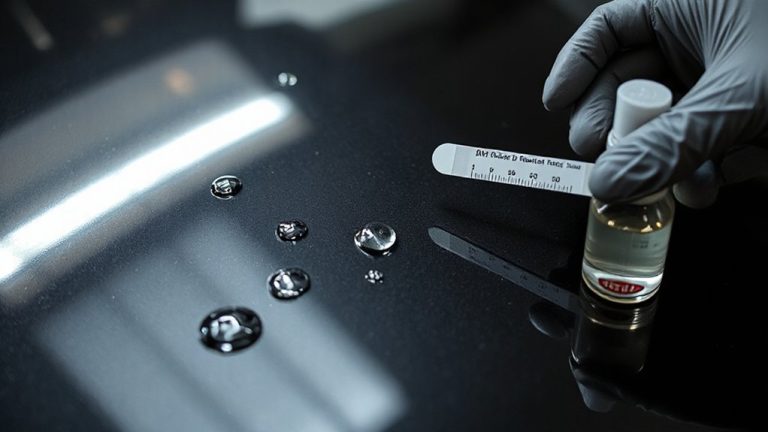
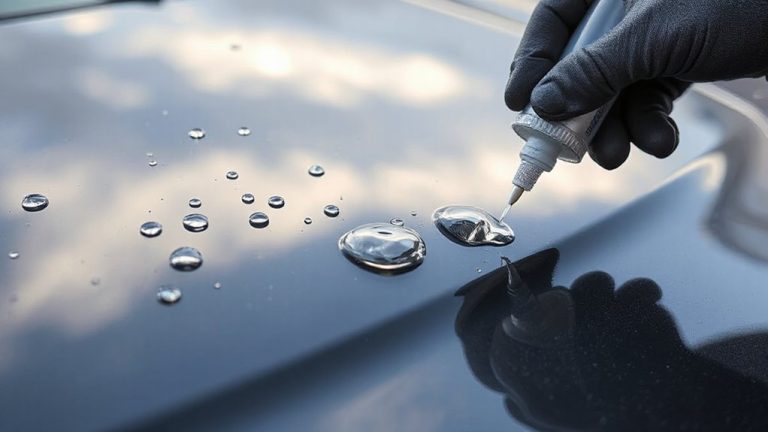
Your vehicle’s defense against moisture starts at the molecular level, where wax creates a hydrophobic surface through low surface energy. Hydrophobic molecules in the wax formulation repel water by minimizing adhesion. These molecules have nonpolar tails that resist interaction with polar water molecules. When water contacts the waxed surface, it beads up due to high surface tension. The droplets form nearly spherical shapes, reducing contact area. This beading effect occurs because surface tension pulls water inward, away from the low-energy wax layer. Contact angles typically exceed 90 degrees, confirming strong hydrophobicity. A tightly packed wax film enhances this effect by creating a uniform barrier. Contaminants and moisture slide off easily during rainfall. You don’t just get visual appeal-you gain functional protection. Water sheeting reduces mineral deposits and spotting. The mechanism relies on physics, not polish. Wax doesn’t absorb water; it prevents wetting. Hydrophobic molecules guarantee long-term surface integrity.
Natural vs Synthetic Wax: Which Lasts Longer?
Most natural carnauba waxes last 4 to 8 weeks under regular driving conditions, while synthetic sealants often provide 6 to 12 months of protection. You’re seeing this difference because carnauba wax is organic and susceptible to biological degradation from UV exposure, oxygen, and microbial activity. Synthetic waxes, however, are built on polymer-based formulations that resist these breakdowns. Their chemical stability allows them to maintain integrity under extreme pH levels, heat cycles, and repeated washings. Carnauba relies on physical adhesion, while synthetics bond covalently with silica or quartz layers in the clear coat. This bond structure resists shearing forces and environmental etching. You’ll get longer performance-up to 12 months-with synthetics, especially in harsh climates. Carnauba feels richer but fades faster. For sustained surface protection, synthetics win on bond strength and longevity metrics. Top-performing synthetic sealants are often recommended in expert best car wax for black cars guides due to their durability and enhanced gloss retention.
On a final note
Your wax’s longevity depends on proper adhesion. Surface preparation removes contaminants, ensuring direct paint contact. Waxes bond through van der Waals forces and hydrophobic polymer cross-linking, typically forming a 0.5–2.0 micron protective layer. Synthetic waxes, like PTFE or silicon dioxide, offer 6–12 months durability, outlasting natural carnauba’s 2–3 months. Water contact angles exceed 90°, enhancing sheeting. Properly applied, modern formulations resist UV degradation and chemical etching, maintaining gloss and surface energy control for maximum protection.