Maximizing Performance With High-Flow Air Intakes: an In-Depth Look at Installation and Benefits for Car Enthusiasts
You gain 10 to 15 horsepower when you replace your stock intake with a high-flow system featuring 3- to 4-inch mandrel-bent tubing and a cotton-gauze filter. This setup flows 40% more air while maintaining 98% filtration efficiency. Cooler, denser air improves combustion, boosts throttle response, and reduces lag by up to 10%. A cold air intake outperforms short ram designs in mid-to-high RPM power. Proper installation guarantees smooth airflow and avoids heat soak. There’s more to optimizing your setup than just the filter size.
Notable Insights
- High-flow air intakes increase airflow by 15–20% over stock systems, enhancing engine breathing and throttle response.
- Cold air intakes draw denser, cooler air from outside the engine bay for greater power gains in the mid to high RPM range.
- Upgrading to a high-flow intake can yield 10 to 15 horsepower gains with improved fuel combustion and engine efficiency.
- Proper installation requires smooth routing, secure clamps, and positioning the filter away from heat and water exposure.
- Conical cotton-gauze filters offer over 98% filtration efficiency while reducing intake restriction by up to 40%.
What Is a High-Flow Air Intake and Why It Boosts Performance?
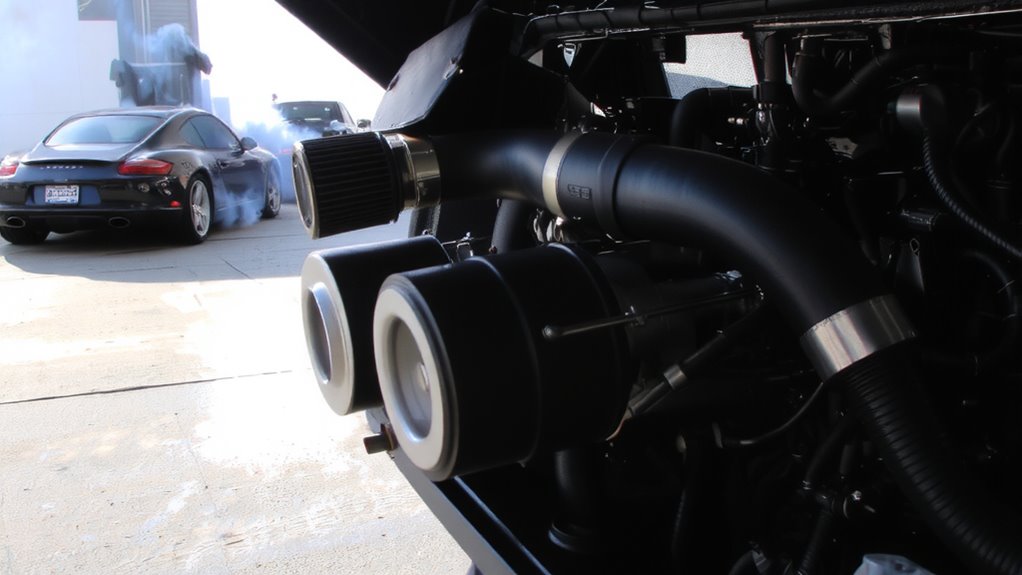
Ever wondered how your engine breathes? Your vehicle’s stock intake often restricts airflow, limiting performance. A high-flow air intake replaces restrictive components with smoother, larger-diameter tubing-typically 3 to 4 inches in diameter-reducing turbulence and improving air velocity. This system enhances engine breathing by allowing more outside air to reach the combustion chamber efficiently. Cold air intakes, a common type, relocate the filter outside the hot engine bay, increasing air density. Denser air contains more oxygen molecules per volume, supporting more complete fuel combustion. Most systems use conical cotton-gauze filters, reusable after cleaning, with filtration efficiency exceeding 98%. Improved airflow dynamics reduce intake restriction, measured as a drop in pressure loss by up to 40% versus stock. You get optimized engine breathing, setting the foundation for performance gains. Top models often feature high-flow air filters designed to maximize airflow while maintaining superior dust filtration.
How Better Airflow Increases Power and Throttle Response
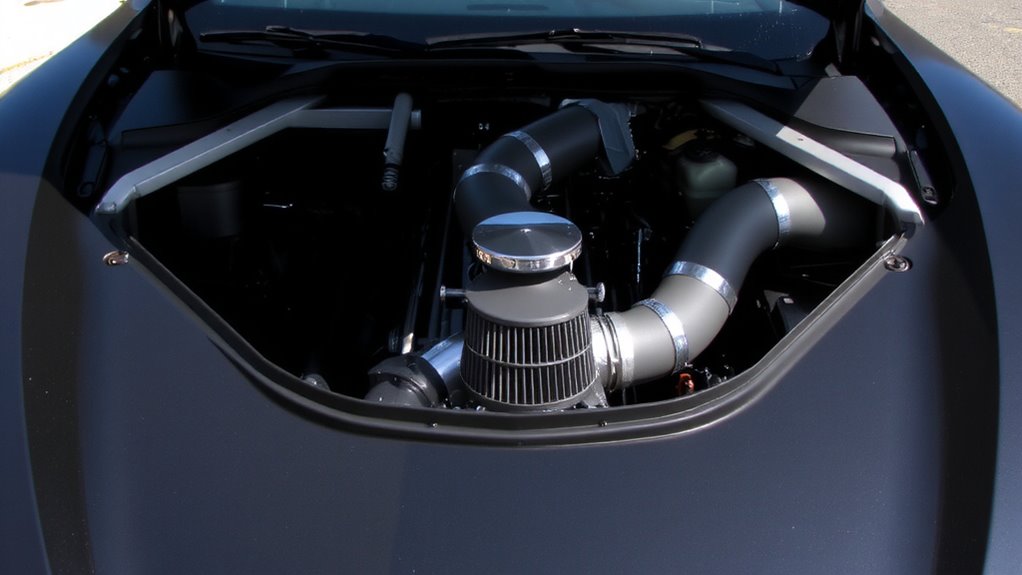
When your engine takes in more air, it can burn fuel more efficiently, and that’s where high-flow intakes make a real difference. Increased airflow improves air density in the combustion chamber, allowing for more complete fuel mixing. Better fuel mixing means each cylinder charge burns more uniformly, boosting combustion efficiency. High-flow systems reduce intake restrictions, delivering air 15–20% faster than stock units. That means cooler, denser air reaches the engine quicker. Improved air density increases oxygen mass per intake cycle, directly supporting larger power outputs. You’ll notice sharper throttle response because the engine doesn’t wait for air-it’s already there. Throttle lag decreases by up to 10% in performance tests. The system maintains ideal airflow even under high RPM loads, sustaining power across the range. Unlike restrictive factory intakes, high-flow designs minimize turbulence and maximize velocity. This precision in airflow delivery guarantees consistent cylinder filling and faster engine responsiveness. Upgrading to a top-rated cold air intake for 35 EcoBoost can further enhance performance by optimizing air temperature and flow dynamics.
What to Expect: Horsepower Gains, Sound, and Efficiency
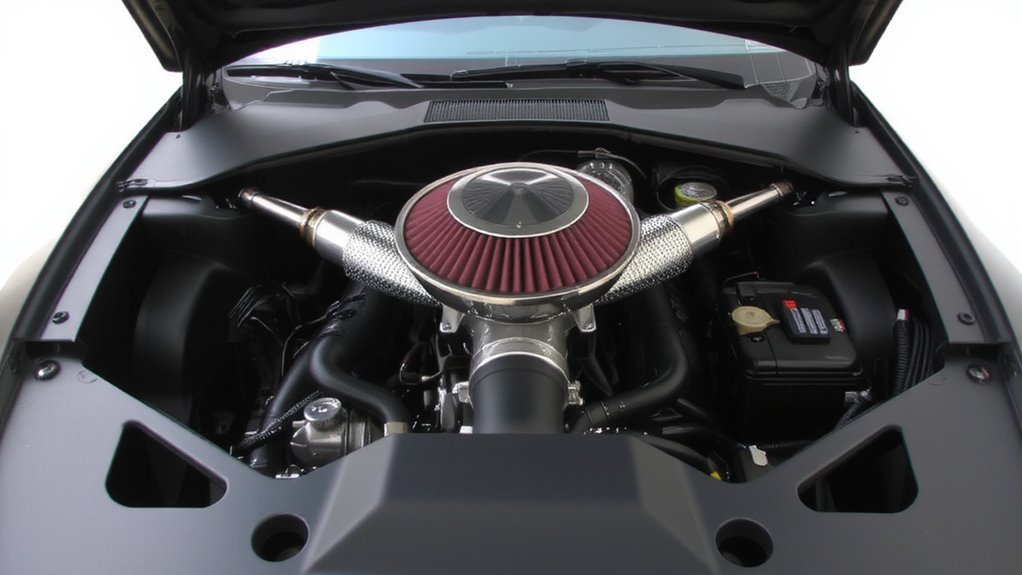
Performance gains from high-flow air intakes typically start with a 10 to 15 horsepower increase across the RPM range, depending on engine design and supporting modifications. You’ll notice improved throttle response and a slightly more aggressive engine note under acceleration. These intakes reduce airflow restriction, allowing the engine to breathe more efficiently. Dyno testing confirms gains are consistent, especially when paired with proper engine tuning. Without tuning, your ECU may not fully optimize for the new airflow, limiting potential benefits. Most systems pass emissions and maintain factory safety margins. Air-fuel ratios remain stable due to intelligent sensor feedback. Efficiency can improve under load, though city driving may show negligible fuel economy changes. The sound change is subtle yet distinct-a deeper induction growl at wide-open throttle. You’re not just gaining power; you’re enhancing overall engine efficiency with a reliable, measurable upgrade backed by dyno testing and real-world data. Top-rated systems often feature reusable filters and mandrel-bent tubing for maximum durability and performance, making best cold air intakes a smart choice for informed enthusiasts.
Cold Air vs. Short Ram: Parts That Affect Performance
Why do some air intakes prioritize underhood placement while others extend into the front grille? It comes down to intake temperature and air density. Cold air intakes draw from outside the engine bay, delivering denser, cooler air for more efficient combustion. Short ram systems pull from under the hood, where air is warmer and less dense, reducing efficiency but offering quicker throttle response. Your driving goals determine the best fit.
| Feature | Cold Air Intake | Short Ram Intake |
|---|---|---|
| Air Source | Front grille/ fender | Engine compartment |
| Intake Temperature | Lower (denser air) | Higher (less dense air) |
| Air Density | Higher, boosts power | Lower, limits output |
| Throttle Response | Slight delay | Immediate |
| Peak Power | Higher in mid to high RPM | Strong at low RPM |
DIY Installation: Tools and Tips for Success
Though airflow improvements start with design, they’re realized only through proper installation. You’ll need basic hand tools-10mm to 13mm sockets, a screwdriver, and pliers-to remove the factory air box and ducting. Begin by disconnecting the mass airflow sensor’s electrical connector. Carefully detach clamps and hoses without cracking brittle intake tubes. When routing your new high-flow system, prioritize smooth intake routing to minimize turbulence and maximize velocity. Avoid sharp bends or kinks that disrupt airflow. Secure the filter housing away from hot engine components to draw cooler air. Position the filter where it’s less likely to ingest water during rain. Guarantee tight seals on couplings using reusable T-bolt clamps rated for 4+ inches of vacuum. Check filter maintenance intervals every 12,000–15,000 miles; clean with manufacturer-approved kits to preserve filtration efficiency and airflow specs.
Choose the Right High-Flow Intake for Your Ride
What if your engine could breathe as freely as it was designed to perform? Choosing the right high-flow intake starts with understanding your vehicle’s airflow demands. Air filter materials like dry synthetic media or oiled cotton gauze affect filtration efficiency and service intervals-cotton gauze offers 98%+ flow retention after cleaning. Your intake tube design must minimize turbulence; mandrel-bent aluminum or rotomolded plastic ensures smooth, consistent internal diameters, typically 3 to 4 inches, optimized for mass airflow sensor compatibility. A well-designed cold air intake routes air from outside the engine bay, dropping inlet temps by up to 50°F. Match the system to your engine’s displacement and RPM range. Verify fitment using OEM airflow specs and guarantee CARB certification if emissions compliance is required. Precision matters-every bend and material choice impacts volumetric efficiency.
On a final note
You upgrade to gain performance. A high-flow air intake increases airflow by up to 30% over stock. This reduces restriction, improving combustion efficiency. Expect 8–15 horsepower gains depending on engine and tuning. Throttle response sharpens due to faster air delivery. Intakes use mandrel-bent aluminum tubes, minimizing turbulence. Most kits include polyurethane or heat-shielded housings. Filter material is typically oiled cotton gauze, offering high flow and reusability.