Exhaust Upgrades: Gain 5-15 HP & Cut Back Pressure Below 1.5 psi
Upgrade your exhaust to gain 5–15 HP by reducing back pressure below 1.5 psi at full throttle. Use stainless or aluminized steel-304 stainless handles up to 1,500°F and lasts over 10 years. Install long-tube headers with 1.75–2 in diameter for high-RPM power, or shorty headers for daily driving. Pair with a high-flow muffler rated over 200 CFM for aggressive sound without drone. Proper tuning matches tube length and diameter to your RPM range, activating another 10–20 HP. There’s more to optimizing performance where heat and flow intersect.
Notable Insights
- Upgrade to performance headers with equal-length tubes to reduce back pressure and improve exhaust scavenging for increased horsepower.
- Install a high-flow muffler with straight-through design to enhance exhaust flow and produce an aggressive, drone-free sound.
- Use stainless steel or aluminized steel exhaust components to ensure durability and resistance to heat and corrosion.
- Apply exhaust wrap to lower underhood temperatures and increase exhaust gas velocity, improving low-end torque and system efficiency.
- Tune the exhaust system with proper pipe diameter and length matched to engine RPM range for maximum power gains.
Upgrade Your Exhaust for More Power and Better Sound
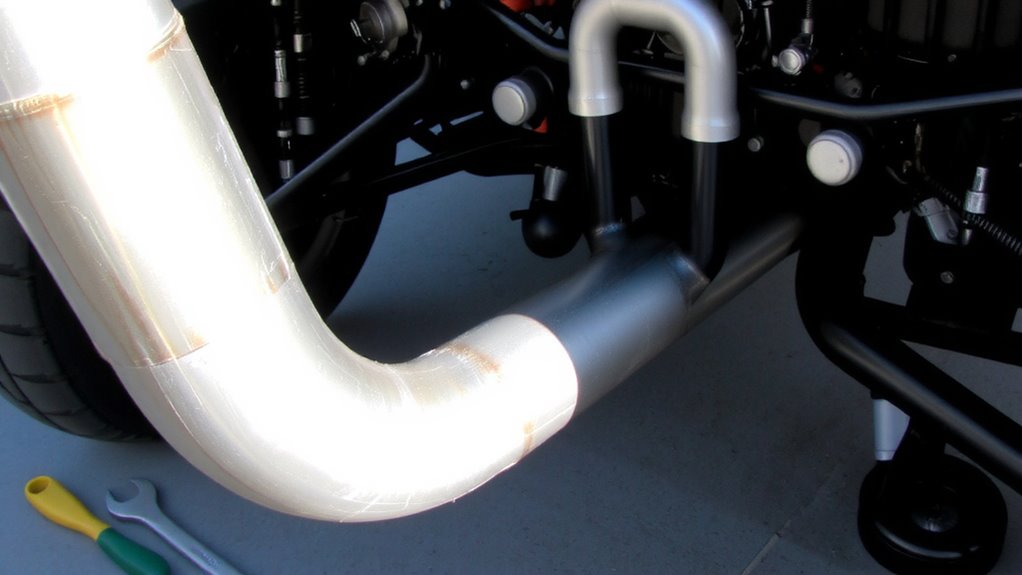
When you upgrade your exhaust system, you’re not just chasing a deeper growl-you’re accessing measurable gains in engine output and efficiency. A free-flowing exhaust reduces back pressure, improving scavenging and boosting horsepower by 5–15 HP depending on engine size. You’ll also see improved fuel economy under load due to decreased exhaust restriction. Exhaust wrap benefits include lower underhood temperatures-reducing heat soak by up to 50%-and increased exhaust gas velocity, which enhances low-end torque. Installing the wrap on headers or manifolds maintains consistent exhaust flow. Some opt for catalytic converter removal to further minimize restriction, though this may violate emissions regulations. Without the catalytic converter’s tight honeycomb structure, back pressure drops markedly-sometimes below 1.5 psi at full throttle-allowing exhaust gases to exit faster. This increases engine efficiency and throttle response. Always verify local laws before modification. For the G35 Coupe, selecting the right system can make a significant difference in performance and tone, with top choices including best exhausts for G35 Coupe.
Choose Stainless or Aluminized Steel for Your Performance Exhaust
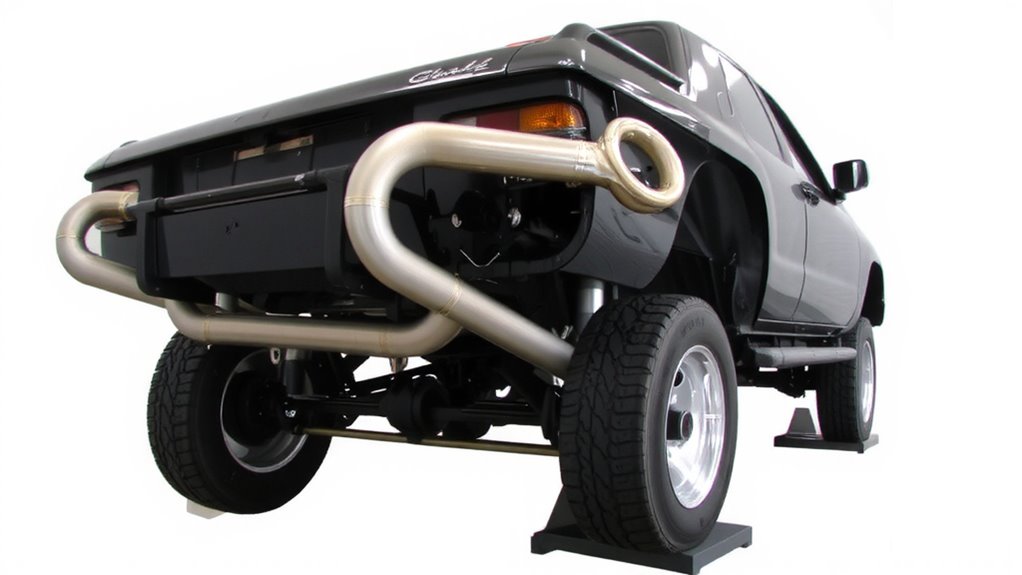
You’ve trimmed back pressure and tuned exhaust flow-now it’s time to pick the right material for lasting performance. Stainless steel offers superior material durability, resisting corrosion and handling temperatures up to 1,500°F. It contains at least 16% chromium, which forms a protective oxide layer. Common grades include 304 and 409, with 304 being ideal for high-performance builds. Aluminized steel provides good heat and rust resistance at lower cost. It’s carbon steel coated with aluminum-silicon alloy, protecting against oxidation. For cost comparison, aluminized systems typically cost 20–30% less than stainless. While aluminized lasts 5–8 years, stainless often exceeds 10. In harsh climates or daily drivers, stainless is worth the investment. Choose based on your budget and driving demands-both improve sound and flow, but stainless guarantees longevity under stress. A high-quality V6 exhaust system enhances both performance and auditory satisfaction.
Install Performance Headers to Reduce Back Pressure
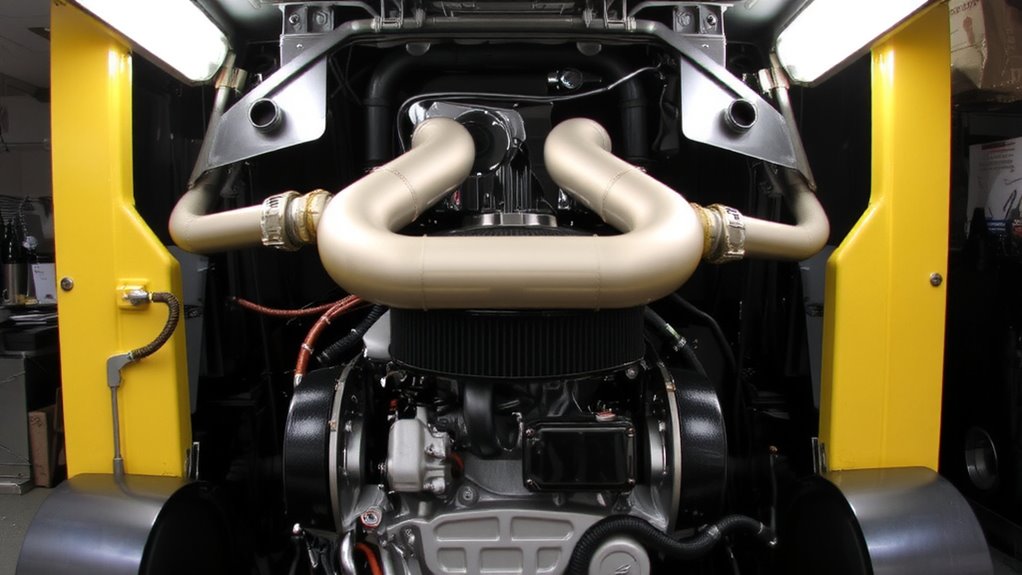
Though stock exhaust manifolds are designed for cost and compactness, they restrict exhaust flow with narrow, uneven piping. Performance headers eliminate this bottleneck through superior header design, using equal-length tubes that balance scavenging and reduce back pressure. You’ll gain horsepower, especially in the mid-to-high RPM range. Material compatibility guarantees longevity-stainless steel resists corrosion, while aluminized steel offers a budget-friendly alternative. Headers come in different configurations, each suited to specific engine layouts.
| Header Type | Tube Diameter | Ideal For RPM Range |
|---|---|---|
| Shorty | 1.5–1.625 in | Daily driving (up to 5,500) |
| Mid-length | 1.625–1.75 in | Street/strip (5,500–6,500) |
| Long-tube | 1.75–2 in | High-performance (6,500+) |
Pick a High-Flow Muffler for Aggressive Tone and Efficiency
If your goal is to enhance exhaust efficiency without sacrificing sound control, a high-flow muffler delivers the balance you need. These mufflers use straight-through perforated tube designs with sound-absorbing fiberglass or stainless steel packing to reduce back pressure while managing volume. Flow ratings typically exceed 200 CFM, improving scavenging and engine efficiency. You’ll gain an aggressive growl under acceleration without excessive drone at cruising speeds. To maintain performance, pair the muffler with exhaust wrap and heat shielding. The wrap reduces underhood temperatures by up to 50%, preserving nearby components and maintaining gas velocity. Heat shielding protects chassis sections and maintains safe operation in high-stress environments. Choose aluminized or stainless steel housings for durability-expect 50,000+ mile lifespans with proper maintenance. Together, these upgrades maintain peak thermal management and long-term efficiency. For the 370Z, upgrading to a top exhaust system ensures optimal fitment and performance gains tailored to your engine’s output.
Tune Your Exhaust System for Maximum Horsepower
When properly tuned, your exhaust system can reveal significant horsepower gains by optimizing back pressure and improving gas flow. Exhaust tuning guarantees spent gases exit efficiently, reducing restrictions that sap engine power. You’ll achieve ideal scavenging when header pipe length, diameter, and merge points are matched to your engine’s RPM range. For most naturally aspirated V8s, 1⅞-inch primary tubes boost mid-range torque, while 2-inch tubes favor high-RPM horsepower optimization. A properly tuned header-back system with mandrel-bent piping reduces turbulence and maintains flow velocity. Pair tuning with a wideband O2 sensor and dyno testing to validate gains. Expect 10–20 horsepower increases from correct exhaust tuning alone. Use 4-into-1 headers for broad powerbands or 4-2-1 for low-end response. Every component, from collector size to exit diameter, directly influences output. Precision matters-each inch impacts performance.
On a final note
You upgrade your exhaust to boost horsepower and sharpen sound. Stainless steel tubing, 2.5 to 3 inches in diameter, resists corrosion and maintains flow efficiency. Performance headers improve scavenging, reducing back pressure by up to 30%. High-flow mufflers, like glasspack or chambered designs, lower restriction while adding aggressive tone. Proper tuning guarantees peak air-fuel ratios, maximizing gains from 5 to 15 horsepower.