Throttle Body Function Explained: Airflow, Sizes & Cleaning Interval
You control engine power by pressing the accelerator, and the throttle body responds by opening a butterfly valve-60mm to 90mm in diameter-to regulate airflow into the intake manifold. This valve rotates up to 90 degrees, adjusting airflow with precision within ±2%. In drive-by-wire systems, response times stay under 100ms. The ECU uses this airflow data to balance fuel injection, maintaining ideal air-fuel ratio for efficient combustion. Modern electronic throttle control guarantees accuracy, while carbon buildup can disrupt performance-keeping it clean matters more than you might think.
Notable Insights
- The throttle body regulates airflow into the engine via a butterfly valve controlled by driver input and the ECU.
- It adjusts airflow precision within ±2% to maintain optimal air-fuel ratio for efficient combustion.
- Electronic throttle control systems respond in under 100ms, synchronizing with the ECU for performance and emissions.
- Carbon buildup can restrict airflow, reducing fuel efficiency by up to 7% and disrupting combustion balance.
- Proper maintenance, including cleaning every 30,000–50,000 miles, ensures consistent throttle response and engine efficiency.
What Is a Throttle Body and How Does It Work?
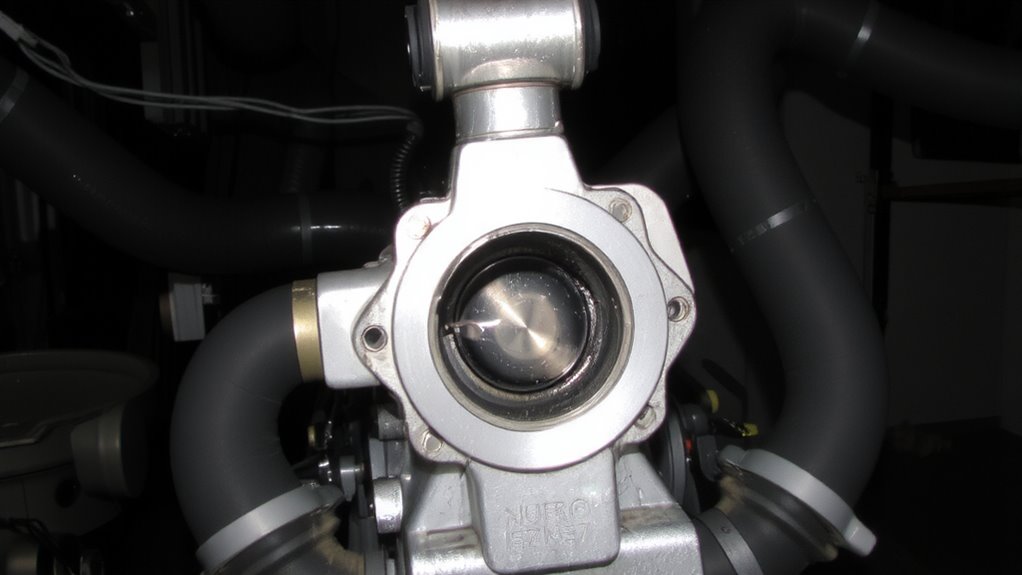
At the heart of your engine’s air intake system sits the throttle body, a crucial component that controls airflow into the engine. It regulates how much air enters based on driver input through the accelerator pedal. Throttle design typically features a butterfly valve mounted on a shaft, housed in an aluminum or composite housing. When you press the gas, the valve rotates open, allowing air to pass. The precision of airflow calibration guarantees ideal air-fuel mixture under varying load and RPM conditions. Modern throttle bodies use electronic throttle control (ETC), replacing cables with sensors and actuators for finer response. Bore diameter ranges from 60mm to 90mm in passenger vehicles, influencing airflow capacity. Proper calibration synchronizes with the engine control unit (ECU), maintaining emissions compliance and efficiency. Malfunctions disrupt idle stability and throttle response.
How Throttle Airflow Controls Engine Power
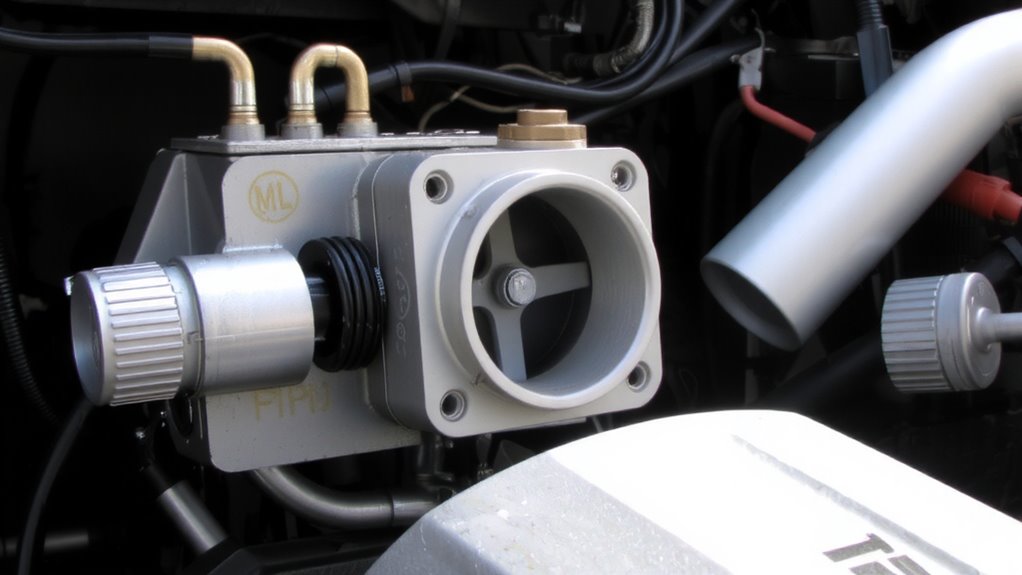
When you press the accelerator, the engine’s power output rises because the throttle body opens to let in more air. This increased air intake allows the engine to burn more fuel efficiently, directly boosting power output. The throttle plate, typically a butterfly valve, rotates from 0 to 90 degrees, modulating airflow into the intake manifold. At wide-open throttle, airflow reaches maximum volume-often measured in cubic feet per minute (CFM)-matching engine demand. The engine control unit (ECU) monitors throttle position, airflow sensors, and load to balance air intake with precise fuel injection. More air means a larger combustion event in each cylinder, increasing torque and horsepower. Throttle response time, usually under 100 milliseconds in modern drive-by-wire systems, guarantees immediate power delivery. Controlling air intake this way gives you direct influence over engine performance, maintaining peak combustion and responsiveness across RPM ranges. Upgrading to a high-performance throttle body for 5.7 Hemi can further enhance airflow and engine efficiency.
Does a Throttle Body Affect Fuel Efficiency?
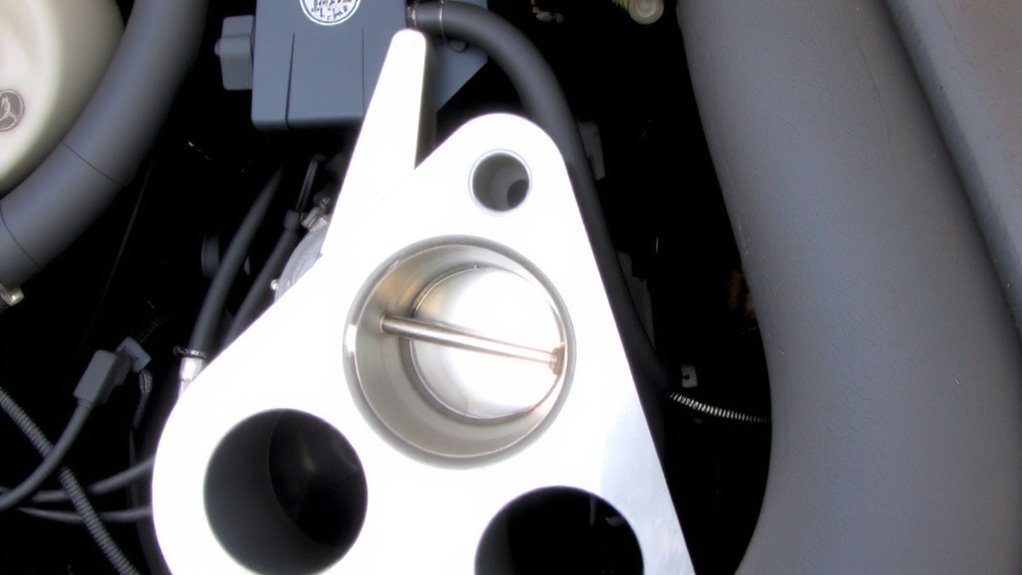
You control engine power by regulating airflow through the throttle body, but that same component also plays a direct role in fuel efficiency. A clean, properly functioning throttle body guarantees precise air intake, allowing the engine control unit (ECU) to maintain a superior air-fuel ratio. Even minor restrictions or carbon buildup can skew this balance, reducing fuel economy by up to 5–7%. Modern throttle bodies, typically 45–70mm in diameter depending on engine size, modulate airflow with a precision of ±2% under normal conditions. When airflow is inconsistent, the ECU compensates by adjusting fuel delivery, often increasing consumption. A smooth throttle bore and responsive throttle plate enhance combustion efficiency, directly improving your vehicle’s fuel economy. Maintaining accurate air intake isn’t just about performance-it’s a critical factor in maximizing miles per gallon and minimizing emissions over time.
Symptoms of a Failing Throttle Body
A failing throttle body often announces itself through erratic engine behavior, and ignoring these signs can lead to reduced performance and higher fuel consumption. You’ll notice poor throttle response, where pressing the accelerator results in delayed or uneven power delivery. This happens because the throttle plate isn’t opening or closing smoothly, disrupting air intake. Sensor failure within the throttle body-especially in the throttle position sensor (TPS)-can send incorrect data to the engine control unit (ECU). The ECU then miscalculates air-fuel ratios, causing rough idling or stalling. You might also see the check engine light illuminate, often with diagnostic trouble codes like P0121 or P0221. In severe cases, the engine may enter limp mode, limiting speed to prevent damage. These malfunctions compromise combustion efficiency and long-term engine health.
How to Clean Your Throttle Body (And How Often)
Though buildup of carbon deposits is inevitable over time, cleaning your throttle body every 30,000 to 50,000 miles helps maintain ideal airflow and throttle response. This interval defines the recommended throttle cleaning frequency for most modern fuel-injected engines. Carbon restricts the bore and interferes with the throttle plate’s seal, reducing airflow accuracy. You’ll need throttle body cleaner formulated to dissolve carbon without damaging sensitive components like the throttle position sensor or bore coatings. With the engine off and air intake disconnected, gently wipe the throttle bore and plate using lint-free cloths. Avoid aggressive scrubbing. Proper cleaning guarantees complete airflow restoration, allowing the engine control unit (ECU) to maintain correct air/fuel ratios. You should notice smoother idle and improved throttle responsiveness. Always reset the ECU after cleaning to enable proper relearning of throttle positioning.
Electronic Throttle Control: How It Replaced Cables
As mechanical linkages gave way to digital precision, electronic throttle control (ETC) systems replaced traditional throttle cables in most vehicles produced after 2008. This shift marks the drive by wire advancement, where your foot’s movement on the accelerator pedal is interpreted by sensors instead of pulled by cables. The system uses a throttle position sensor (TPS) and an accelerator pedal position sensor (APP) to relay input to the engine control unit (ECU). It then calculates ideal throttle plate angle, adjusting airflow with stepper motors or DC motors within milliseconds. ETC improves electronic reliability by reducing mechanical wear and enabling integration with stability control, cruise, and fuel management systems. There’s no physical cable-just precise signal transmission. You get smoother response, better fuel economy, and enhanced safety. The throttle body still regulates air, but now it listens to electrons, not steel cables.
Can You Tune Your Throttle Body for Better Performance?
What if you could access hidden performance just by fine-tuning one small component under the hood? You can-by optimizing your throttle body during performance tuning. Modern throttle bodies control airflow into the intake manifold with precision, directly impacting throttle response. When you recalibrate the electronic throttle control (ETC) module, you reduce throttle lag and sharpen acceleration. Performance tuning often includes resetting the throttle position sensor (TPS) parameters and adapting idle air control. Some aftermarket tuners adjust throttle butterfly sensitivity, improving responsiveness by up to 20%. A properly tuned throttle body guarantees immediate pedal feedback and seamless engine-transmission communication. It doesn’t increase horsepower directly but enhances drivability. For vehicles with forced induction, this fine-tuning is critical. You’ll notice smoother take-offs and quicker mid-range response. Always use OEM-compatible software. Throttle response tuning is subtle but measurable-verified through dynamometer runs and 0-60 mph comparisons.
On a final note
You rely on your throttle body to regulate airflow into the intake manifold with precision. It controls engine power by adjusting the throttle plate angle, typically from 0° (closed) to 90° (wide open). Modern electronic throttle control (ETC) systems use throttle position sensors (TPS) with ±0.5° accuracy. A clean, properly calibrated throttle body maintains ideal air-fuel ratios, improving combustion efficiency and fuel economy by up to 4%.