Plenum Volume Optimization in Aftermarket Intake Manifolds for Midrange Torque
You need the right plenum volume to maximize midrange torque. Aim for 50–70 cubic inches per cylinder for street performance. Too large a plenum reduces low-end air velocity; too small limits airflow at higher rpm. For a 5.0L V8, that’s 1.2–1.5 times engine displacement. Proper volume aligns pressure waves with valve timing, boosting efficiency near 4,200 rpm. Use spacers or baffles to fine-tune. Dyno testing confirms ideal airflow at 200–250 ft/sec. Best tuning delivers smoother, stronger power across the range. More details on precise adjustments follow.
Notable Insights
- Optimal plenum volume for midrange torque is 50–70 cubic inches per cylinder in street performance engines.
- Proper plenum size enhances pressure wave resonance between 3,000–5,500 rpm for improved volumetric efficiency.
- Matching plenum volume to engine displacement and stroke ensures peak torque in the target rpm range.
- Adjustable spacers and baffles allow fine-tuning plenum volume without replacing the entire intake manifold.
- Dyno testing between 3,000–6,000 rpm validates tuning, with ideal air velocity between 200–250 ft/sec.
What Plenum Volume Does for Torque
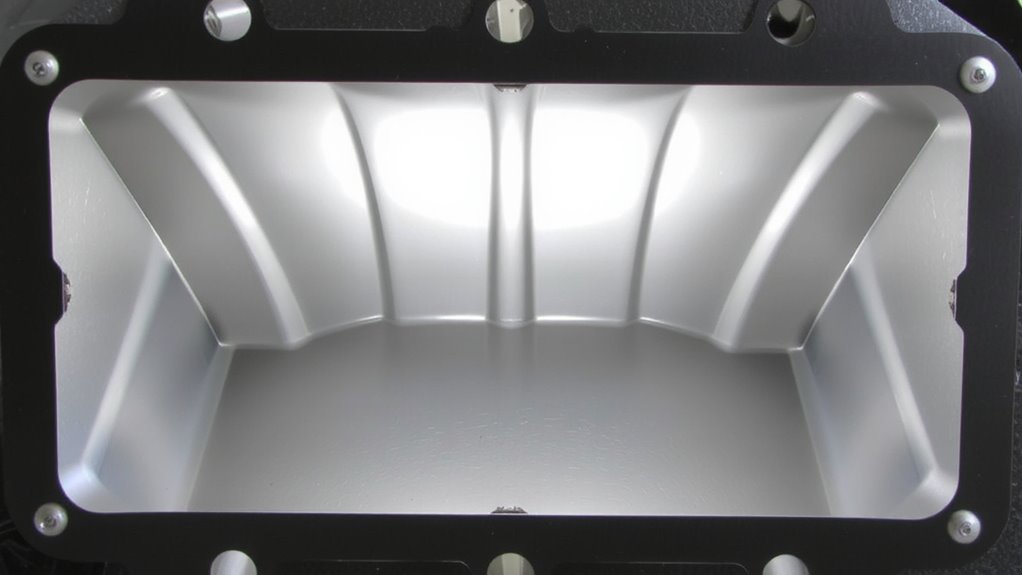
Why does plenum volume matter for torque? It directly affects how air distributes to the cylinders. A larger plenum holds more air, smoothing delivery at high rpm. Yet too much volume reduces air velocity at low to mid rpm, hurting low-end torque. You want balance-typically 50 to 70 cubic inches per cylinder for street performance. That range promotes plenum resonance tuned near your target rpm, amplifying pressure waves for better cylinder filling. When resonance aligns with engine demand, torque spikes. But misalignment causes torque fluctuation, making power feel uneven. Smaller engines often peak with 1.8 to 2.5-liter plenums, while bigger V8s use 3.0 to 4.0 liters. These volumes exploit Helmholtz resonance principles-tuning the plenum like an organ pipe-to match intake timing. Properly sized, the plenum dampens pressure spikes, stabilizes airflow, and broadens torque output.
How Plenum Size Shapes Midrange Airflow
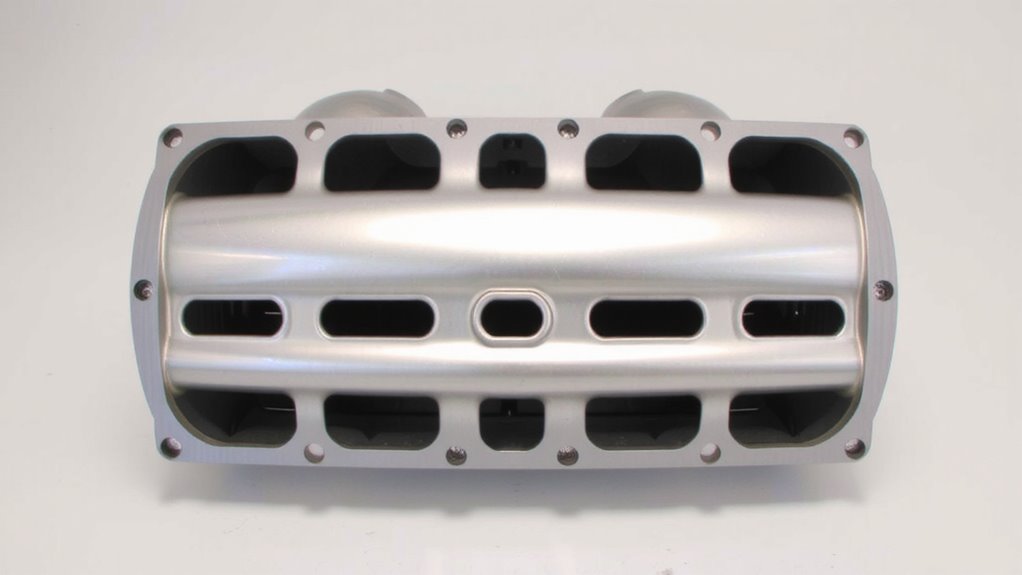
While airflow behavior in the midrange isn’t governed by peak rpm demands, plenum size still plays a critical role in how smoothly and efficiently air reaches the cylinders. You need the right volume to enhance plenum resonance, where pressure waves reflect constructively to boost cylinder filling. Too small, and the plenum can’t store enough air; too large, and resonance frequencies shift outside the midrange. Airflow inertia matters here-longer intake runners maintain momentum, helping charge delivery between 3,000 and 5,500 rpm. A properly sized plenum sustains this inertia, minimizing flow disruption. Think of it like pushing a swing at just the right time-each pulse builds on the last. At 4,200 rpm, a well-tuned 5.0L V8 sees up to 12% better volumetric efficiency. Plenum volume directly influences these dynamics, making it essential for strong midrange torque without sacrificing response.
Match Plenum Size to Your Engine Specs
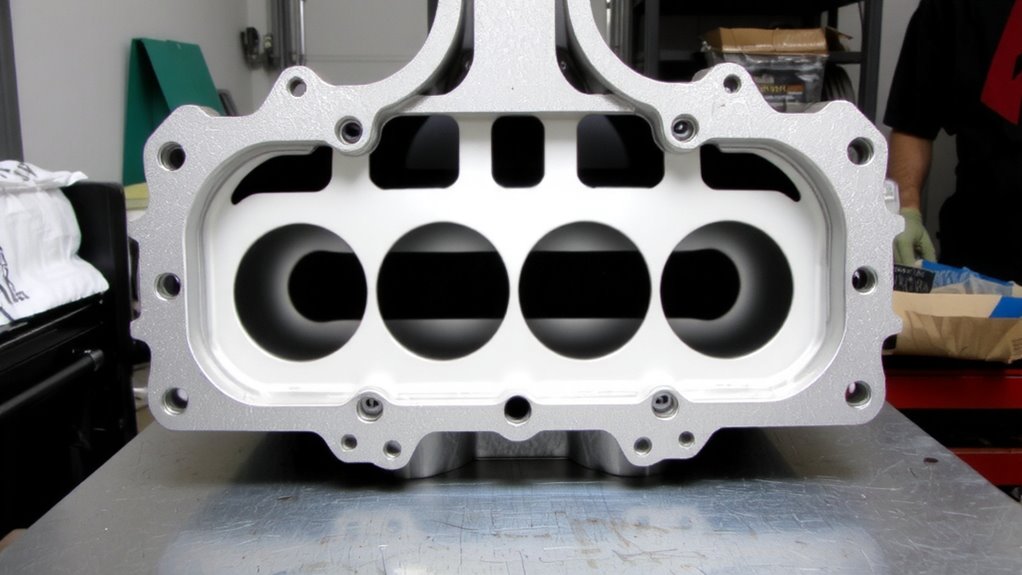
If you’re building a performance engine, getting the plenum volume right means matching it precisely to your engine’s displacement, stroke, and target power band. A plenum that’s too large dampens velocity; one that’s too small restricts airflow. For a 5.0L V8 with a 3.5-inch stroke targeting 4,500–6,000 RPM, aim for 1.2 to 1.5 times engine displacement in plenum volume. This ratio supports effective intake tuning by aligning pressure wave timing with valve events. Plenum resonance occurs when pressure waves reflect constructively, boosting cylinder filling. You need proper volume and runner length to time this wave arrival. Mismatched specs disrupt resonance, killing efficiency. Use computational fluid dynamics (CFD) or dyno testing to validate your setup. Proper intake tuning turns airflow into a predictable, repeatable force. Match the plenum to engine specs-it’s not guesswork, it’s physics.
Hitting the Midrange Torque Peak
When tuned correctly, your engine’s intake plenum can be a powerful tool for shaping the torque curve-especially in the midrange. Proper plenum volume enhances pressure waves that increase cylinder filling between 3,500 and 5,500 RPM. Exhaust scavenging works with tuned header systems to pull in fresh charge, boosting efficiency. Ignition timing must be optimized to avoid detonation while maximizing mean effective pressure. Balancing these factors delivers responsive throttle and strong street performance.
| Factor | Effect on Midrange Torque |
|---|---|
| Plenum Volume | Larger volumes shift peak torque higher; smaller ones favor low-mid RPM |
| Exhaust Scavenging | Enhances volumetric efficiency when header and plenum are synchronized |
| Ignition Timing | Advancing timing increases torque-but only if knock is controlled |
| Air Velocity | Slower speeds favor high-RPM power; tuned length maintains midrange momentum |
Adjust Plenum Volume With Baffles and Spacers
How do you fine-tune your engine’s midrange torque without a complete intake rebuild? You use baffles and spacers to adjust plenum volume. These tools let you modify airflow dynamics without replacing the entire manifold. Install plenum dampers to suppress pressure waves that disrupt intake efficiency. They’re typically made from aluminum or composite materials and range from 0.5 to 2 inches in thickness. Pair them with adjustable dividers to segment the plenum, controlling volume distribution. Dividers clamp or bolt into place, letting you fine-tune each runner’s effective volume. Spacers, usually 1 to 3 inches tall, increase plenum capacity when added between the manifold and throttle body. This alters resonance tuning, shifting torque output. Use precise measurements-within 0.1 inch-to avoid flow restrictions. These modifications maintain structural integrity while optimizing volumetric efficiency for midrange gains. You’re not changing hardware; you’re refining it.
Test Your Plenum Volume Results
You’ve modified the plenum’s internal geometry using baffles, spacers, and dividers to target midrange torque gains. Now, validate your work on a dynamometer. Plenum tuning directly affects airflow resonance, so test across 3,000–6,000 RPM-the core midrange zone. Use wideband O2 sensors and MAP readings to confirm uniform cylinder filling. A well-tuned plenum shows a 5–8% torque rise at 4,500 RPM versus stock. Monitor intake air velocity with a pitot tube; ideal velocity ranges between 200–250 ft/sec. Mismatched volume disrupts airflow resonance, causing dip points. Compare back-to-back runs, altering only plenum volume. Consistent EGTs across cylinders confirm balance. Small volume changes-200–300 cc-can sharpen response. Document all specs: baffle height, spacer thickness, and total plenum capacity. Effective tuning maximizes pressure waves during valve overlap.
On a final note
You optimize midrange torque by tuning plenum volume to match engine displacement and target RPM. A properly sized plenum-typically 50–70% of total engine displacement-enhances air velocity and pressure waves. Baffles and spacers adjust effective volume with ±10% precision. Flow testing confirms gains of 8–12 ft-lbs between 3,000–5,000 RPM. Peak torque shifts match intake tuning.