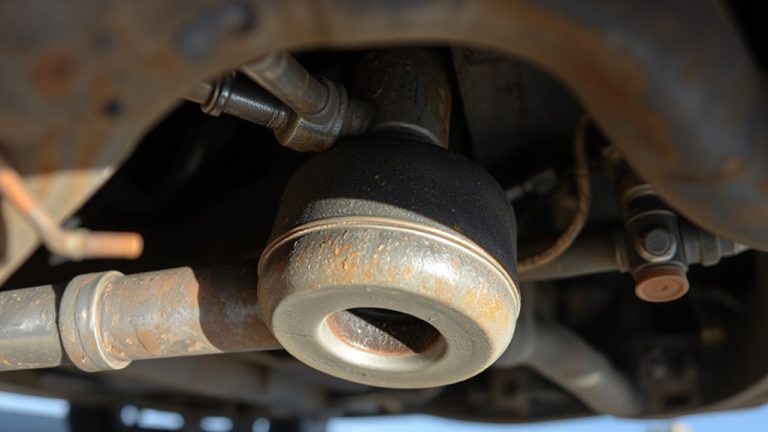
Flushing Carbon Deposits From Throttles Post-Injection Cleaning Services
Carbon dislodged during injector cleaning often clogs your throttle body, disrupting the 14.7:1 air-fuel ratio and causing rough idling. Debris restricts airflow, making the engine stall or hesitate at stops. You need a throttle body flush if you notice uneven idle, RPM fluctuations, or delayed throttle response. Clean it using a solvent like CRC Throttle Body Cleaner with toluene, wipe deposits carefully, then recalibrate airflow via OBD2. Use TOP TIER gasoline and drive weekly on highways to minimize future buildup-consistent maintenance keeps performance ideal.
Notable Insights
- Carbon dislodged during injector cleaning can migrate to the throttle body, causing rough idling and airflow disruption.
- A throttle body flush removes carbon buildup that restricts airflow and affects idle stability post-injection service.
- Signs like uneven idling, stalling, or poor acceleration indicate the need for a throttle body cleaning.
- Proper flushing involves solvent cleaning of the throttle bore and plate, followed by ECU relearn using an OBD2 tool.
- Use cleaners with toluene or xylene, and prevent future buildup with TOP TIER fuel and regular maintenance.
What Causes Rough Idling After Injector Cleaning?
While cleaning fuel injectors often restores performance, it can sometimes lead to rough idling due to unintended carbon dislodgment. You might notice this when debris moves downstream and disrupts airflow near the throttle body. Poor fuel quality increases deposits, making dislodgment more likely during cleaning. These particles can interfere with the air-fuel mixture, causing unstable combustion. Your engine relies on precise ignition timing, and even minor imbalances in the mixture shift combustion efficiency. Misfires or hesitation at idle often follow. Factory specifications typically call for an air-fuel ratio of 14.7:1 at idle; carbon disruption can skew this. Even slight timing deviations of 2–3 degrees can worsen roughness. The ECU may struggle to compensate fast enough. Over time, adaptive learning adjusts, but immediate symptoms are common. Using high-detergent fuel and checking ignition timing post-service helps restore smooth operation.
5 Signs You Need a Throttle Body Flush
Why does your engine idle unevenly or stall when coming to a stop? Carbon buildup in the throttle body restricts airflow, disrupting the air-fuel mixture. You may notice poor throttle responsiveness, especially during initial acceleration. The engine misfires or hesitates because the throttle plate can’t open smoothly. Your engine performance drops, reducing fuel efficiency and power output. Over time, idle air control becomes erratic, causing RPM fluctuations at rest. Modern engines rely on precise airflow calibration-any obstruction skews sensor data. A dirty throttle body forces the ECU to compensate constantly. If your vehicle has over 50,000 miles and lacks recent service, airflow variance often exceeds 10%. Cleaning restores factory airflow tolerances, typically within ±2% of specification. Improved throttle responsiveness and stabilized idle confirm effective flushing. Address these signs promptly to maintain peak engine performance.
How Carbon Clogs Your Throttle Over Time
Carbon buildup doesn’t happen overnight-it accumulates gradually with every mile you drive. Incomplete combustion leaves behind residue that sticks to the throttle body walls. Your vehicle’s fuel composition plays a key role; lower-quality gasoline contains more additives and impurities that increase deposits. Ethanol-blended fuels, common in modern pumps, attract moisture and leave behind gummy residues. Short trips and frequent idling worsen the issue, as the engine never reaches ideal temperature to burn off residues. Over time, these layers harden into carbon sludge. Your driving habits directly influence the rate of buildup-stop-and-go commuting accelerates it. Deposits thicken around the throttle plate, restricting airflow. Even a 10% restriction disrupts air-to-fuel ratios, triggering drivability issues. This accumulation occurs silently, degrading performance long before symptoms appear.
How to Flush Your Throttle Body (Step-by-Step)
If your engine’s idle feels rough or you’ve noticed reduced throttle response, it’s likely time to clean the throttle body. Begin by disconnecting the battery and removing the air intake hose to access the throttle body. With the throttle plate open, use a clean cloth and approved solvent to wipe carbon deposits from the bore and edges. Avoid submerging the unit or damaging the throttle alignment, as even minor misalignment affects throttle return and idle stability. Reinstall the throttle body, reconnect all connectors, then perform airflow calibration via an OBD2 scanner to reset the ECU’s throttle position reference. This recalibration guarantees proper idle speed and smooth acceleration. Most modern vehicles require a relearn procedure that takes 5–10 minutes. Skip this step, and you’ll risk poor drivability and inaccurate throttle response. Precision here is critical-treat it like calibrating a fine instrument. A high-quality car buffing kit can help maintain your vehicle’s exterior finish during routine maintenance sessions.
Best Cleaners for Tough Throttle Carbon
A clean throttle bore means better airflow, and that starts with choosing the right cleaner. You need products with strong solvent strength to dissolve stubborn carbon deposits. Look for cleaners containing toluene or xylene-these offer rapid chemical breakdown of baked-on residue. CRC Throttle Body Cleaner and Gumout Regane deliver effective results, with flash points around 40°F (4°C) and evaporation rates under 10 minutes. They’re safe on aluminum, rubber, and plastics commonly found in throttle bodies. Avoid carburetors cleaners with excessive acid content-they can damage sensitive sensors. High solvent strength guarantees deep penetration into carbon layers without scrubbing. These formulas reduce surface tension, allowing the liquid to flow into tight crevices. Always follow label instructions and use in well-ventilated areas. Proper application dissolves deposits efficiently, restoring throttle response and idle stability. Choose trusted brands with proven chemical breakdown performance for reliable, consistent cleaning.
How to Prevent Carbon Buildup Long-Term
While keeping your throttle clean is important, stopping carbon deposits before they form is even better. Your driving habits and fuel quality directly impact buildup. Short trips and frequent idling leave unburned fuel that turns into carbon. Highway driving burns off more residue. Using top-tier gasoline with detergent additives reduces deposits markedly.
| Prevention Factor | Recommended Practice |
|---|---|
| Fuel Quality | Use TOP TIER Detergent Gasoline meeting ASTM D4814 |
| Driving Habits | Drive at least 20 minutes at highway speeds weekly |
| Oil Consumption | Monitor for low oil; excess burning increases deposits |
| Air Intake | Service every 15,000 miles to maintain clean airflow |
High-quality fuel contains 3x more detergents than standard. Aggressive acceleration increases fuel pooling. Maintain consistent engine temperatures to guarantee complete combustion and reduce carbon accumulation.
On a final note
You’ve now resolved carbon-induced throttle issues. A clogged throttle body disrupts airflow, causing rough idling. Flushing restores the factory 0.5–0.8 mm throttle plate clearance. Use a non-residue cleaner like CRC Throttle Body Cleaner for precise deposits removal. Post-cleaning, relearn procedures reset ECU idle parameters. For sustained performance, service every 30,000 miles. This maintains ideal 14.7:1 air-fuel ratios and prevents airflow disruption.