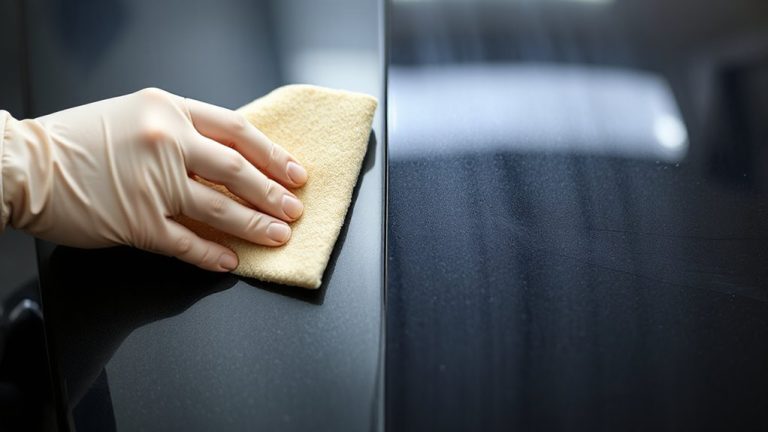
The Importance of Temperature Control During Car Maintenance Chemical Application
You must control temperature when applying car chemicals because it directly impacts performance and durability. Below 50°F (10°C), increased viscosity hinders even spreading, slowing evaporation and curing. Above 85°F (29°C), solvents evaporate too fast, degrading active ingredients and causing hazing. Ideal application occurs between 60°F and 80°F (15.5°C to 26.6°C), where surface energy and chemical stability guarantee proper adhesion. For best results, monitor both surface and air temperature-further insights follow.
Notable Insights
- Temperature affects chemical viscosity, ensuring optimal flow and even application between 60°F and 80°F.
- Cold weather slows solvent evaporation, increasing drying times and risking uneven curing or residue buildup.
- Extreme heat accelerates evaporation, causing premature drying, hazing, and reduced chemical effectiveness.
- Applying chemicals below 40°F risks moisture trapping and frost damage, compromising adhesion and performance.
- Accurate surface and air temperature measurement ensures conditions support proper bonding and curing of products.
Why Temperature Matters in Car Chemical Application
When applying car care chemicals, temperature plays a critical role in how well the product performs. Cold conditions slow molecular activity, reducing the rate of chemical reactions necessary for cleaning or protection. At low temperatures, many solvents fail to evaporate efficiently, leaving residues. Heat accelerates these reactions, but excessive warmth can degrade active ingredients. You risk uneven application or premature drying. Material expansion also affects outcomes-metal, plastic, and paint expand at different rates as temperature increases. This differential expansion may compromise sealant adhesion or cause micro-cracking. Ideal performance occurs when substrates are between 60°F and 80°F (15.5°C to 26.6°C). At this range, molecules interact predictably. Surface energy supports uniform spreading. Chemical stability is maintained. You achieve full activation of polymers, corrosion inhibitors, and detergents without stressing the materials. Temperature isn’t just a suggestion-it’s a functional requirement for effective chemical engagement with vehicle surfaces.
What’s the Ideal Temperature for Car Chemicals?
The ideal temperature range for applying car care chemicals isn’t arbitrary-it’s grounded in material science and chemical kinetics. You’ll get best results between 60°F and 80°F (15°C to 27°C). In this range, chemical viscosity remains low enough to spread evenly without pooling or running. If it’s too cold, viscosity increases, making products thick and hard to apply. Too hot, and the evaporation rate spikes-especially with solvent-based cleaners or waxes-causing them to dry before you can work them in. Proper temperature guarantees active ingredients bond correctly to surfaces. For example, sealants need balanced evaporation rates to cure uniformly. You’re not just following a guideline-you’re controlling reaction efficiency. Consistent application temperatures mean consistent performance. Stick to this window, and your products deliver as designed.
Can You Apply Car Chemicals in Cold Weather?
Why do your car care products struggle to perform in winter? Cold temperatures increase chemical viscosity, making fluids thicker and less able to spread evenly across surfaces. This reduced flow impedes proper adhesion and coverage, diminishing effectiveness. Many sealants and waxes rely on solvents to evaporate, but in cold weather, evaporation slows, prolonging drying times and risking uneven curing. Applying chemicals below their recommended temperature-often 40°F (4°C)-can lead to frost damage, especially if moisture is trapped beneath the product layer. Ice crystallization compromises bond integrity, causing premature failure. Most manufacturers specify application ranges between 50–80°F (10–27°C) for ideal performance. If you must work in cold conditions, warm the product and surface beforehand. Pre-heating to at least 40°F guarantees better viscosity control and reduces the risk of frost-related compromise.
What Happens If You Apply Chemicals in Extreme Heat?
Few realize just how drastically extreme heat can compromise the performance of automotive chemicals. When you apply them in temperatures above 90°F (32°C), chemical degradation accelerates, reducing effectiveness. High heat breaks down active ingredients faster, especially in cleaners, waxes, and sealants. For example, solvent-based degreasers may evaporate before lifting grime, leaving residue. You risk uneven application and diminished protection. Chemical degradation also alters pH levels, increasing corrosiveness. This leads to surface damage, particularly on painted finishes and rubber trim. Rapid drying causes hazing or streaking, requiring reapplication. Plastics become more brittle when exposed to overheated chemicals, raising the risk of cracking. Always check product labels-many specify maximum application temperatures, often between 75°F and 85°F (24–29°C). Exceeding these limits undermines performance. Extreme heat doesn’t just reduce shelf life-it compromises immediate results and long-term vehicle protection.
How to Measure Surface and Air Temperature
Don’t guess when the sun’s beating down-measuring temperature accurately keeps your chemical applications effective. Use an infrared thermometer for precise surface readings; these tools detect radiant energy to deliver accurate temperature data in seconds. For best results, hold the device perpendicular to the surface, within 6 inches, to avoid skewed measurements. Surface readings below 50°F or above 100°F can compromise chemical adhesion and drying times. Pair this with digital thermometers or thermo-hygrometers for real-time air monitoring. Air monitoring guarantees ambient conditions support proper chemical reactions-ideal ranges fall between 60°F and 85°F with relative humidity under 60%. Avoid measuring in direct sunlight or near exhaust heat sources to prevent false highs. Calibration matters: check devices monthly against ice water (32°F) or boiling water (212°F). Accurate tools mean reliable data-both surface and air-so your maintenance work performs as designed.
How Seasonal Changes Affect Car Chemical Use
How does the shifting calendar reshape your approach to car care? Seasonal changes directly impact chemical performance, especially regarding seasonal viscosity and chemical evaporation. As temperatures fluctuate, fluids thicken or thin, altering their effectiveness. You must adjust product selection and application methods accordingly.
| Season | Typical Temp Range (°F) | Recommended Adjustments |
|---|---|---|
| Winter | 20–40 | Use low-viscosity oils; store chemicals indoors to prevent thickening |
| Spring | 40–70 | Monitor evaporation rates; apply cleaners early in the day |
| Summer | 70–100 | Reduce spray pressure to limit chemical evaporation |
| Fall | 40–60 | Check seasonal viscosity specs; reseal containers tightly |
Ignoring these factors risks underperformance and surface damage. Always refer to manufacturer guidelines for temperature-specific application parameters.
On a final note
You must control temperature when applying car chemicals for best results. Most products perform best between 50°F and 85°F (10°C–29°C). Outside this range, solvents evaporate too fast or fail to bond. Cold slows chemical reactions; below 40°F (4°C), adhesion drops up to 40%. Heat above 90°F (32°C) causes uneven curing. Always measure surface temp with an infrared thermometer. Maintain ideal conditions for maximum efficacy and longevity.