How to Inspect Wheels for True Roundness and Lateral Runout
Secure your wheel in a frame or truing stand and spin it slowly to check for wobble. Use a zip-tie as a gauge near the rim to detect lateral runout-if the gap changes by more than 1 mm, you have a noticeable deviation. For radial true, use a caliper or dial indicator to measure roundness; variance over 0.5 mm indicates hops. Spoke tension imbalances over 15% often cause these issues. Correct smaller deviations with a spoke wrench, but consider professional truing for complex damage-if your wheel shows multiple flaws, deeper inspection reveals whether repair is viable.
Notable Insights
- Secure the wheel in a frame or truing stand and remove the tire for clear access to the rim.
- Use a zip-tied cable or dial indicator near the braking surface to detect lateral wobble as the wheel spins.
- Spin the wheel slowly and measure lateral runout with a caliper or gauge, noting deviations beyond ±1 mm.
- Attach a dial indicator to measure radial runout, ensuring variance stays under 0.5 mm for true roundness.
- Check spoke tension consistency; imbalances over 10–20% can cause wobble and require truing or professional repair.
Why Your Wheel Wobbles and Why True Roundness Matters
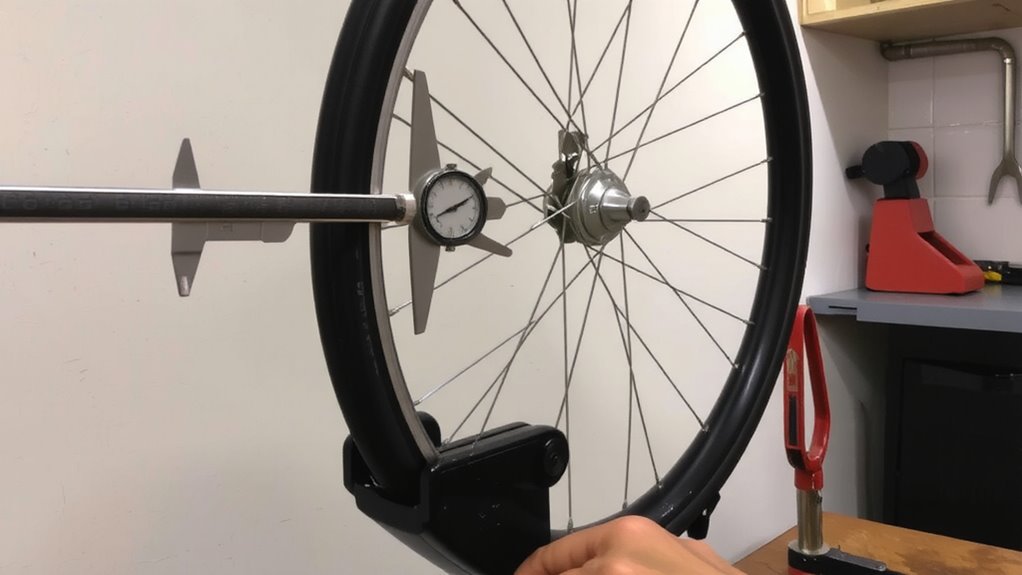
A wobble in your wheel isn’t just annoying-it’s a sign of mechanical issues that can affect safety and performance. You’re likely dealing with uneven spoke tension or poor wheel balance. Spoke tension must be uniform; otherwise, the rim distorts, creating lateral runout. High-performance wheels typically require spoke tension within 10–20% across all spokes. A tension imbalance as small as 15% can induce noticeable wobble under load. Without proper wheel balance, vibration increases, especially at speeds over 25 mph, reducing traction and control. True roundness guarantees consistent contact with the road, minimizing rolling resistance and brake rub. Deviations beyond 1.5mm from true introduce measurable drag and wear. Even minor deviations compromise efficiency and handling. Maintaining ideal spoke tension and wheel balance directly impacts longevity and ride quality. Wobble isn’t just cosmetic-it reflects structural integrity. Address it early to preserve performance and safety.
Set Up to Check Wheel True at Home
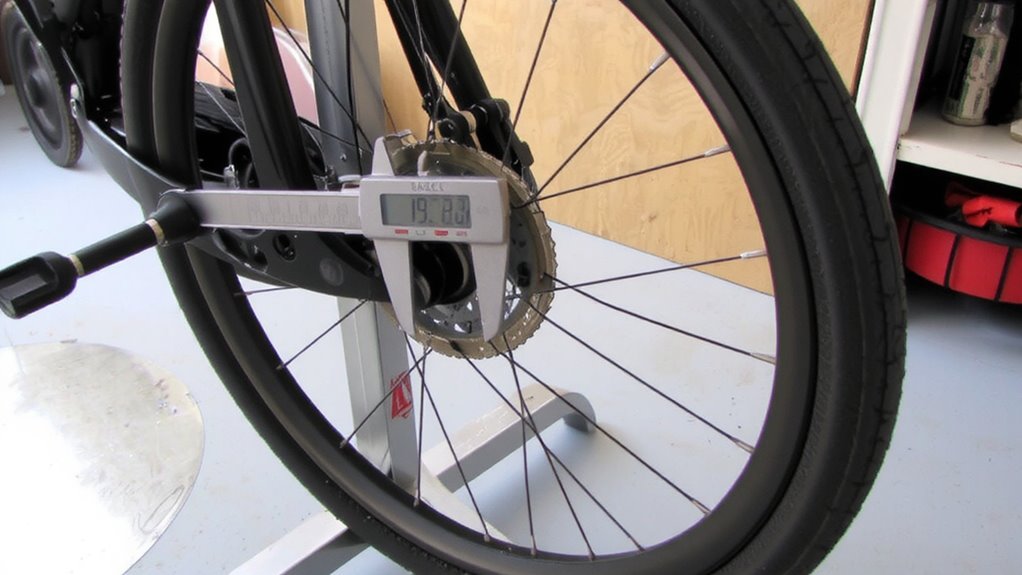
With the right tools and a stable workspace, you can accurately assess your wheel’s truenrupt at home without professional equipment. Guarantee bike stability by securing the frame in a repair stand or flipping it upside down on a soft surface. Remove the wheel and remount it firmly to prevent wobble from axle misalignment. Install a truing stand or use zip-tied cable as a makeshift guide near the rim’s braking surface. Maintain precise tool calibration by confirming that measurement devices, like dial indicators or calipers, are zeroed and fixed rigidly. Even 0.5 mm of lateral deviation matters, so calibrate your reference points carefully. Position the indicator tip perpendicular to the rim, 2–3 mm from the surface. Consistent contact guarantees repeatable readings. Avoid drafts or vibrations during setup. Accurate diagnostics start with setup discipline-small errors in bike stability or tool calibration magnify measurement inaccuracies.
Check for Wobble: Measure Lateral Runout
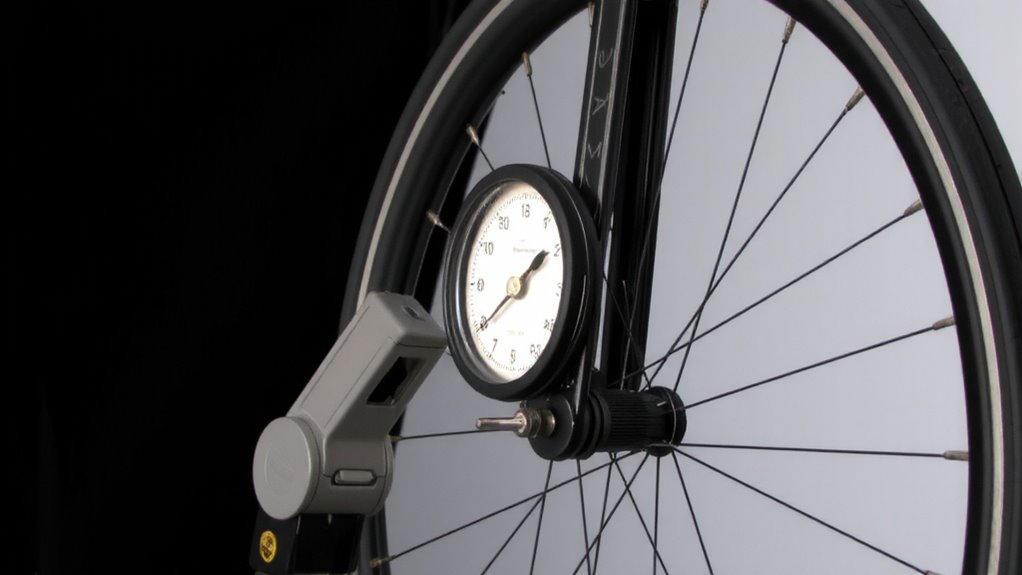
Lateral wobble can turn a smooth ride into a shaky mess. You need to measure lateral runout to detect side-to-side movement. Secure the wheel in the frame or truing stand and spin it slowly. Use a caliper or zip-tape gauge with 0.3 mm accuracy. Any deviation beyond ±1 mm signals trouble. Common causes include uneven spoke tension or rim damage. Adjusting spoke tension corrects most wobble. Ignore severe rim damage-it often means wheel replacement.
| Issue | Action |
|---|---|
| <1 mm wobble | Monitor over time |
| 1–2 mm wobble | Adjust spoke tension |
| >2 mm wobble | True the wheel |
| Visible rim damage | Replace wheel |
Check for Roundness: Measure Radial Runout
You’ve already checked how much the rim moves side to side, but now it’s time to see if your wheel spins perfectly round. Attach a dial indicator to your fork or frame, positioning the tip near the rim’s braking surface. Spin the wheel slowly and watch for radial runout-any deviation from perfect circular rotation. Excessive runout often signals rim deformation or inconsistent spoke tension. Ideally, radial variance should stay under 0.5mm. Larger deviations can affect braking, ride quality, and stress components. High spots typically point to increased spoke tension in that section; low spots suggest under-tensioned spokes. Even if lateral alignment looks good, radial flaws disrupt smooth rotation. Think of it like a tire out of round-your bike shouldn’t pulse with each revolution. Consistent measurements matter. Check multiple points around the rim, especially near the valve and spoke crossings. Address notable discrepancies before riding.
Know the Signs: When It’s Time to True Your Wheel
Why does your wheel wobble or pulse when you spin it? You’re likely dealing with lateral or radial runout. If the rim moves side-to-side more than 0.5mm, it’s out of true. Visible hop during rotation suggests radial deviation beyond 0.3mm, indicating uneven spoke tension. Tension imbalances cause the rim to distort under load, compromising ride quality and safety. Check for spoke tension discrepancies using a tensiometer; most performance wheels require 100–120 kgf on the drive side. Low tension leads to rim instability. Also, inspect for rim damage-dents, cracks, or buckling-especially after impacts. Even minor damage affects true alignment and weakens structural integrity. A warped rim won’t stay true, no matter how well you adjust tension. These signs mean it’s time to true your wheel. Ignoring them risks further damage, poor braking, and potential failure. Consistent wobble or recurring deflection means action is required.
Fix It Yourself or See a Pro: When to Know the Difference
How do you know when to pick up a spoke wrench or simply take the wheel to a professional? Minor lateral runout under 2mm can usually be corrected at home with a spoke wrench and truing stand. You’ll need a calibrated dishing tool to guarantee even tension across spokes. But if the rim is twisted, cracked, or has multiple broken spokes, it’s time for wheel replacement. Severe hop or wobble indicates structural failure, not just misalignment. Rim brake compatibility also matters-deep damage may prevent proper pad contact, reducing stopping power. Disc brake setups offer more leeway but demand hub alignment within 0.5mm tolerance. If you lack cone wrenches, a truing stand, or experience, professional truing saves time and risk. Mechanics use precision fixtures and have faster diagnostics. For high-tension alloy or carbon rims, improper truing risks total failure. When in doubt, consult a pro-especially with modern wheels that require exact spoke tension patterns.
On a final note
Your wheel must spin smoothly and maintain alignment under stress. Lateral runout exceeding 0.5 mm indicates side-to-side wobble requiring correction. Radial runout beyond 0.2 mm affects true roundness, impacting speed and control. Use a dial indicator for precise measurement. If spoke tension varies more than 20% across the wheel, realignment is critical. Truing guarantees peak contact patch and braking performance. Small deviations cause significant issues at high speed. Correct immediately or seek professional truing.